Joint Seminar of Three Major Broadcasting Associations
Conflicts Over Network Usage Fees Possible... Big Tech Leads Public Opinion Formation and Influences Legislation
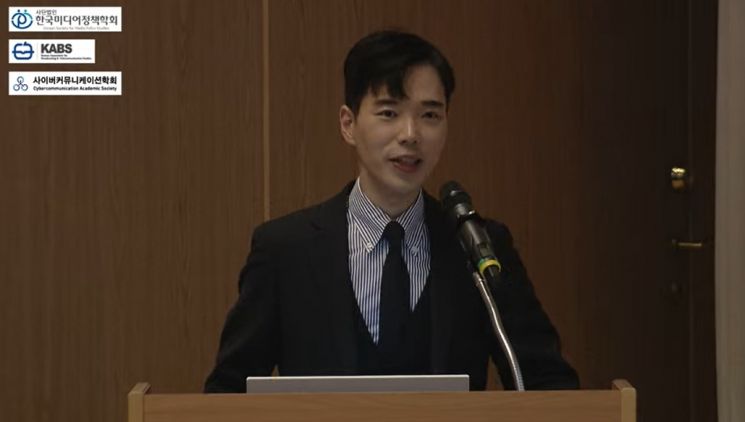 Professor Lee Jong-myung of Kangwon National University is presenting at the joint seminar on "Internet Network Usage Fee Policy and Legislation" held at the Broadcasting Hall on the afternoon of the 20th.
[Asia Economy Reporter Lim Hye-seon] After Google took YouTubers hostage to voice opposition to network usage fees, the total views of 25 YouTube videos expressing opposition to network usage fees have surpassed 5 million. While conflicts between telecommunications operators and content providers are natural, concerns have been raised that big tech companies are leading public opinion formation based on their excessive influence in the media market, even affecting the legislative processes of certain countries.
The Korean Broadcasting Society, the Korean Society for Cyber Communication, and the Korean Media Policy Society held a joint seminar titled "Internet Network Usage Fee Policy and Legislation: Issue Discourse and Public Opinion Formation" at 3 p.m. on the 20th in the press conference room on the 3rd floor of the Broadcasting Hall.
The seminar discussed the issue discourse and public opinion formation regarding network usage fee policies and legislation. The conflict over network usage fees between domestic telecommunications operators (ISPs) and overseas content providers (CPs) such as Google has continued for several years. Recently, as the National Assembly pushed for mandatory legislation on internet network usage fees, the positions of telecommunications companies and content providers have strongly clashed. In particular, Google is using YouTube to mobilize public opinion formation through the internet. Park Cheon-il, president of the Korean Media Policy Society, pointed out, "Big tech platform companies are leading public opinion formation and attempting to influence the legislative process of specific countries, raising concerns."
Professor Lee Jong-myung of Kangwon National University, who presented at the seminar, said, "We need to see how the network usage fee issue is being handled by YouTubers and what kind of responses it is eliciting from audiences." He added, "The total views of 25 YouTube videos related to the network usage fee issue reached 5,755,000, meaning more than one-tenth of the population has watched them." He then examined the problems in videos by Daedoseogwan, Kim Seong-hoe Knowledge Encyclopedia, Sugar World, and others. Professor Lee noted, "The videos blur the line between 'discussion summary' and 'emotional explanation,' shifting the judgment of explanations onto the 'subscribers.' Rather than maintaining objective distance, they emphasize emotional involvement and re-emphasize the issue within an organic relationship with subscribers."
Following this, Dr. Roslyn Layton (Senior Columnist at Forbes US and Professor at Aalborg University, Denmark) stated, "Ultimately, what American tech companies want is cost minimization." Dr. Layton said, "Large corporations like Samsung and LG pay Google millions or even billions of dollars annually for product and service advertising. Google earns a lot of money in the Korean market, and Google's customers are not the end users but Korean companies themselves." She added, "If Google's costs increase, it will be Korean companies, the advertisers, not the end consumers, who bear those costs. Google's claim that they will reduce the amount paid to content creators is exactly how Google wages its battles."
Dr. Layton also pointed out, "We have seen American tech companies harm end consumers to get what they want. Netflix lowered video quality in the US and Europe to provoke users to protest their own government agencies." This induces users to think, "I can't watch movies in high quality. Did my internet provider reduce the quality of my home internet?"
Dr. Layton emphasized, "The culprit is not the internet providers but the large tech companies that do not hesitate to harm their customers to achieve political goals. Google is generating record sales every year in the Korean market and has more than enough money to pay network usage fees." She continued, "Google's content already accounts for a significant portion of global internet traffic, so I believe Google should pay network usage fees."
© The Asia Business Daily(www.asiae.co.kr). All rights reserved.

















