Introduced in 1985... Key Issue During 5th Republic Hearings
Annual Maintenance Costs of Tens of Billions Won Due to Repairs and Parts Replacement
Air Force Took Charge of Maintenance After Introduction... Evaluated as the First Actual Unit
Replacement Causes Ongoing Pain... "Model Selection by Current Government, New Equipment Operation by Next Government"
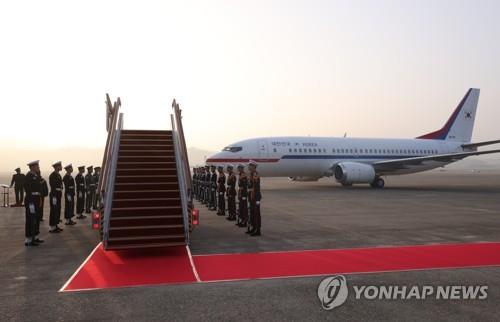
[Asia Economy Reporter Bae Kyunghwan] It appears that the Republic of Korea Air Force's No. 2 aircraft will undergo replacement procedures. The presidential aircraft generally referred to the Air Force No. 1 aircraft, and discussions about replacement and leasing have mainly focused on the No. 1 aircraft. However, the No. 2 aircraft is considered the "de facto No. 1 aircraft" because it is the presidential aircraft purchased by the government.
The Air Force No. 2 aircraft is a 40-seat Boeing 737-3Z8 model, introduced in August 1985 during the Fifth Republic era. It was built based on a small passenger plane, allowing takeoff and landing on short runways, so it has mainly been used for domestic and nearby country visits.
The Air Force No. 2 aircraft is regarded as the actual Air Force No. 1 aircraft. Currently, the Air Force No. 1 aircraft is a large model leased and operated by Korean Air, a commercial airline. Since Korean Air is responsible for maintenance and operation rather than the Air Force, military officials explain that calling it a "chartered plane" is more accurate than a presidential aircraft. The No. 2 aircraft, which the Air Force is responsible for maintaining and operating, strictly corresponds to the "Air Force No. 1 aircraft."
The Air Force No. 2 aircraft has been quite active over the years. During the previous administration, for example, in September 2018 when the inter-Korean summit was held in Pyongyang, former President Moon Jae-in used the No. 2 aircraft to visit Baekdu Mountain during the summit. The same year, when Chung Eui-yong, the National Security Office chief at the Blue House, led a special envoy delegation to North Korea, the Air Force No. 2 aircraft was also deployed.
It was also used during former President Moon’s tour of three Southeast Asian countries in 2019. The Air Force No. 2 aircraft, which was in Korea, was urgently called before the visit to Angkor Wat in Cambodia. Although former President Moon arrived in Southeast Asia on the Air Force No. 1 aircraft, the Siem Reap Airport, the gateway to Angkor Wat, was too small for the No. 1 aircraft to land.
There have been several cases where other dignitaries boarded the aircraft as well. In September 2018, then Prime Minister Lee Nak-yeon used the Air Force No. 2 aircraft to attend the 4th Eastern Economic Forum held in Vladivostok, Russia. Notably, former President Moon’s wife, Kim Jung-sook, used the Air Force No. 2 aircraft to visit India in 2018. It was the first time in 16 years that a sitting president’s spouse traveled abroad alone since Lee Hee-ho, wife of former President Kim Dae-jung, visited New York for the UN General Assembly in 2002.
However, after nearly 40 years of operation, the Presidential Office has judged that it is no longer feasible to maintain the aircraft despite repeated repairs and parts replacements to extend its lifespan. The annual maintenance costs, which amount to tens of billions of won, are also a headache, and voices from the political sphere suggest that replacing the aircraft is better than bearing enormous maintenance costs every year in the long term. According to the military, the maintenance costs for the Air Force No. 2 aircraft were 1.896 billion won in 2016, 1.397 billion won in 2017, 5.598 billion won in 2018, and 3.935 billion won in 2019.
That said, purchasing a new aircraft by pouring a huge amount of tax money at once is also not an easy decision. Past presidents also failed to overcome public opinion and political obstacles each time.
In particular, the introduction of the Air Force No. 2 aircraft became controversial during the 1988 Fifth Republic hearings after a regime change. The Asian Wall Street Journal in Hong Kong reported in April 1988 that "the Chun Doo-hwan regime purchased two Boeing 737 aircraft as presidential planes in 1985, paying more than twice the price of similar planes due to special orders including electronic defense systems capable of detecting missiles." At that time, the price of a Boeing 737 was around 30 million dollars, but the Air Force No. 2 aircraft reportedly cost 75 million dollars each. Because of this, the opposition party included the purchase process of the presidential aircraft in the Fifth Republic hearing investigations.
The Ministry of National Defense explained after the report that they purchased one aircraft for 40 million dollars, including the airframe and auxiliary equipment, due to the aging and safety risks of the propeller aircraft bought 20 years earlier.
Recently, the government has begun pushing for the replacement of the Air Force No. 2 aircraft. A Ministry of National Defense official also told reporters, "We are carefully reviewing costs, operational efficiency, and the timing of deployment for the operation of the Air Force No. 2 aircraft." This is a follow-up to the decision made at the National Security Council (NSC) Standing Committee in July 2018 during the previous administration to introduce the Air Force No. 2 aircraft.
The initial draft was to operate a total of three aircraft by leasing one additional plane along with the Air Force No. 1 and No. 2 aircraft, but they are now considering purchasing only the No. 2 aircraft newly, operating a total of two aircraft. The new Air Force No. 2 aircraft is likely to be a larger plane than the Boeing 737-3Z8. The timing of introduction may vary depending on the project implementation method. The Ministry of National Defense expects the model selection to be possible within the current administration’s term.
The Presidential Office also conveyed that the review for purchasing the Air Force No. 2 aircraft is ongoing. However, they cautiously added that "nothing has been decided." This seems to reflect the government’s stance on maintaining sound fiscal management. Earlier, President Yoon emphasized several times his determination to prevent unnecessary financial expenditures.
© The Asia Business Daily(www.asiae.co.kr). All rights reserved.

















