Store Owner "Occupying 4-Person Seats Slows Table Turnover" Complaints
Part-Timer "Low Work Intensity," Student "Better Concentration"

[Asia Economy Culture Intern Reporter Young] In June, a post titled "I just received a note from a woman at a cafe" was uploaded on an online community. The author, residing in Cheongju, Chungbuk, said that a woman approached them at a franchise cafe and handed a note that read, "Sorry, but if you are going to continue talking, please move down to the first floor. I can't concentrate." The writer expressed disbelief, saying, "I came to a franchise cafe instead of a study cafe."
So-called 'Kagongjok' (people who study at cafes) have become common, but debates continue. While studying at a cafe is understandable, since cafes are not solely 'places for studying,' asking for quiet is considered crossing the line. However, Kagongjok argue that the coffee price includes the seat fee, and studying is not a problem as long as it does not cause significant inconvenience to other customers.
Store owners did not favor Kagongjok. Mr. A, who has been running a franchise cafe for two years, said, "Although there are single seats, people often sit at four-person tables, leaving laptops and belongings, causing inconvenience to other customers." He added, "Some order the cheapest Americano and stay all day." Some cafe owners have even filed complaints with local governments requesting usage restrictions.
Part-time workers also viewed Kagongjok negatively, citing reasons such as "complaints due to occupying multi-person tables" and "complaints due to long-term seat occupation." Mr. B, who worked part-time at a shaved ice shop for about a year, said, "There was a customer who stayed continuously during the busiest summer." He explained the situation, "They stayed all day and suddenly took out kimbap from their bag to eat in the evening."
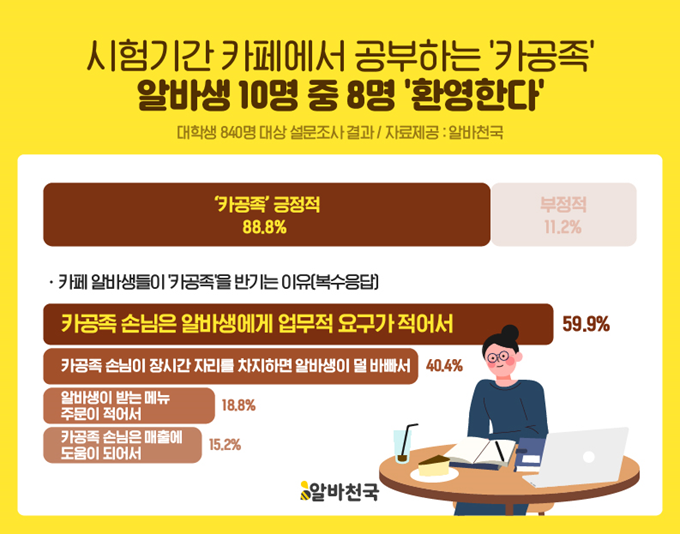 According to a survey conducted by 'Albacheonguk,' a part-time job portal specializing in job recruitment and job seeking, among 840 university students, 8 out of 10 part-time workers responded positively about the "Kagongjok." Photo by Albacheonguk
However, some part-time workers and customers showed positive attitudes toward 'Kagong.' According to a survey by 'Alba Heaven,' a job portal specializing in part-time jobs, 93% of 840 university students responded that they have studied at cafes.
They stayed an average of 2 hours and 40 minutes while studying at cafes, and 93.5% ordered one drink per person. The top reason for choosing cafes as study spaces was "wanting to study while consuming drinks and food" at 55.4%. This was followed by "feeling more focused" (32.8%) and "ease of using devices like laptops and tablets" (30.5%).
There is theoretical evidence that cafes help improve concentration. The "Coffeehouse Effect" refers to the phenomenon where people change their behavior or improve work efficiency when they feel they are being observed. Studying at a cafe naturally makes one conscious of others' gazes, motivating them to focus more to set a good example or show a positive image.
Additionally, among 312 university students with cafe part-time experience, 88.8% responded positively toward Kagongjok. Part-time workers said Kagongjok customers have relatively "lower work intensity" than other customers. The most common reason was "fewer work demands on part-timers" at 59.9%, followed by "part-timers are less busy when Kagongjok occupy seats for long periods" at 40.4%.
Those in favor of Kagong say that whatever customers do is their freedom, and the problem lies with some noisy customers. Cafes near universities often rely on Kagongjok for most of their sales, making it impossible to give them up. However, store owners and customers agree that for a mature Kagong culture to settle, it is essential to follow basic cafe etiquette such as "not causing inconvenience to others" and "one menu item per person."
© The Asia Business Daily(www.asiae.co.kr). All rights reserved.


















