Government Announces 'Joseon Gap Resolution Plan' the Previous Day
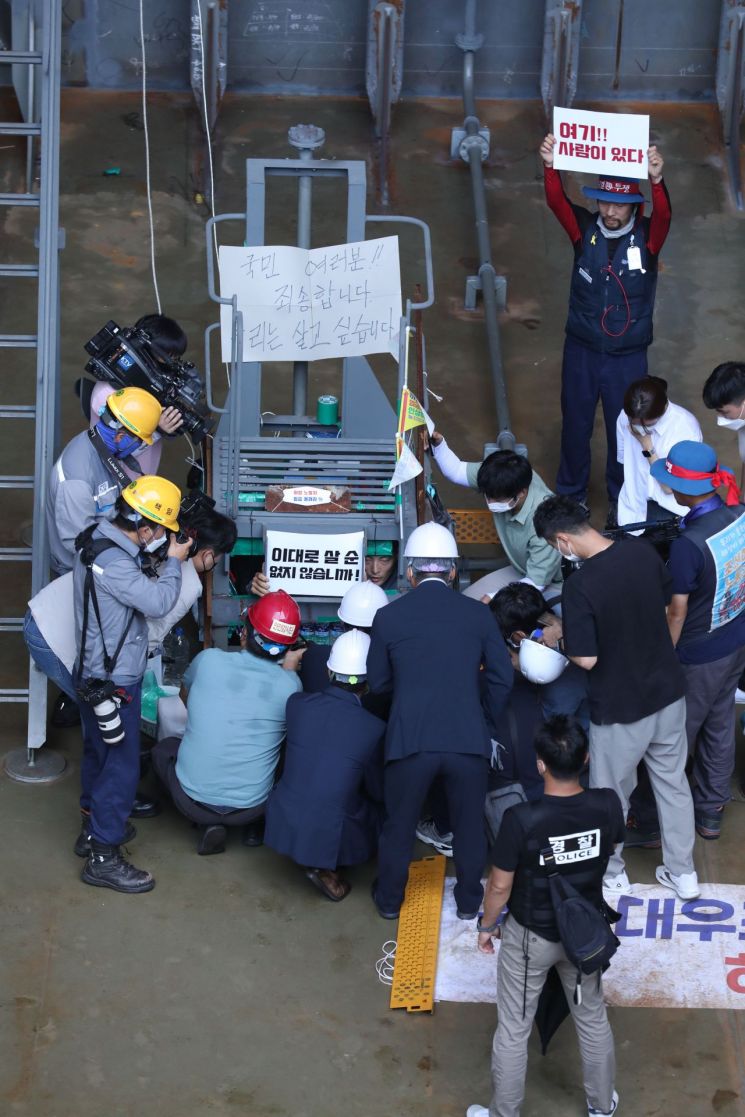 Minister of Employment and Labor Lee Jeong-sik visited the strike site at Daewoo Shipbuilding & Marine Engineering Okpo Shipyard in Aju-dong, Geoje-si, Gyeongnam, on the afternoon of July 19. He is meeting with Yoo Choi-an, vice chairman of the Metal Workers' Union Geoje-Tongyeong-Goseong Shipbuilding Subcontracting Branch, who is protesting inside a 1m by 1m by 1m steel structure on the floor of the shipyard's independent cargo hold.
 [Image source=Yonhap News]
[Asia Economy Reporters Donghoon Jeong and Seoyoon Choi] The government has announced the 'Measures to Eliminate Disparities and Improve the Structure of the Shipbuilding Industry' amid labor shortages and a low-wage structure entrenched within the subcontracting system in the shipbuilding sector. While there is hope for a new turning point to resolve the chronic low-wage structure in the shipbuilding industry, some remain skeptical.
On the 20th, a shipbuilding industry insider who requested anonymity evaluated, "There will be efforts inside and outside the industry to enhance execution, but most of the measures are declarative in nature," adding, "It is true that there are doubts about their feasibility."
Another insider also said, "It is true that the subcontracting structure problem needs to be resolved, but if it were something that could be solved by labor-management autonomy, it would have been resolved long ago," and added, "Forms such as profit sharing are only possible when the shipbuilding industry shifts to a profitable structure, but there is still a long way to go."
The government announced these measures jointly by related ministries at an emergency economic ministers' meeting held at the Government Seoul Office the day before. On the same day, the Ministry of Employment and Labor, Ministry of Trade, Industry and Energy, and the Fair Trade Commission, along with representatives of the five major shipbuilders (Hyundai Heavy Industries, Samsung Heavy Industries, Daewoo Shipbuilding & Marine Engineering, Hyundai Mipo Dockyard, Hyundai Samho Heavy Industries) and the chairman of the Korea Offshore & Shipbuilding Association, announced the 'Joint Declaration for Win-Win Cooperation for the Re-advancement of the Shipbuilding Industry.' The main contents of this plan, led by the Ministry of Employment and Labor, are broadly divided into three parts: ▲ Establishing fair trade order and improving subcontracting structure between primary and subcontractors ▲ Building a virtuous cycle system of 'labor inflow - retention incentives - skill formation' and resolving labor shortages ▲ Strengthening protection for subcontracted workers from industrial accidents and wage arrears.
The dual structure of the labor market refers to the stark differences in working conditions and wage systems between employees of primary contractors and subcontractors. Subcontracted workers often perform almost the same tasks as primary contractor employees under poor working conditions but receive significantly lower wages. The government expects that as order volumes recover over the next 3 to 5 years, the shipbuilding industry will regain its competitiveness.
In a statement released the day before, the Korea Employers Federation said, "This will provide an opportunity for our shipbuilding industry to overcome its slump and take off again," adding, "There is great expectation as the solution is sought autonomously by the industry for win-win cooperation, with government support."
Despite these measures, the labor sector's response has been cold.
The Korean Metal Workers' Union of the Korean Confederation of Trade Unions stated in a press release the day before, "These measures will not achieve any practical effect," and sharply criticized, "Do not expect that the primary contractor capitalists, who are the top of the hierarchy, and the subcontractor company presidents, who are the lifeline of the primary contractors, will autonomously increase the progress payments given to subcontractors, establish equal trading relationships, share profits with workers, and improve the multi-tier subcontracting structure." They continued, "This government is unaware of the reality in shipyards where progress payments are made during project execution. If they knew and still proposed such measures, it would be a crime."
Regarding the government's direct measures to improve the treatment of subcontracted workers, they evaluated it as "beyond disappointment, it is despair." In particular, they criticized the government policy to massively deploy migrant workers, stating, "The government's and capital's intention to increase migrant labor is precisely to maintain the low-wage structure, which is the problem."
© The Asia Business Daily(www.asiae.co.kr). All rights reserved.
![From Bar Hostess to Organ Seller to High Society... The Grotesque Con of a "Human Counterfeit" [Slate]](https://cwcontent.asiae.co.kr/asiaresize/183/2026021902243444107_1771435474.jpg)
















