Haenam-gun and Mokpo National University Museum Host International Conference on 'Ancient Port Cities and Shinmiguk'
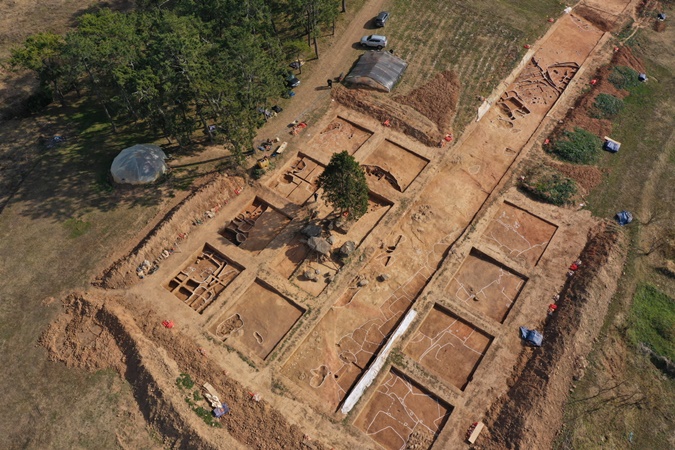
[Haenam=Asia Economy Honam Reporting Headquarters Reporter Kim Hyun] Jeonnam Haenam-gun announced on the 20th that it will hold an international academic conference titled “Ancient Ports and the Shinmiguk (新彌國) Seen through the Haenam Gungok-ri Ruins” on the 21st at the Jeongsanmok Hall of Mokpo National University’s 70th Anniversary Memorial Hall.
Co-hosted with the Mokpo National University Museum, this international academic conference is organized to summarize the excavation status and research achievements of the Baekpoman area in Gungok-ri, Haenam, which flourished as an ancient international trading port connecting Korea, China, and Wa (ancient Japan).
From the first excavation in 1986 to the excavation results of the Gungok-ri shell mound conducted in 2022, the conference will explore the growth and development processes of port powers representing the southern coast of the Korean Peninsula and western Japan, focusing on Baekpoman, Gimhaeman, and northern Kyushu in Japan. It will also review research outcomes derived through integration with various natural science fields.
The conference is structured around three major themes: “From ‘Shell Mound’ to ‘Ruins’ in Gungok-ri,” “Ancient Baekpoman and Surrounding Maritime Powers,” and “Ruins Maintenance and Utilization Plans,” consisting of one keynote lecture and nine thematic presentations.
After the presentations, a comprehensive discussion will be held chaired by Professor Lee Jeong-ho of Dongshin University to facilitate organic debate and review.
The keynote lecture will be delivered by Professor Emeritus Choi Seong-rak of Mokpo National University, titled “Research Status and Tasks of the Haenam Gungok-ri Ruins.” Through this lecture, he will examine the significance of facts revealed by investigations and research on the ruins so far and outline future tasks to be undertaken.
Professor Choi, who first discovered and investigated the Haenam Gungok-ri ruins in the 1980s, has led efforts to publicize the site nationwide. Based on his deep affection for the ruins, he presents a broad perspective on the past, present, and future of the Gungok-ri ruins within a large framework.
The first part, focusing on the theme “From Shell Mound to Ruins,” includes four presentations. The first presentation, “Contents and Significance of the Ruins Investigation” (Kang Gwi-hyeong, Mokpo National University Museum), considers the significance of the investigation contents.
Following are “Livelihood Seen through the Plant Remains of the Ruins” (Lee Kyung-ah and Lee Hyun-soo, University of Oregon, USA) and “Livelihood Economy Seen through Animal Resources” (Bae Hyung-gon, Kyushu University, Japan), which reveal information related to the diet of ancient Gungok-ri people and past ecological environments through animal and plant data obtained from the ruins.
The fourth presentation, “Archaeological Landscape of the Baekpoman Area” (Kim Jin-young, Institute of Ancient Cultural Heritage), focuses on changes in the cultural landscape from the Paleolithic era to the Three Kingdoms period in the Baekpoman area.
The second part, themed “Ancient Baekpoman and Surrounding Maritime Powers,” consists of four presentations.
First, “Port Powers of Ancient Baekpoman Seen through Archaeological Data” (Lee Dong-hee, Inje University) discusses the formation and development process of ancient Baekpoman maritime powers based on archaeological data. “Ancient Port Powers and Maritime Exchanges of Haenam Seen through Literary Sources” (Kang Bong-ryong, Mokpo National University) focuses on the political names and the nature of political groups appearing in the literature.
Then, “Formation Process of the Ancient Gimhaeman Kingdom during the Simhan Period” (Lee Chang-hee, Pusan National University) and “Port Hub Powers in Ancient Western Japan” (Teruyuki Shikefuji, Saga University, Japan) examine the status of ancient maritime powers representing Korea and Japan.
The final theme, “Ruins Maintenance and Utilization Plans” (Kim Young-hoon, Mokpo National University), presents plans for future maintenance and utilization of the ruins.
Myung Hyun-gwan, Haenam County Governor, stated, “Haenam is a region of great historical value, regarded as the beginning and end of Mahan maritime exchange history. Through this international academic conference, we expect to have in-depth discussions on the Haenam Gungok-ri ruins, a central site of ancient history, which can serve as a milestone for research on ancient historical culture.” He added, “Haenam-gun plans to systematically promote the restoration and maintenance project of the Mahan historical and cultural zone through historical and cultural tourism resource development.”
Meanwhile, participation in the academic conference is possible both in person and online via ZOOM.
Haenam=Asia Economy Honam Reporting Headquarters Reporter Kim Hyun alwatros@asiae.co.kr
© The Asia Business Daily(www.asiae.co.kr). All rights reserved.
![Clutching a Stolen Dior Bag, Saying "I Hate Being Poor but Real"... The Grotesque Con of a "Human Knockoff" [Slate]](https://cwcontent.asiae.co.kr/asiaresize/183/2026021902243444107_1771435474.jpg)
















