French oil workers strike for a month... Railway union joins causing transport chaos
German pilots strike causing aviation chaos... UK logistics union plans strike at month-end
Severe inflation in countries near Ukraine... Hungary bread prices up 77% in one year
[Asia Economy Reporter Park Byung-hee] As inflation continues to soar across Europe, strikes demanding wage increases are spreading throughout the continent. In Germany and France, strikes by airline and railway unions have caused transportation chaos, while in Hungary, where bread prices have surged by a staggering 77% in a year, teachers' strikes have escalated into conflicts with the government as parents and students join in.
In France, the strike by the largest oil company TotalEnergies' union has entered its fourth week. According to major foreign media on the 19th (local time), the General Confederation of Labour (CGT) decided to end the strike that day, but three other groups?the Democratic Confederation of Labour (CFDT), the Confederation of Management ? General Confederation of Executives (CFE-CGC), and Workers' Force (FO)?chose to continue striking. The TotalEnergies refinery union strike began on the 20th of last month, marking exactly one month on this day. The union went on strike demanding wage increases to cope with the cost of living, resulting in a fuel supply crisis where one out of every three gas stations nationwide in France is struggling to provide fuel.
According to the AP and others, large-scale protests took place across France on the 18th, with over 100,000 people including transport workers, teachers, and healthcare workers participating in the strike. On the same day, railway unions also launched a nationwide strike, reducing train operations in French provinces by half, and Eurostar services connecting Paris and London were suspended.
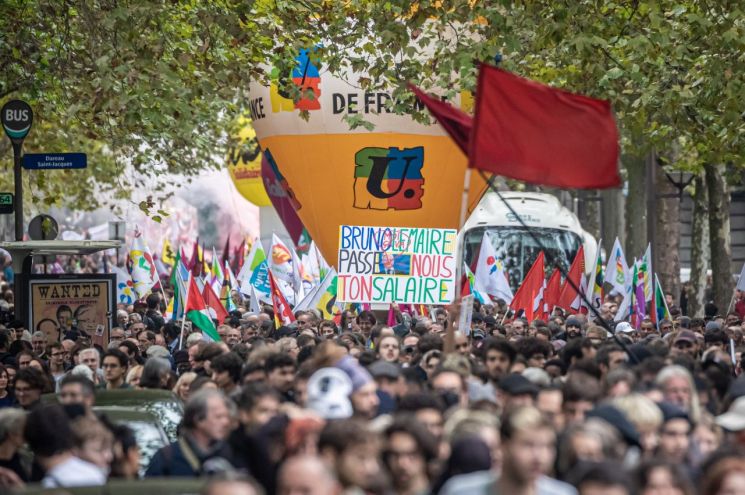 Thousands of Paris citizens participated in a strike protest on the 18th (local time), demanding a wage increase. On that day, strike protests demanding wage increases took place across France, with more than 100,000 people joining the demonstrations. Paris, France = EPA · Yonhap News Photo by EPA
In Germany, captains of Lufthansa's low-cost subsidiary Eurowings staged a three-day strike starting on the 17th. On the first day of the strike, 240 out of 488 scheduled flights were canceled, and about half of the flights were canceled again on the 18th, causing an aviation crisis.
In the UK, logistics unions have announced a five-day strike starting at the end of this month. Hundreds of dockworkers at Liverpool, the UK's largest container port, also declared they would strike for more than two weeks starting on the 24th.
In Hungary, thousands of students and parents have recently joined teachers in protests. Last month, when teachers staged protests demanding wage increases, the government dismissed five protesting teachers, which has escalated into anti-government demonstrations. Teachers are intensifying their protests in response to the government's dismissal actions, and with parents and students joining in, conflicts with the government are growing.
Hungary, which shares a border with Ukraine and some eastern regions, is experiencing severe inflation, with consumer price inflation reaching 20.1% in September. The New York Times reported that inflation is particularly severe in regions near the war, noting that bread prices in Hungary have risen by 77% compared to a year ago. Bread prices in Croatia, Estonia, Latvia, Lithuania, Poland, and Slovakia have also increased by more than 30%.
The impact of the Ukraine war is worsening inflation across Europe. The UK Office for National Statistics announced on the 19th that the Consumer Price Index (CPI) for September rose 10.1% year-on-year. The UK's CPI inflation rate first crossed the 10% mark among the Group of Seven (G7) countries in July, recording 10.1%.
Although it slightly fell to 9.9% in August, it returned to double digits in September, matching the July level. The core CPI, which excludes volatile energy and food items, rose 6.5%, up from 6.3% in August, indicating an accelerating trend. With the UK's inflation rate remaining high, the Bank of England (BOE) is expected to tighten monetary policy again at its meeting on the 3rd of next month. The BOE has raised its base interest rate seven consecutive times since December last year, including two recent big steps (0.5 percentage point increases).
The European Union's statistical office, Eurostat, also announced on the same day that the September CPI inflation rate was finalized at 9.9%. This was 0.1 percentage points lower than the preliminary figure but significantly higher than August's 9.1%, marking a record high. The European Central Bank (ECB) decided on its first-ever giant step (a 0.75 percentage point base rate hike) at its September monetary policy meeting and is expected to decide on another giant step at its meeting on the 27th.
© The Asia Business Daily(www.asiae.co.kr). All rights reserved.

















