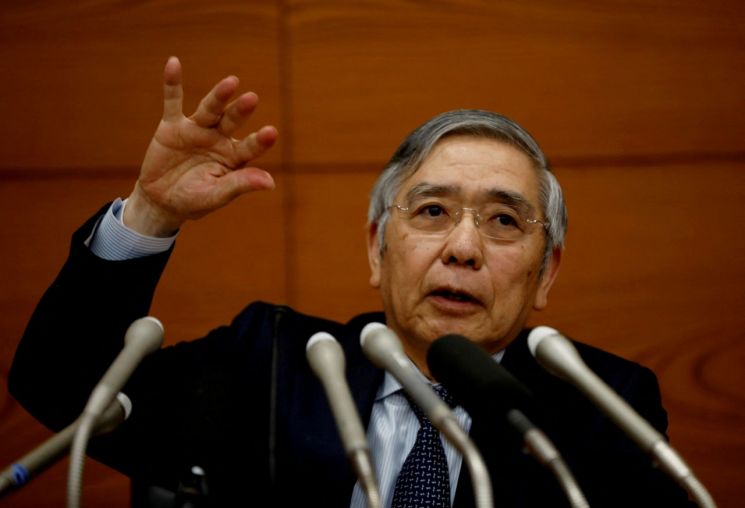
[Asia Economy Reporter Jeong Hyeon-jin] As the value of the Japanese yen has sharply declined and the yen-dollar exchange rate surged close to 150 yen, Haruhiko Kuroda, Governor of the Bank of Japan (BOJ), evaluated that "the recent rapid and one-sided yen depreciation is negative for the economy and undesirable."
According to the Nihon Keizai Shimbun and others, Governor Kuroda appeared before the House of Councillors (Upper House) Budget Committee on the same day and responded to questions about the worst yen depreciation in 32 years. He said, "It increases uncertainty by making it difficult for companies to formulate business plans," adding, "It is true that I have said that a stable depreciation of the yen would have a positive effect on the overall economy, but the impact varies unevenly depending on the industry, company size, and economic agents."
Furthermore, Governor Kuroda evaluated the market intervention by the Ministry of Finance and BOJ on the 22nd of last month, which involved selling dollars and buying yen to counter the yen depreciation, as "very appropriate."
Governor Kuroda has continuously expressed his intention to maintain the accommodative monetary policy, which is a key factor driving up the yen-dollar exchange rate. If the BOJ maintains this policy, the interest rate gap between the U.S. and Japan will widen, inevitably deepening the yen depreciation. When asked about monetary policy after his term expires in April next year, he said, "(It is) logically and realistically impossible for the current governor to mention this," but projected that the current monetary easing would continue as long as the consumer price index does not suddenly change.
Seiji Adachi, a BOJ Policy Board member, also stated at a lecture in Toyama City on the same day that "it is premature to revise" the monetary easing policy and that "the foreign exchange market is not directly controlled by monetary policy." Regarding the reason for not changing the monetary easing policy, he explained, "If we respond each time, it would rather increase the uncertainty of future policy operations," adding, "From a long-term perspective, it is not good for the Japanese economy."
Meanwhile, the yen-dollar exchange rate surpassed 149 yen per dollar the previous day, and during the day in the Tokyo foreign exchange market, it exceeded 149.3 yen per dollar. Japan’s Finance Minister Shunichi Suzuki stated, "We are closely monitoring movements with increased frequency," and added, "As mentioned before, we will respond firmly (including market intervention) to excessive exchange rate fluctuations."
© The Asia Business Daily(www.asiae.co.kr). All rights reserved.
![Clutching a Stolen Dior Bag, Saying "I Hate Being Poor but Real"... The Grotesque Con of a "Human Knockoff" [Slate]](https://cwcontent.asiae.co.kr/asiaresize/183/2026021902243444107_1771435474.jpg)
















