16 Cases This Year... Increase Along with Heavy Rain
Seoul City Sinkhole Preparedness Budget Decreases
Experts Say "Sinkholes Are Man-Made Disasters... Budget Should Be Increased"
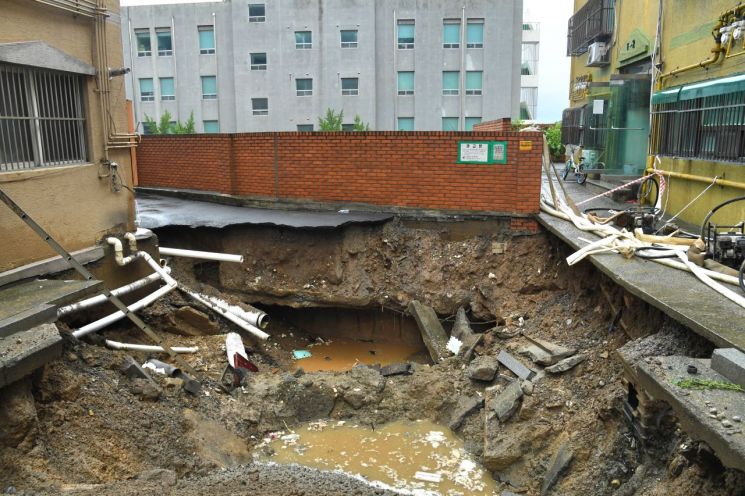 A residential area in Sinwol-dong, Yangcheon-gu, Seoul, where a sinkhole occurred due to heavy rain last August. [Image source=Yonhap News]
[Asia Economy Reporter Gong Byung-sun] Despite aging drainage facilities and decreasing budgets, the number of ground subsidence (sinkhole) incidents in Seoul has increased again. Experts point out that sinkholes are man-made disasters rather than natural ones, and thorough investment in preventive measures is necessary to stop them.
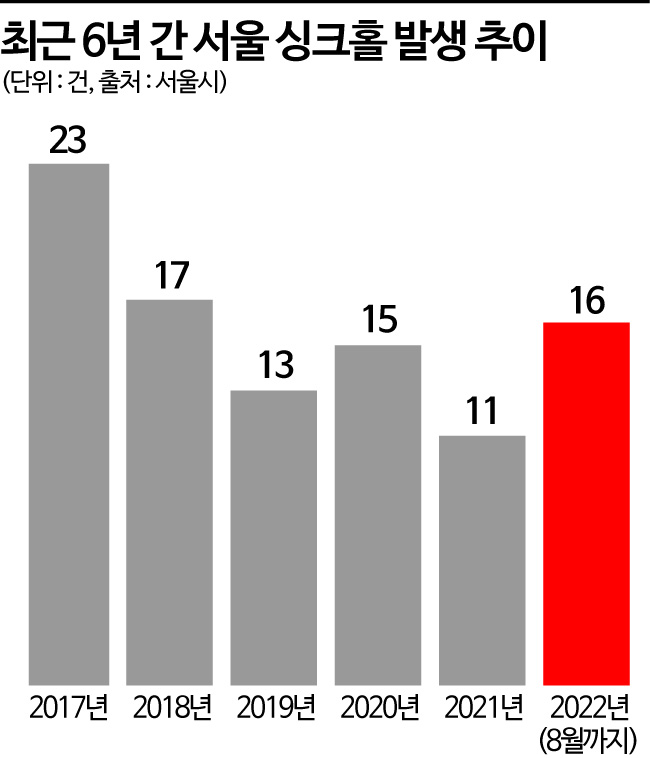
According to Seoul City on the 20th, the number of sinkhole occurrences in Seoul from January to August this year was recorded at 16 cases. The number had decreased from 23 cases in 2017 to 11 cases last year but has risen again. The locations of sinkholes were not limited to Gangnam-gu, which suffered heavy rain damage. The districts where sinkholes occurred this year in Seoul include Gangnam-gu, Gangdong-gu, Gangseo-gu, Gwanak-gu, Dongdaemun-gu, Dongjak-gu, Seongbuk-gu, Songpa-gu, Yangcheon-gu, Yeongdeungpo-gu, Eunpyeong-gu, and Jongno-gu. Among these, Gwanak-gu, Dongdaemun-gu, Yeongdeungpo-gu, and Jongno-gu experienced sinkholes twice.
A Seoul city official explained, "Since the 2014 Seokchon Lake sinkhole, Seoul has thoroughly prepared for sinkholes, but they increased again due to this year's heavy rains. Sinkholes have occurred every year regardless of the season, but this year they were concentrated in summer."
Sinkholes are closer to man-made disasters than natural ones such as weak ground conditions. When drainage facilities age and leak, the surrounding ground becomes saturated and weakens. If an impact is applied to the weakened ground, the land subsides. In fact, according to a Seoul city investigation conducted during the 2014 Seokchon Lake sinkhole, there was aging and damage to the sewage pipes, and excavation work around the pipes caused the sinkhole.
Sinkholes occurring in large cities like Seoul can potentially lead to major casualties. According to the paper "Analysis of Sinkhole Risk Factors Using Terrain Spatial Information" by Professor Kim Dong-moon of the Department of Spatial Information at Namseoul University, sinkholes in large cities not only cause human and property damage but also degrade citizens' quality of life. This is because they occur suddenly and are not limited to specific areas.
While drainage facilities are aging, budgets are decreasing. This year, Seoul City's budget for road collapse prevention projects is 2.858 billion KRW, a decrease of 56 million KRW compared to the previous year. According to Moon Jung-bok, a member of the Democratic Party of Korea, as of last year, nearly 50% of Seoul's sewage pipes are over 30 years old. If the standard is set to over 20 years, it reaches 70%. Seoul City responded that the budget for next year's road collapse prevention projects has not yet been finalized.
Experts emphasize the need to increase the budget to thoroughly prepare for sinkholes. Professor Gong Ha-seong of the Department of Fire and Disaster Prevention at Kyungil University said, "Sinkholes are definitely man-made disasters. If sufficient budget is allocated to replace drainage pipes, sinkholes in urban areas can be prevented. If a system to detect sinkholes in advance is also established, it will be possible to fully prepare for sinkholes."
© The Asia Business Daily(www.asiae.co.kr). All rights reserved.


















