'Strategy to Secure Super-Gap in the Shipbuilding Industry'... Includes Measures to Resolve Manpower Shortage
Establishment of E7 Visa Shipbuilding Quota... Up to 200 Additional Entries Annually
Promotion of Localization of Core LNG Ship Technology... Strengthening Financial Support Such as RG
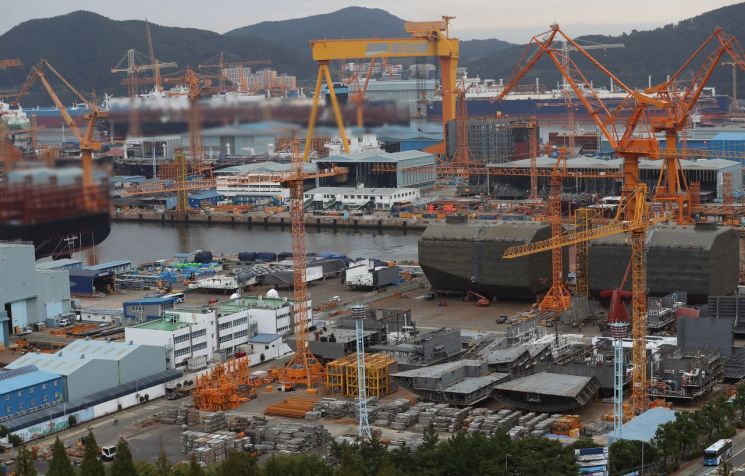 A large crane installed at Daewoo Shipbuilding & Marine Engineering Okpo Shipyard in Aju-dong, Geoje-si, Gyeongnam.
 [Image source=Yonhap News]
[Asia Economy Sejong=Reporter Dongwoo Lee, Sejong=Reporter Junhyung Lee] The government has decided to raise the market share of high value-added ships, including autonomous navigation vessels, to 75% by 2030 to secure a global super-gap competitiveness in the domestic shipbuilding industry. To alleviate the manpower shortage in shipbuilding, the government plans to extend the special extended working hours period for manufacturing industries and strengthen additional support for advance payment refund guarantees (RG) in case of issues with ship orders, focusing on securing export competitiveness for the domestic shipbuilding sector.
The Ministry of Trade, Industry and Energy disclosed the joint government 'Shipbuilding Industry Super-Gap Securing Strategy' at the Emergency Economic Ministers' Meeting held on the 19th. This strategy aims to support industry production activities in line with the full-scale recovery of the shipbuilding market and to lay the foundation for sustainable future growth.
Jang Young-jin, the first vice minister of the Ministry of Trade, Industry and Energy, said, "As the global ship market enters a full recovery phase, the business environment of our shipbuilding industry is improving with increased orders and rising ship prices," adding, "We will concentrate all policy capabilities to realize a super-gap as the changes in the future ship market, represented by eco-friendly and digital transformation, present opportunities for our shipbuilding industry, which possesses world-class technological competitiveness."
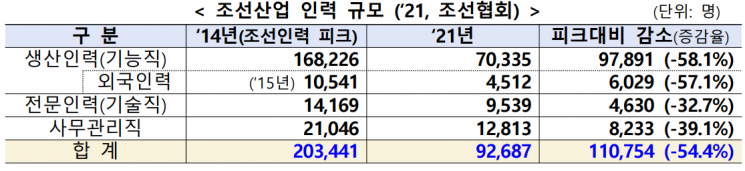
According to the Ministry, last year's global order volume reached 52.29 million CGT (Compensated Gross Tonnage), marking the highest level in eight years since 62.21 million CGT in 2013. It is expected that a stable order volume of over 40 million CGT annually will continue until 2030. Last year, domestic orders also achieved a record high of 17.46 million CGT in eight years, and the cumulative order share as of September this year was 42% (12.54 million CGT), the highest since 2011 (43.3%). However, despite this improvement in order performance, production manpower to support it was found to be insufficient. The shipbuilding production workforce decreased by about 58%, from 168,000 in 2014 to around 70,000 last year, due to restructuring following a long-term recession after the 'order cliff' in 2016.
Localization of Core Technologies... Support for Workforce Expansion
The government will first promote the localization of core technologies for future eco-friendly liquefied natural gas (LNG) ships. This includes the localization of key equipment such as cargo tanks and low-pressure pumps for LNG vessels. To advance carbon emission reduction technologies, development of eco-friendly ship technologies such as onboard carbon dioxide capture and storage technology and rotor sails (wind propulsion auxiliary devices) will be pursued. Pilot construction of liquefied hydrogen carriers will begin in 2024, aiming for early commercialization by 2029. Through these efforts, the goal is to achieve a 75% market share of high value-added ships by 2030.
The government is also planning to diversify the future portfolio. To commercialize autonomous ships (IMO Level 3) that can operate remotely without crew onboard, legislation is being prepared. From 2024 to 2029, a plan to support 280 billion KRW for the development of digital transformation technologies in production for small and medium shipbuilders and equipment industries is under review. The government will also concurrently promote the FSRU (Floating Storage Regasification Unit) conversion project for aging LNG carriers, which is expected to expand in the future market.
To alleviate manpower shortages in shipbuilding, support will be provided to expand workforce in production and technical fields. The biggest change is the temporary extension of the annual allowable period for special extended working hours in manufacturing industries to a maximum of 180 days. To promote the inflow of foreign workers into shipbuilding, a new shipbuilding quota will be established for E-9 (simple labor) foreign workers changing their status to E-7 (skilled workers). This is expected to enable the addition of up to about 200 workers in shipbuilding starting next year. Customized workforce training programs tailored to corporate demand will also support the rapid deployment of new workers to the field. To encourage employment and retention of production workers, the period for wage subsidy payments will be extended from the current 2 months to 6 months.
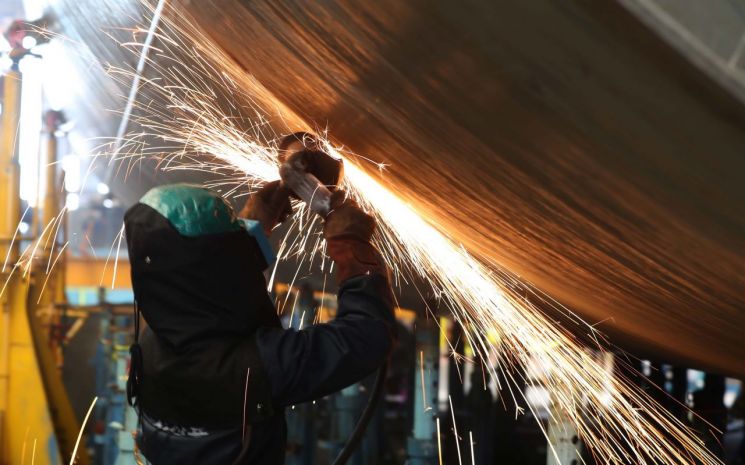 A skilled worker working at the Daewoo Shipbuilding & Marine Engineering headquarters in Geoje-si, Gyeongnam. [Image source=Yonhap News]
Strengthening Financial Support... Expansion of RG Special Guarantees
Financial support will also be strengthened to enhance the export competitiveness of the domestic shipbuilding industry. The government plans to ensure that advance payment refund guarantees (RG) are issued promptly so that shipbuilders' order activities are not disrupted. RG is a guarantee whereby a bank pays the advance payment to the shipowner if the shipbuilder fails to deliver the constructed ship. RG issuance is essential to finalize orders. An official from the Ministry of Trade, Industry and Energy explained, "As order performance improves and ship prices and exchange rates rise, demand for RG is also increasing," adding, "We are reviewing additional RG issuance available by the end of this year through consultations with financial institutions."
Support for RG special guarantees will also be provided. If large shipbuilders face a shortage of RG limits, additional funds will be supported by utilizing the Korea Trade Insurance Corporation's RG special guarantee system. The Trade Insurance Corporation can provide special guarantees when the financial institutions' RG share exceeds 85%. For small and medium shipbuilders, the government plans to review expanding the operating multiplier, which is currently three times, for special guarantees.
Cooperation with upstream and downstream industries will also be strengthened. The Ministry plans to improve the negotiation method for the price of steel plates, which account for about 20% of shipbuilding costs. This is based on the judgment that the time gap of over a year between order contracts and ship production makes shipbuilders vulnerable to raw material price fluctuations such as steel plates. Accordingly, the Korea Shipbuilding & Offshore Plant Association and the Korea Iron & Steel Association will sign a memorandum of understanding (MOU) within the year to promote cooperation and jointly conduct research projects.
Support measures for small and medium shipbuilders and equipment industries have also been prepared. Considering that supply contracts between shipbuilders and equipment companies are conducted in package units, research and development (R&D) projects will also be promoted in package units. Additionally, to support the development of new eco-friendly ship models by small and medium shipbuilders, 4.5 billion KRW will be invested annually to provide design and engineering technology support. To expand exports of small and medium shipbuilders, the government is also considering establishing joint overseas after-sales service (AS) centers.
© The Asia Business Daily(www.asiae.co.kr). All rights reserved.














