Government Announces Measures to Improve Dual Structure in Shipbuilding Industry
Focus on Support for Principal-Subcontractor 'Voluntary Agreements'
Improvement of Subcontracting Structure, Strengthening Subcontractor Welfare
Government and Shipbuilders Declare 'Win-Win Cooperation for Rebound'
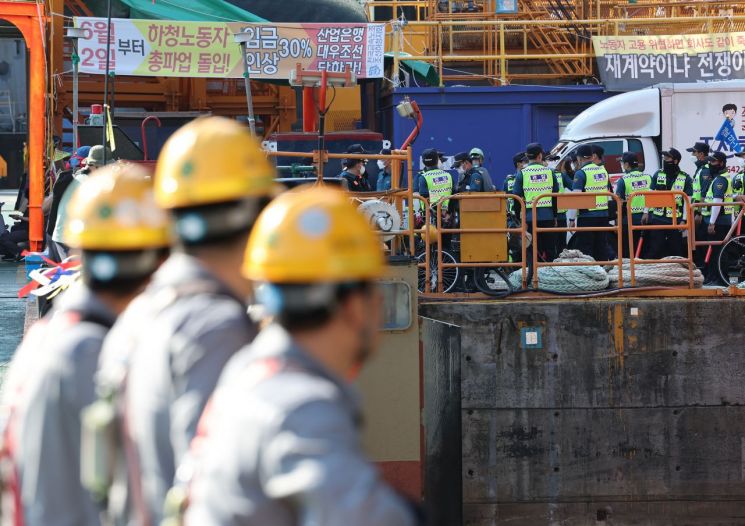
The government has decided to support win-win cooperation between primary contractors and subcontractors to resolve structural issues such as wage gaps revealed by the Daewoo Shipbuilding & Marine Engineering subcontractor strike. While establishing a support system that enables autonomous establishment of fair trade order between primary and subcontractors, the government plans to enhance worker welfare and significantly expand foreign labor to help the shipbuilding industry become a sustainable structure.
On the 19th, at an emergency economic ministers' meeting held at the Government Complex Seoul, the government announced the "Measures to Eliminate Gaps and Improve Structure in the Shipbuilding Industry," jointly prepared by related ministries. South Korea's shipbuilding industry is a representative export-driven core industry with a world-leading position, but over the past 30 years, a production structure relying on subcontracting has become entrenched, leading to frequent strikes and ongoing labor shortages. Especially since the 2016 downturn, the dual structure problem between primary and subcontractors has worsened, culminating in the Daewoo Shipbuilding strike incident.
According to a survey by the Ministry of Employment and Labor, subcontracted shipbuilding workers work significantly more than primary contractor workers but earn much lower wages. The average annual working days are 180 days for primary contractors and 270 days for subcontractors, yet subcontractor wages are only 50-70% of those of primary contractors. Subcontractors often work overtime, work on days off, and are heavily assigned to high-risk and undesirable tasks, resulting in an average tenure of 2-3 years compared to over 20 years for primary contractor workers.
The government judged that this dual structure problem between primary and subcontractors in the shipbuilding industry fuels strikes and exacerbates labor shortages, leading to a decline in the industry's competitiveness. Poor treatment of subcontracted workers discourages skilled workers who left during downturns from returning, which lowers productivity and growth potential. If this situation continues, it will be difficult to maintain technological competitiveness over China in the future.
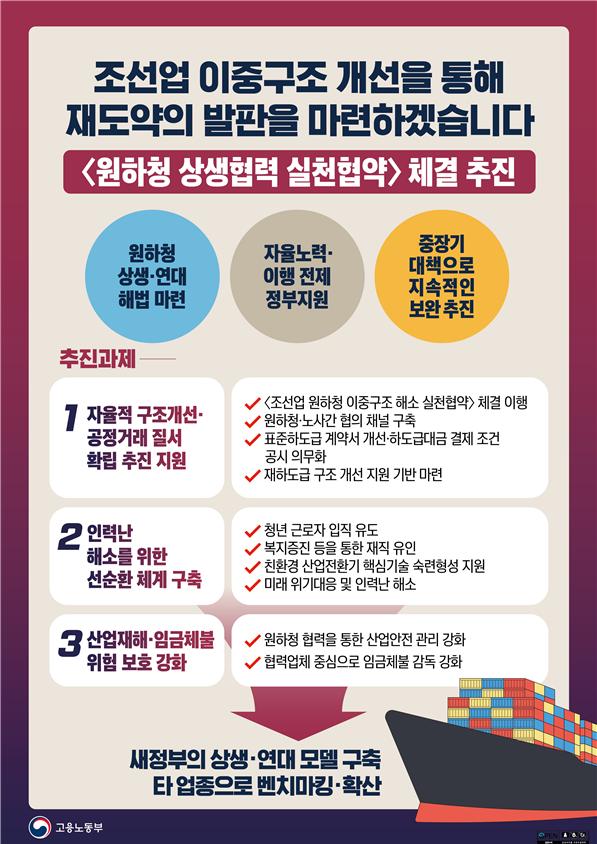
Focus on Primary-Subcontractor 'Autonomous Agreement'... Government Support
The government recognized that the lack of a consultative framework to reconcile conflicting interests among the four parties?primary contractor labor and management and subcontractor labor and management?has prevented problem resolution. Therefore, it decided to support the signing and implementation of the "Shipbuilding Industry Primary-Subcontractor Win-Win Cooperation Practice Agreement." According to the agreement, the management sides of both primary and subcontractors will protect workers by establishing a worker welfare fund and reducing subcontracting within subcontractor volume teams, while the worker sides will strive to share benefits between primary and subcontractor workers and establish professional ethics such as skill improvement.
The government will provide incentives such as bonuses and preferential allowances based on participation and implementation levels of the agreement, establish a "Shipbuilding Industry Win-Win Support Package," and promote regulatory innovation. By next year, the government will support the installation and operation of joint labor-management consultative bodies at individual primary contractor units involving both primary and subcontractor labor and management. In the second half of this year, it will also support costs for encouraging participation in labor-management partnership projects between primary and subcontractors and for shipbuilding industry-specialized labor-management win-win plus education.
Additionally, to eradicate unfair trade, the government will strengthen information disclosure by mandating public disclosure of subcontract payment terms in the first half of next year and prepare improvement measures for the standard subcontract contract for the shipbuilding industry within this year. The Ministry of Employment and Labor, the Fair Trade Commission, the Ministry of Trade, Industry and Energy, and other related ministries will jointly conduct a survey on subcontracting transactions in the shipbuilding industry to secure basic data for structural improvement.
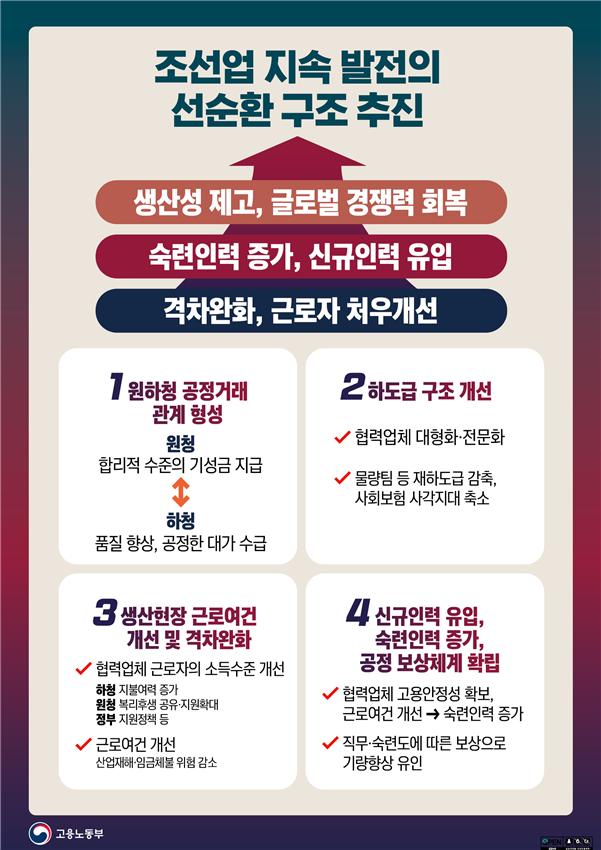
Attracting Youth and Skilled Workers... 2,500 Foreign Workers to Arrive by Year-End
The government also plans to actively support labor supply and demand in the shipbuilding industry. First, to encourage youth employment, it will abolish the age limit (45 years) for the Hope Deduction, which pays a 6 million KRW one-year maturity deduction fund contributed by workers, local governments, and the government, and expand the implementation areas. For newly employed workers, a new "Employment Settlement Allowance" of 1 million KRW will be provided after three months of continuous employment. The number of trainees for partner company hires and job seekers at primary contractor technical training centers will also be expanded. Training allowances will increase from 200,000 KRW to 1 million KRW.
Alongside this, the government will expand matching support for company-specific joint worker welfare funds and enhance welfare for subcontracted workers by increasing support for rent and transportation costs. Incentives will be provided for reemployment of retired skilled shipbuilding workers, and the support period for continued employment incentives for older workers will be extended.
Foreign labor will also be increased. E-9 visa foreign workers will be given top priority allocation to shipbuilding companies, employment quotas per workplace will be expanded, and the additional use of 1,000 flexibly allocated workers will be considered. Furthermore, until labor shortages are resolved, the government plans to temporarily extend the special overtime work limit for manufacturing industries, including shipbuilding, to 180 days. The Ministry of Employment and Labor explained, "a total of 2,500 foreign workers will arrive by year-end and work in the shipbuilding industry."
Minister of Employment and Labor Lee Jeong-sik stated, "The dual structure problem in the shipbuilding labor market cannot be solved by short-term measures or symptomatic treatments. All parties, including primary and subcontractor labor and management and the government, must unite their will and continuously strive to solve the problem to achieve results." He added, "We will monitor the progress annually for the next five years and continuously revise and supplement the measures to ensure this plan does not end as a one-time effort."
© The Asia Business Daily(www.asiae.co.kr). All rights reserved.
![Clutching a Stolen Dior Bag, Saying "I Hate Being Poor but Real"... The Grotesque Con of a "Human Knockoff" [Slate]](https://cwcontent.asiae.co.kr/asiaresize/183/2026021902243444107_1771435474.jpg)


















