"Difficult Decision Possible"... Full Withdrawal Likely
Provocation Over Alaska Airspace by US... "Approach to Air Defense Identification Zone"
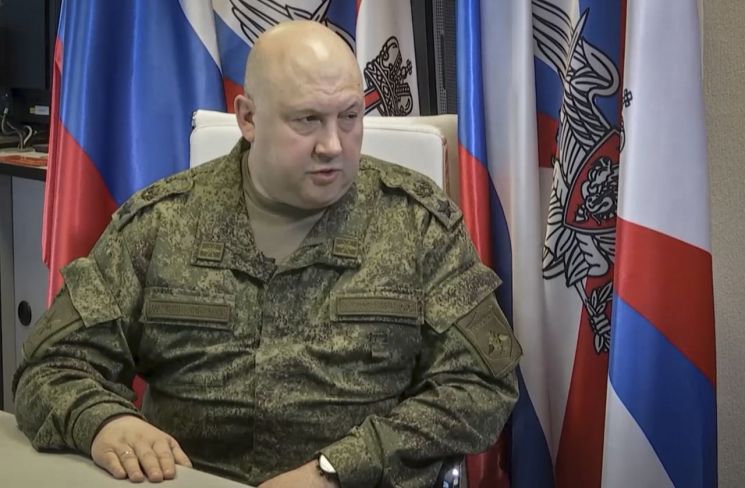
[Asia Economy Reporter Hyunwoo Lee] Sergey Surovikin, the Joint Forces Commander overseeing Russia's invasion forces in Ukraine, indicated the possibility of a full withdrawal, describing the situation in Kherson, a key strategic point in the occupied territories, as very serious. As the Ukrainian forces' recapture of Kherson is expected to make it very difficult to reverse the course of the war, concerns over nuclear provocation threats are growing, with Russian bombers approaching near the airspace over Alaska.
On the 18th (local time), Commander Surovikin stated in an interview with the local Rossiya 24 broadcast, "The situation in Kherson can be described as very difficult," adding, "The Russian forces will continue to act prudently and timely, and we do not rule out making complex and difficult decisions." He further emphasized, "Additional plans in Kherson depend on the unfolding military situation," and "Instead of pursuing rapid progress, we aim to preserve our soldiers, block the enemy, and minimize civilian casualties."
In particular, the phrase "difficult decisions" mentioned by Commander Surovikin is interpreted as suggesting a full withdrawal from the Kherson region. This is analyzed to be due to the Russian forces being pushed back by Ukrainian counterattacks across Kherson, making defense extremely challenging. According to the U.S. Institute for the Study of War (ISW), the city of Kherson, the capital of Kherson Oblast, is currently cut off from supply routes, and most of the western part of Kherson city has been recaptured by Ukrainian forces.
Ukrainian authorities are also projecting that if the current situation continues, Russian forces will be pushed beyond the border by next summer. Kyrylo Budanov, head of Ukraine's Defense Intelligence, stated in a press release that "Russian losses are inevitable, and by the end of the year, we can achieve significant territorial gains. We hope Kherson will be included in this victory," emphasizing, "By around next summer, Ukraine's borders will return to what they were when it gained independence from the Soviet Union in 1991." This reflects confidence that not only the territories currently occupied by Russian forces but also the Crimean Peninsula can be fully restored.
As Russia's defeat becomes more apparent, concerns over nuclear provocations are also increasing. The Russian Ministry of Defense announced that two strategic bombers, Tupolev (TU)-95MS, flew for 12 hours over the Pacific Ocean, Bering Sea, and Sea of Okhotsk. During the flight, these bombers approached the U.S. Air Defense Identification Zone (ADIZ) near Alaska, prompting the U.S. to scramble two F-16 fighter jets to intercept them.
These bombers are capable of carrying nuclear warheads. This sortie is analyzed as a provocative act intended to signal the possibility of nuclear provocation to Western countries such as the United States and the European Union (EU).
Some speculate that the Russian government, facing increasing difficulties on the Ukrainian front, has begun showing interest in ceasefire negotiations. According to CNN, Karen Donfried, U.S. Assistant Secretary of State for European and Eurasian Affairs, said in an online briefing, "In recent weeks, several Russian officials, including Putin, have suggested they might be interested in negotiations," but added, "However, Russia must demonstrate through actions, not words, that it is ready to engage in negotiations in good faith."
© The Asia Business Daily(www.asiae.co.kr). All rights reserved.

















