Starting with Samsung in 2017, SK and LG Accelerate Business
Wide Applications Including Data, Phones, TVs, and Air Conditioners
"More Advantageous to Specialize AI Research by Region and Usage"
[Asia Economy Reporter Moon Chaeseok] Leading domestic IT companies such as Samsung, SK, and LG are drawing attention as they accelerate the commercialization of artificial intelligence (AI). Not only research but also business organization restructuring and performance have become visible, long surpassing mere product performance improvement or future investment concepts. In the home appliance industry, which has started a grand experiment to interoperate each company's applications (apps) centered around the international consortium called HCA, there is a growing sense of crisis that failure to secure AI technology may lead to exclusion from the mainstream.
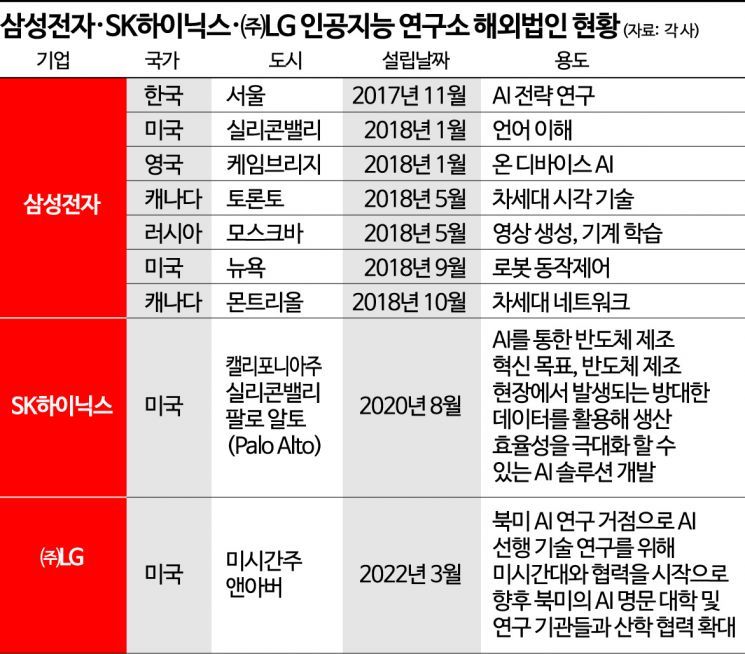
According to the industry on the 20th, Samsung, SK, and LG have been actively accelerating their entry into this field over the past five years, starting with Samsung in 2017, by establishing AI research organizations both domestically and internationally. Samsung Electronics, SK through funding from Hynix operating the AI software 'Gauss Labs,' and LG through its holding company LG Corp. are each striving to revitalize their AI businesses.
In the case of Samsung Electronics, Vice Chairman and Device Experience (DX) Division Head Han Jong-hee will personally participate in the company's own AI forum next month. The announcement of the forum was made about 20 days after the semiconductor (DS) division's design business organization System LSI's system-on-chip (SoC) development office was bifurcated into AI·Computing and Communication Development divisions. Although these are different business divisions, from the perspective of Samsung Electronics as a whole, the organization restructuring followed by holding a related forum has attracted attention. Since the mobile and automotive application processor (AP) 'Exynos' is installed in the Galaxy S22 series, the Consumer Electronics (CE) and Mobile Experience (MX) divisions are also closely related to the AI field.
Gauss Labs, affiliated with SK Hynix, signed a capacity-building agreement with Seoul National University earlier this month and is expanding its organization by recruiting global interns. Broadening the view to the entire SK Group, AI company Sapeon, collaborating with SK Telecom, is also accelerating mass production of AI chips. According to the industry, Sapeon recently decided to mass-produce the next-generation AI chip X330 (X300 series), which applies TSMC's 7-nanometer process from the Taiwanese foundry.
In LG's case, Group Chairman Koo Kwang-mo, who is also CEO of LG Corp., is leading the AI business. In March, LG opened the 'LG AI Research Center, Ann Arbor' in Ann Arbor, Michigan, and is cooperating with the University of Michigan. Gradual results are becoming visible mainly in the home appliance business division.
On the 18th, LG Electronics showcased the commercial system air conditioner 'Multi V i' under the Whisen brand at the international heating, ventilation, and air conditioning exhibition 'HAFCO' held at KINTEX in Goyang, Gyeonggi Province. It features the 'AI Indoor Space Care' function, which automatically controls multiple indoor units to maintain uniform room temperature. Whisen is one of the flagship products of the H&A (Home Appliance & Air Solution) business division. The AI semiconductor 'Alpha 9,' applied to OLED TVs, is also noteworthy. Despite fierce competition from Chinese home appliance maker TCL, LG revealed directly at the largest European home appliance exhibition IFA 2022 last month that thanks to 'Alpha 9,' it maintains about a three-year technological gap.
The industry unanimously stated that leveraging AI's versatility, which is used across data centers, home appliances, and automotive sectors, is essential not only for developing high value-added products but also for securing a broad customer base. An industry insider said, "Securing AI technology has become essential not only for developing high value-added semiconductor products but also for marketing 'hyper-connected' home appliance products. For example, AI is indispensable for improving the quality of home appliance platforms connected to each company's integrated apps such as SmartThings and ThinQ, so there is a consensus that it is advantageous to secure as many AI research organizations as possible by country and application."
© The Asia Business Daily(www.asiae.co.kr). All rights reserved.

















