Developing Countries Economic Forum Releases Proposal Ahead of November COP27 Summit
"Wealthy Nations Must Compensate Developing Countries Hit Hard by Climate Change"
[Asia Economy Reporter Bang Je-il] The issue of climate inequality, which holds developed countries in the Northern Hemisphere responsible for climate change, has been consistently raised. In particular, developing countries hit hard by climate change are demanding compensation from wealthy nations.
The V20 (Vulnerable Twenty Group), a consultative body of finance ministers from 20 developing countries vulnerable to the climate crisis, announced a proposal on the 18th (local time) urging wealthy countries to urgently establish plans to support developing countries vulnerable to the climate crisis. The V20 is an economic consultative body of finance ministers formed in 2015 by 20 countries that find it difficult to respond systematically to climate change. Currently, 55 countries are active members.
The V20 argues that since the major 20 countries (G20), composed of developed countries and rapidly industrializing nations, are responsible for about 80% of total greenhouse gas emissions, these countries should provide financial support for developing countries' climate change adaptation. In the proposal, the V20 claimed that the promise by developed countries to provide $100 billion annually in climate funds to developing countries by 2020 has not been fulfilled, increasing the damage to developing countries caused by climate change.
◆ Persistent Climate Inequality, Damage Entirely Burdened by Developing Countries
Climate inequality refers to the phenomenon where Northern Hemisphere countries, having achieved the Industrial Revolution through fossil fuels, hinder the development of underdeveloped countries under the pretext of the Green New Deal, carbon taxes, and so forth. At the 26th United Nations Climate Change Conference of the Parties (COP26) held last year, the issue of loss and damage compensation due to climate change was a major topic of discussion.
Sherry Rehman, Pakistan's Minister of Climate Change, said in an interview with The Guardian on September 4, "Wealthy countries that caused pollution should compensate Pakistan for flood damage," adding, "The global carbon emission targets and compensation for ruthless climate disasters need to be reconsidered."
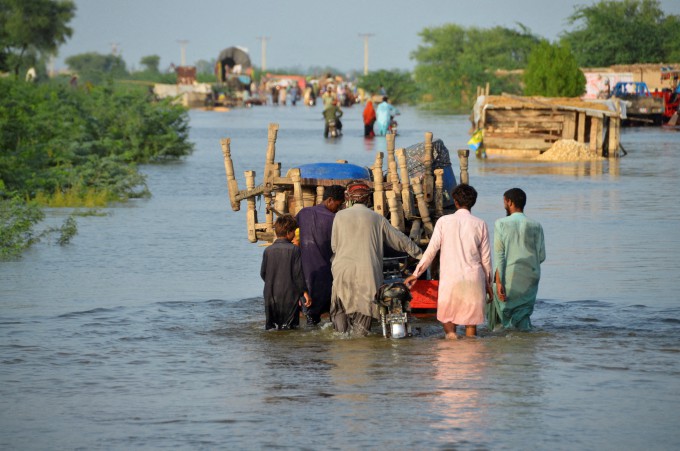 Since the monsoon rainy season floods began in Pakistan in June, a national emergency has been declared, and the death toll has surpassed 1,300. Photo by Yonhap News Agency
Just a few weeks ago, Pakistan was suffering from severe drought, but now, due to monsoon climate-induced heavy rains, about 1,300 people have died. One in three victims was a child. More than 33 million people, or one in seven of Pakistan's population, have been affected by the floods.
Pakistan's unprecedented floods are attributed to climate change. Global warming has made the monsoon stronger and more irregular, causing 500-700% more rainfall than usual in Pakistan this August. The monsoon, meaning "seasonal wind," is a phenomenon where seasonal winds blow due to temperature differences between continents and oceans. When temperatures rise, more water vapor is generated, leading to heavy rains. In 2014, an international joint research team from Pusan National University and Nanjing Normal University in China announced research results showing that a 1-degree increase in global temperature causes the South Asian monsoon to produce 5% more rainfall.
Minister Rehman emphasized, "A climate equation is needed to prevent the impact of irresponsible carbon emissions on countries that cannot even build infrastructure for self-recovery," adding, "The consequences of suffering from climate disasters should also be discussed at COP27."
Pakistan is not the only country suffering from climate inequality. Nigeria in Africa has also suffered significant flood damage during this year's rainy season. According to AFP and BBC reports on the 16th (local time), the cumulative death toll from floods has exceeded 600. Brazil and Venezuela also suffered damage from heavy rains last weekend.
◆ Climate Crisis Caused by Failure of Climate Funds
Meanwhile, the proposal submitted by the V20 includes imposing a 'windfall tax' on oil and gas producers to finance climate funds and calls for stronger roles from the International Monetary Fund (IMF), the World Bank, and the Group of Seven (G7). The Guardian predicted that the V20's proposal could become a key issue at the 27th Conference of the Parties to the United Nations Framework Convention on Climate Change (COP27) to be held in Egypt on November 6.
Shona Aminath, Maldives' Minister of Environment, Climate Change and Technology, said in an interview with The Guardian, "We talk about loss and damage because climate funds have failed." She added that if the promised climate funds had been delivered, it would have been possible to build levees or preserve natural flood barriers made of trees and wetlands to enhance resilience to the climate crisis.
She said wealthy countries "have invested many resources in responding to COVID-19 and the Ukraine war," and added, "It is clear that the problem is not a lack of money or technology. The problem is a lack of political will and not recognizing the climate crisis as an emergency."
As more and more budgets are spent on disaster recovery due to disasters and calamities, social issues such as health, education, and poverty are neglected, causing further social problems. Minister Aminath argued, "Support for developing countries should expand beyond physical damage recovery to the level of social welfare."
© The Asia Business Daily(www.asiae.co.kr). All rights reserved.

















