Fruition Achieved Seven Months After Joint Development with Bodytechmed
[Asia Economy Yeongnam Reporting Headquarters Reporter Dongguk Lee] A prototype diagnostic kit for screening 'normal pressure hydrocephalus,' a type of dementia, has been developed, attracting attention from the medical industry.
Advanced biomarker specialist company 'D&P Biotech' announced on the 18th that it has successfully developed a prototype diagnostic kit for screening 'normal pressure hydrocephalus' (NPH), classified as a type of dementia.
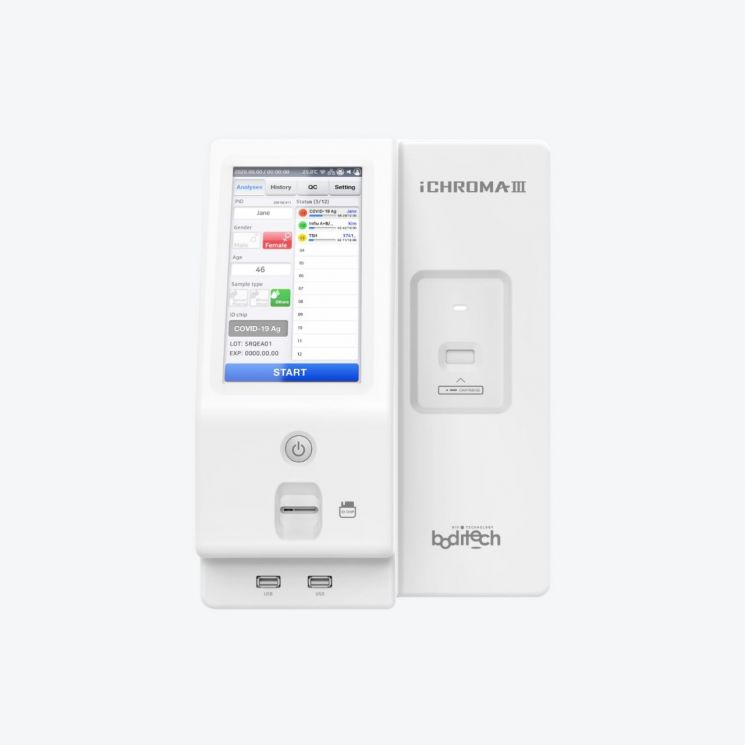
According to D&P Biotech, this prototype, developed based on Bodytechmed's diagnostic platform Ichroma, has improved diagnostic performance compared to existing research-use products. It represents a technological advancement that enhances the separation between normal and disease groups.
'Normal pressure hydrocephalus' is a condition caused by an increase in the production or impaired absorption of cerebrospinal fluid that protects the brain, leading to excessive accumulation. Although classified as a type of dementia, unlike Alzheimer's disease, it is treatable, making early detection crucial for this degenerative brain disorder.
Since the initial symptoms of normal pressure hydrocephalus resemble those of Alzheimer's, misdiagnosis is common. Researchers at Tohoku University in Japan estimate that about 3% of people over 65 may have normal pressure hydrocephalus.
It has been reported that 73% of patients who undergo surgery maintain an improved condition for more than three years. The company explains that this newly developed product can provide many patients with a chance for recovery.
The success of this prototype development was achieved seven months after signing an agreement with diagnostic specialist company Bodytechmed in February. The medical industry anticipates that this will be the world's first diagnostic kit related to normal pressure hydrocephalus.
D&P Biotech aims to complete regulatory clinical trials by the end of 2024 and obtain approval in the first half of 2025 to enter the market. Bodytechmed will be responsible for the production and supply of the product required for approval.
The two companies are discussing more practical cooperation methods to create synergy related to entering this new market.
Lee Myunghoon, CEO of D&P Biotech, stated, "We are also conducting regulatory clinical trials for diagnostic kits related to lung cancer prognosis and preterm birth, so multiple products will enter the market consecutively in the near future."
He added, "Our lung cancer prognosis diagnostic technology using CT imaging and the PROTAC screening platform UBIQAS have been consecutively published in international academic journals, externally proving the excellence of the technologies held by D&P Biotech."
D&P Biotech plans to expand beyond diagnostics into new drug development by starting with the launch of UBIQAS, discovering new biomarkers using UBIQAS, and developing companion diagnostics for PROTAC (PROteolysis-TArgeting Chimera).
UBIQAS can verify the ubiquitination status and degradation degree within cells and provides direct information on the ubiquitination sites of target proteins, making it an analytical method that can more precisely verify the function of PROTAC drug candidates. Ubiquitin is a protein composed of 76 amino acids.
Recently, the direction of new drug development has shifted from 'inhibiting' protein functions to 'removing' them, with the protein degradation system using PROTAC at the center of this shift.
PROTAC is a synthetic compound that brings the body's protein degradation system and target proteins into close proximity to induce degradation. It has many advantages over existing synthetic therapeutics and is expected to be a platform for innovative new drug development.
Due to technological limitations, only 13% of human proteins have been targeted for drug development with existing synthetic therapeutics, but PROTAC can develop therapeutics for any target, potentially broadening the scope of new drug development.
© The Asia Business Daily(www.asiae.co.kr). All rights reserved.

















