Recent Bill Proposed to Ban Mention of Drugs in Food Labeling and Advertising
Seoul Metropolitan Council Also Proposed Similar Ordinance on the 18th
'Drug Marketing' Has Long Been Used in Korea, Warning Signals Rise as Drugs Increase
[Asia Economy Reporter Byeon Seon-jin] "Once you try it, it's so addictive you can't forget it, the so-called 'drug ○○'."
The so-called 'drug marketing,' which was commonly encountered in Korea, is likely to disappear in the future. Ten lawmakers, including Kwon Eun-hee, proposed a revision to the 'Act on Labeling and Advertising of Foods' last August, which prohibits the inclusion of harmful substances like drugs in food labeling and advertising. Following this, the Ministry of Food and Drug Safety is currently preparing for follow-up procedures such as revising notifications and enforcement ordinances after the law amendment. Additionally, the Seoul Metropolitan Council has proposed an ordinance on the 18th aimed at preventing the abuse of drug-related product names.
Lee Han-deok, team leader of the Addiction Rehabilitation Center at the Korea Drug Prevention Movement Headquarters, said on the 19th, "With several amendments and ordinances being proposed, awareness about drug marketing can be raised in the future," adding, "drugs can destroy human lives, but drug marketing subtly lowers awareness of the dangers of drugs,” he pointed out. The Korea Drug Prevention Movement Headquarters issued a statement in 2015 saying, “If the term 'drug' is attached to food, society as a whole will eventually face enormous difficulties due to drug abuse,” and urged "an immediate stop to using the term 'drug' in food and business names." Lee said, "there was no proper law to regulate drug marketing," and "the only way to regulate drug marketing was through prohibited advertisements under the Outdoor Advertising Control Act, but even that has been difficult until now," he said.
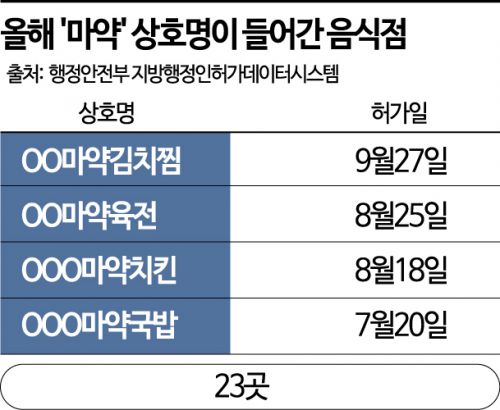
The practice of attaching the word ‘drug’ to food names to exaggerate how ‘delicious’ they are has been widely used in Korea since the 2000s. According to the Local Administration Permit Data System of the Ministry of the Interior and Safety, there are currently 203 restaurants with ‘drug’ in their business names, of which only 9 (4.5%) opened before 2000, while 194 (95.5%) opened afterward. This year alone, 23 places (11.3%) have newly opened.
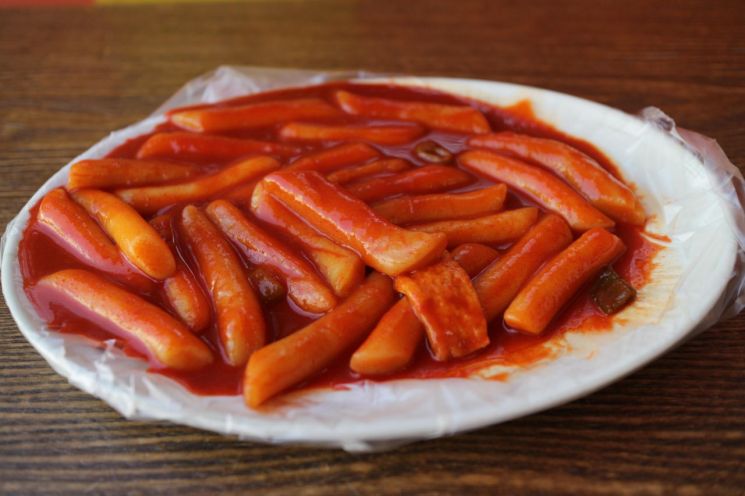
‘Mayak Kalguksu’ (drug knife-cut noodles), ‘Mayak Meat,’ ‘Mayak Gukbap’ (drug soup with rice), ‘Mayak Tteokbokki’ (drug spicy rice cakes), and ‘Mayak Jjimdak’ (drug braised chicken) are attached to virtually every food encountered in daily life. One visitor wrote in a review of a restaurant selling ‘Mayak Gimbap’ (drug seaweed rice rolls), “I think I understand why the term ‘drug’ is used,” adding, “The lingering taste of mustard sauce remains.” Recently, drug marketing has evolved to include specific types such as ‘Daema Coffee’ and ‘Daema Toast.’ In Thailand, where cannabis is legalized, if the business name or food name includes cannabis-related terms like ‘kanabis,’ ‘kancha,’ or ‘kanchong,’ it actually contains the substance.
The term ‘drug’ is also used outside of food. When searching for the word ‘drug’ on an online shopping mall A, ‘drug pillow,’ ‘drug cushion,’ ‘drug sleeping bag,’ and ‘drug mat’ appeared as autocomplete search terms. One seller of pillows said, “We used the term ‘drug’ to dramatically express that it’s ‘so soft you could faint,’” and added, “There have been no complaints related to this so far.”
However, as Korea has recently become a country not free from drugs, consumer resistance to drug marketing is gradually increasing. According to the ‘2021 Drug Crime White Paper’ published by the Supreme Prosecutors’ Office in May, the amount of drugs seized last year reached 1,295.7 kg, which is 8.4 times the 154.6 kg seized in 2017. The number of drug offenders in their teens and twenties also increased 2.5 times from 2,331 to 5,527 during the same period. Kang, a housewife in her 30s, said, "I am worried that young students, who do not properly understand what drugs are, might think they are ‘good things.’"
© The Asia Business Daily(www.asiae.co.kr). All rights reserved.



















