Decision on Delisting by the 25th
Inbosa Reportedly Implemented Improvements in Clinical Trials and Fundraising
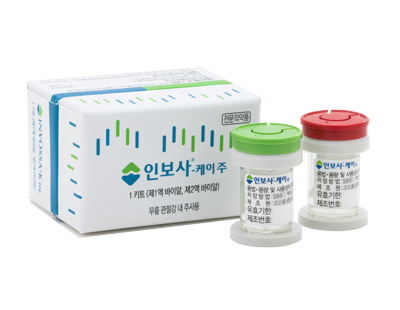
[Asia Economy Reporter Chunhee Lee] The fate of Kolon TissueGene, which is facing the risk of delisting following the 'Invossa scandal' and subsequent embezzlement and breach of trust allegations, will be decided within this month. Following the successful maintenance of listing by Curiont and SillaJen, there is growing optimism that Kolon TissueGene will also survive, but concerns remain due to issues related to the quality of the drug.
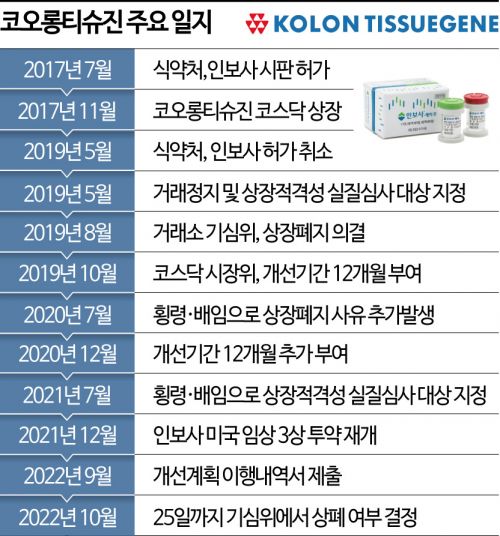
According to industry sources on the 18th, the Korea Exchange will hold a corporate review committee meeting by the 25th to decide whether to delist Kolon TissueGene. This comes after a trading suspension of about three years and five months since May 2019.
Kolon TissueGene rose to stardom in July 2017 when 'Invossa,' the world's first 'gene therapy for osteoarthritis,' received approval from the Ministry of Food and Drug Safety (MFDS). Following its listing on the KOSDAQ in November and successful entry into Phase 3 clinical trials in the United States, expectations grew that it would become a global blockbuster drug company. Particularly, the strong interest and direct nurturing by Woong-yeol Lee, Honorary Chairman of the Kolon Group, heightened these expectations.
However, in May 2019, two years later, the MFDS revoked Invossa's approval. Kolon TissueGene had reported that the transduced cells in Invossa were 'chondrocyte-derived cells' at the time of approval, but it was revealed that they were actually 'kidney-derived cells.' Kolon TissueGene argued that the kidney-derived cells were accidentally mixed in and that safety and efficacy had already been proven through clinical trials, but this argument failed to convince the authorities.
Consequently, the Korea Exchange suspended trading of Kolon TissueGene's shares and designated it for a delisting suitability review. However, the following year, additional reasons for the review arose, including a refusal of audit opinion and embezzlement and breach of trust allegations in July, leading to an extended improvement period. As a result, stock trading has not resumed for over three years.
All Improvement Measures Implemented... 'Invossa' Issue Remains a Stumbling Block
Within the industry, there is a prevailing view that Kolon TissueGene will overcome its risks through this review, as SillaJen maintained its listing by fulfilling all improvement requirements set by the Korea Exchange.
SillaJen had its trading suspended in 2020 due to embezzlement and breach of trust allegations against former CEO Moon Eun-sang and other executives. The preliminary review committee demanded securing funds and management changes. In response, SillaJen welcomed M2N, led by Chairman Seo Hong-min, as its largest shareholder, secured new investment funds, conducted additional paid-in capital increases, and appointed a new CEO. However, with another improvement period granted, further requirements included hiring a Chief Medical Officer (CMO) and expanding the new drug pipeline to ensure business continuity. SillaJen diligently fulfilled these tasks, including licensing the anticancer drug 'BAL0891' from Swiss company Basilea, leading to the resumption of trading.
Kolon TissueGene is also reported to have submitted a report on the implementation of its improvement plan, satisfying all requests from the Korea Exchange. Key improvements reportedly include conducting clinical trials for Invossa's revival and securing financial soundness through research and development (R&D) funding.
Regarding clinical trials, the delayed Phase 3 clinical trial for knee osteoarthritis in the U.S. resumed dosing in December last year, and in the same month, the U.S. Food and Drug Administration (FDA) approved plans for a Phase 2 clinical trial for hip osteoarthritis, showing gradual momentum.
On the financial side, Kolon TissueGene raised approximately 100 billion KRW through convertible bonds (CB) issuance and paid-in capital increases. Notably, Honorary Chairman Lee personally contributed about 10 billion KRW from his private funds, demonstrating the firm support of the owner family and the group.
However, concerns remain that Kolon TissueGene differs from SillaJen. Curiont, a recently relisted anticancer drug developer, was suspended mainly due to insufficient sales, and SillaJen due to internal management or operational issues such as embezzlement and breach of trust. In contrast, Kolon TissueGene's problems arose not only from management but also from issues in the drug development process, which is the company's core business, suggesting a different perspective is needed.
An industry insider said, "Since U.S. clinical trials have only just resumed and approval has not yet been granted, it is somewhat questionable whether the reasons for delisting have been completely resolved," adding, "There is also a possibility that the Korea Exchange may make a cautious decision."
© The Asia Business Daily(www.asiae.co.kr). All rights reserved.
![Clutching a Stolen Dior Bag, Saying "I Hate Being Poor but Real"... The Grotesque Con of a "Human Knockoff" [Slate]](https://cwcontent.asiae.co.kr/asiaresize/183/2026021902243444107_1771435474.jpg)

















