Hybrid Flexible Work Combining Advantages of Remote and Office Work Spreads
Hybrid Work Already a Global Trend... Accelerating Corporate Culture Improvement
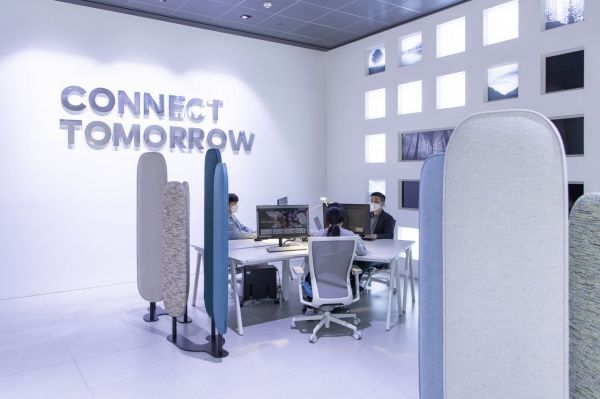 Employees working at Samsung Electronics' base office 'Delight Seocho' (Seocho-gu, Seoul). [Photo by Samsung Electronics]
[Asia Economy Reporter Han Yeju] "Commuting from Gyeonggi Province to Seoul is truly hell. I spend three hours a day just commuting, and when I get to the office, unnecessary meetings pile up, leaving me with insufficient time for actual work. It's the worst in terms of efficiency." (A, a 30-something assistant manager at a large corporation)
As employee demand for flexible work arrangements continues to grow, major manufacturing-based large corporations, often labeled as 'conservative,' are also changing their work cultures. These measures aim to reduce employees' commuting time and costs while improving work efficiency. With some U.S. tech companies having announced permanent remote work policies, a forward-looking movement to establish autonomous work systems is expected to accelerate domestically as well.
According to the business community on the 22nd, Samsung Electronics employees will soon be able to work outside the rigid office environment in flexible workspaces named 'Delight.' Delight consists of a total of six locations, including two external hub offices in Seocho (Seocho Building) and Daegu (ABL Tower), and four autonomous work zones within business sites: Digital City (Suwon), Seoul R&D Campus (Umyeon), Smart City (Gumi), and Green City (Gwangju).
The strategy behind these shared hub offices is interpreted as an effort to reduce employees' commuting time and thereby increase work productivity and efficiency. The goal is to transform the work culture into a more future-oriented and employee-friendly environment to attract top talent. Notably, Samsung Electronics Vice Chairman Lee Jae-yong expressed in June, "Our task is to bring in good people and create a flexible culture that allows our organization to adapt to predictable changes," revealing his commitment to advanced corporate culture and talent acquisition.
A Samsung Electronics official explained, "As part of the 'Work From Anywhere' policy that allows employees to focus on work regardless of time and place, we have established flexible workspaces both inside and outside the company. Especially, the external hub offices were created through a task force (TF) involving employees themselves to design the optimal work environment from the employees' perspective."
Following other major corporations that introduced hub offices earlier, the participation of Samsung Electronics, the largest domestic company, is expected to lead to further expansion of hub offices across the business sector.
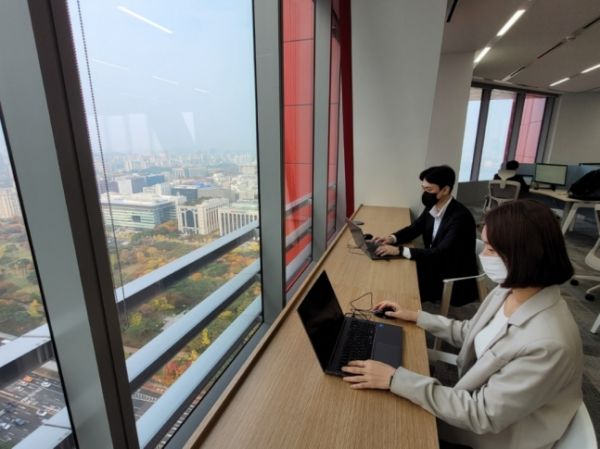 POSCO Group's base office With POSCO Work Station located at Park One in Yeouido, Seoul. [Photo by POSCO Group]
Hyundai Motor Company has been operating hub offices called 'H-Work Station' since June last year at locations including Gye-dong Building in Jongno-gu, Seoul; Wonhyo-ro Building in Yongsan-gu; Daebang Building in Dongjak-gu; Seongnae Building in Gangdong-gu; Samsan Building in Bupyeong-gu, Incheon; Anyang Building in Gyeonggi Province; and Uiwang Research Center. This allows employees working at the Yangjae headquarters or Namyang research center to work at hub offices near their homes.
Hyundai Motor Group Chairman Chung Euisun agreed, "I support creating satellite offices where employees can commute and work, thereby shortening commuting time and improving efficiency," which led to the full-scale introduction of hub offices.
SK Group is considered the most advanced among large corporations, as all its affiliates implement various forms of flexible work systems.
For example, SK Innovation introduced a free seating system in 2019. Employees reserve their desired seats in advance before coming to the SK Seorin Building office and can choose seats regardless of their company or organizational affiliation.
SK Hynix will implement the Global Experience Program (GXP) for five weeks starting at the end of this month, allowing employees to work at overseas business sites. Employees can select their preferred overseas work location and flexibly adjust the balance between their existing domestic tasks and new tasks during the day. Work locations include the company’s overseas subsidiaries in the U.S., China, Japan, and Germany, as well as major partners such as ASML in the Netherlands, Lam Research in the U.S., and Tokyo Electron in Japan. Selected employees will receive support for airfare, accommodation, and car rentals tailored to their overseas work location.
LG Electronics has partially implemented 'Remote Work,' allowing employees to work freely outside the company premises even before COVID-19. LG Innotek and LG Display also operate hub offices.
POSCO Group has been operating shared hub offices for group employees in Yeouido and Euljiro, Seoul, since the end of last year.
A business community official explained, "Various flexible work arrangements that started first in startups, IT, and distribution companies are expanding to manufacturing large corporations. This is part of efforts to improve corporate culture, aiming to shed the existing image of manufacturing-based large corporations in electronics, automotive, steel, and petrochemical sectors as conservative and outdated, and to transform into new, progressive organizations."
© The Asia Business Daily(www.asiae.co.kr). All rights reserved.


















