Ban on Single-Use Plastic Bag Sales at Convenience Stores from November 24
Delivery Apps Like B Mart and Coupang Eats Are Not Subject to Regulation
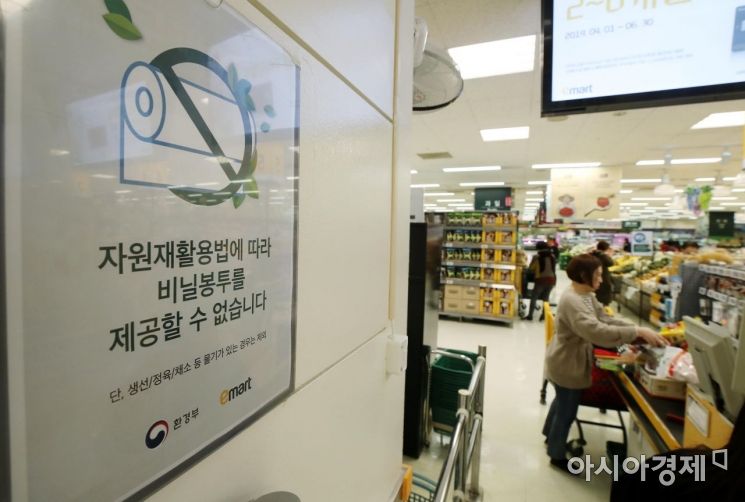 On April 1, 2019, the first day of the ban on the use of disposable plastic bags at large supermarkets, department stores, and shopping malls nationwide, a notice restricting plastic bags in accordance with the Resource Recycling Act was posted at a large supermarket in Yongsan-gu, Seoul.
[Asia Economy Reporter Kim Jeong-wan] Starting from the 24th of next month, the use of disposable plastic bags at convenience stores will be completely banned, while delivery apps are excluded from the plastic bag regulations, leading to criticism that they represent a 'blind spot' in single-use item controls.
According to the Ministry of Environment on the 18th, the revised enforcement rules of the "Act on the Promotion of Saving and Recycling of Resources," which prohibit the sale of disposable plastic bags at convenience stores and bakeries, will take effect from the 24th of next month. Under the revision, from the 24th of next month, consumers caught being provided with plastic bags will face fines of up to 3 million KRW. Currently, convenience stores sell plastic bags at prices ranging from 20 to 100 KRW depending on the store, but from that day forward, it will be impossible to purchase or use plastic bags even if paying for them.
Accordingly, convenience stores will not be allowed to use 'biodegradable plastic bags' either, and only volume-based waste bags, paper bags, or reusable bags will be permitted. The Ministry of Environment had previously applied this regulation to large stores over 3,000㎡ and supermarkets over 165㎡. Restaurants and cafes will be banned from using disposable paper cups and plastic straws, and baseball stadiums will prohibit disposable plastic cheering sticks.
Delivery apps are not subject to these regulations. Currently, the Ministry of Environment's regulations exclude quick commerce marts (urban micro-fulfillment centers), and the scope of this regulation is limited to general retail and food service industries. Therefore, non-store sales businesses for quick commerce such as B Mart and Coupang Eats will still be allowed to use plastic bags after the 24th of next month.
Since the delivery market has rapidly grown after COVID-19, there are criticisms that the delivery industry cannot be free from environmental issues. According to Statistics Korea, the transaction amount of online food services surged from 9.7328 trillion KRW in 2019, the year before the COVID-19 pandemic, to 17.3336 trillion KRW in 2020, and 25.6847 trillion KRW last year. These represent growth rates of approximately 78% and 48% year-on-year, respectively.
According to the waste processing status at public waste treatment facilities, the amount of paper and plastic waste also sharply increased starting from the COVID-19 period. In 2020, paper waste increased by 24.8% compared to the previous year, and plastic waste also rose by 18.9% during the same period.
© The Asia Business Daily(www.asiae.co.kr). All rights reserved.
![Clutching a Stolen Dior Bag, Saying "I Hate Being Poor but Real"... The Grotesque Con of a "Human Knockoff" [Slate]](https://cwcontent.asiae.co.kr/asiaresize/183/2026021902243444107_1771435474.jpg)
















