[Asia Economy Reporter Donghyun Choi] Domestic companies prefer job training that enables employees to deliver timely performance over system overhauls such as digital transformation.
HUNET, a lifelong education specialist, announced the results of the "2023 Corporate Education Outlook" survey conducted on corporate education officials on the 18th. A total of 521 HR and education managers from companies responded to the survey.
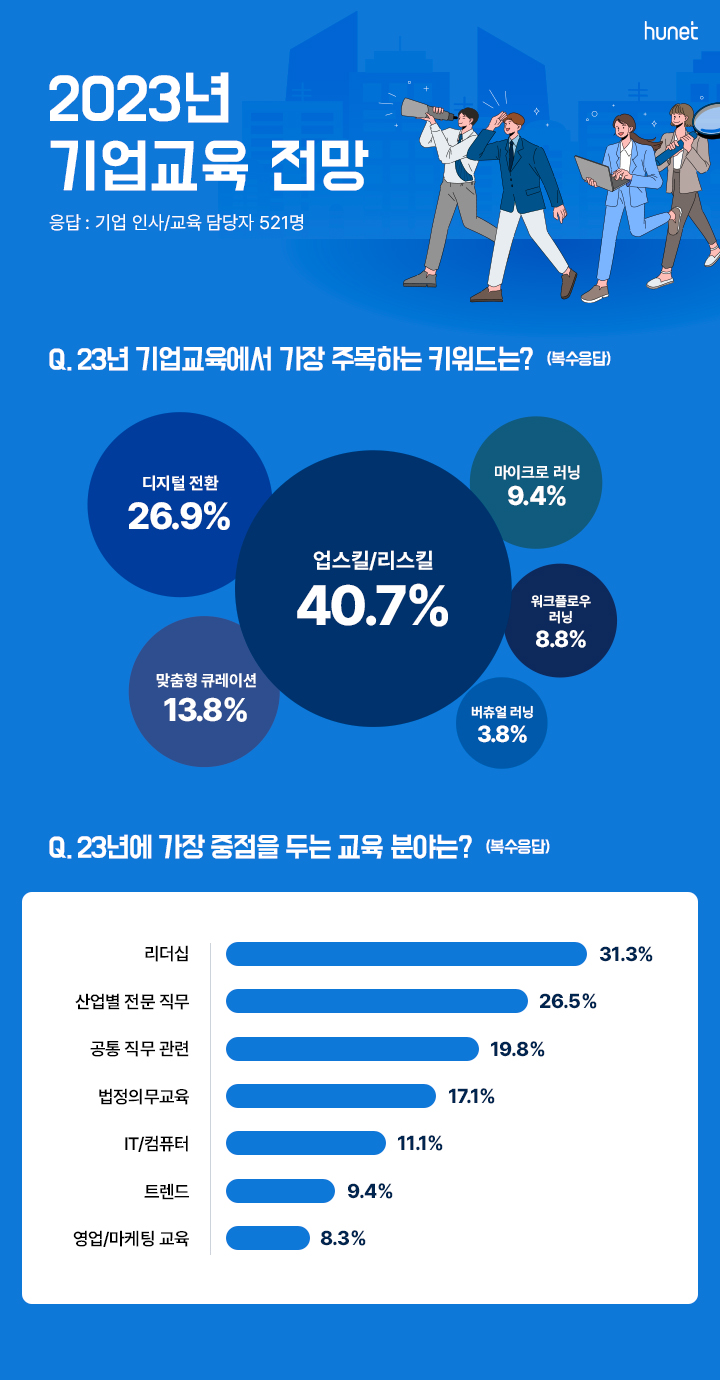
The top keyword(s) of focus for next year's corporate education (multiple responses allowed) was "Upskill/Reskill" (40.7%), ranking first. Upskill refers to improving job skills, while Reskill means training in new skills. As job roles diversify due to changes in the digital environment, companies appear highly interested in strengthening employees' capabilities to enhance corporate competitiveness. Following this, "Digital Transformation" (26.9%) ranked second, with "Customized Curation" (13.8%), "Microlearning" (9.4%), "Workflow Learning" (8.8%), and "Virtual Learning" (3.8%) trailing behind.
Kim Yong-gi, Vice President of HUNET's Enterprise Business Division, stated, "This seems to strongly reflect an HR trend aiming to boost corporate performance by enhancing the capabilities of existing members rather than new hires," adding, "The demand is growing not just for education itself but for education to contribute to performance outcomes."
When asked about changes in next year's education budget, respondents expected an average increase of about 6.8%. The responses were "Increase" (48.0%), "Freeze" (37.0%), "Decrease" (8.0%), and "Undecided" (7.0%). The main reason for the increase was "growing necessity for education," while the main reason for decrease was "economic downturn." Although a budget decrease was anticipated due to the economic slowdown, the intention to achieve results through training existing employees rather than hiring appears to have influenced budget changes.
The education area receiving the most emphasis (multiple responses allowed) was "Leadership" (31.3%). This was followed by "Industry-specific specialized jobs" (26.5%), "Common job-related" (19.8%), "Mandatory legal education" (17.1%), "IT/Computer" (11.1%), "Trends" (9.4%), and "Sales & Marketing education" (8.3%).
Regarding planned education methods for next year (multiple responses allowed), respondents answered "Online education" (42.8%), "Offline education" (31.5%), "Blended online and offline education" (27.1%), "Microlearning" (7.7%), "Online live" (7.1%), "Free channels such as YouTube" (6.9%), and "Reading education" (6.5%).
© The Asia Business Daily(www.asiae.co.kr). All rights reserved.
![User Who Sold Erroneously Deposited Bitcoins to Repay Debt and Fund Entertainment... What Did the Supreme Court Decide in 2021? [Legal Issue Check]](https://cwcontent.asiae.co.kr/asiaresize/183/2026020910431234020_1770601391.png)