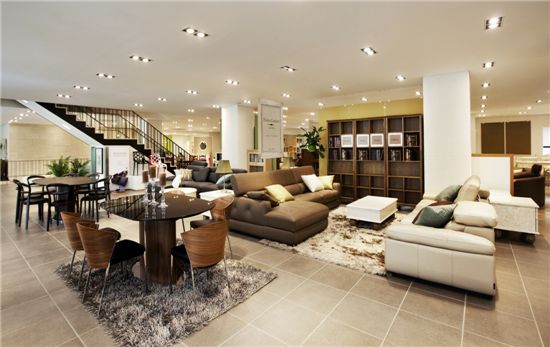
 The interior view of a furniture company's showroom.
[Asia Economy Reporter Choi Dong-hyun] The furniture and interior industry is facing difficulties even during the busy autumn season, when weddings and moves typically peak. Due to the housing market slump caused by interest rate hikes and rising raw material prices, the atmosphere is unlike previous years, and the upcoming third-quarter earnings are also expected to be disappointing.
According to the Seoul Real Estate Information Plaza on the 19th, apartment transactions in Seoul last month totaled 517 cases. During the same period last year, 2,691 transactions were recorded. Considering that there are still about two weeks left for the real estate reporting deadline (within 30 days after the contract), it seems unlikely that September transactions will exceed 1,000 cases. July and August transactions were also low, at 644 and 675 cases respectively. Only 85 transactions have been reported this month. The single-family and multi-family housing markets show a similar trend.
Real estate transaction volume is a barometer for the boom and bust of the furniture and interior industry. The more frequently homes change hands, the higher the demand for new furniture and interior purchases. However, with consecutive big steps (0.5 percentage point hikes in the base interest rate) pushing rates higher, forecasts predict a prolonged downturn in the real estate market due to loan burdens and falling home prices. As a result, the furniture industry’s mood remains gloomy despite the autumn moving season.
Hanssem recorded sales of 525.9 billion KRW and operating profit of 10 billion KRW in the first quarter of this year. Compared to the same period last year, sales decreased by 4.9%, and operating profit dropped by 60.2%. The situation worsened in the second quarter. Sales fell 12% year-on-year to 499.8 billion KRW, and operating profit plunged 92.4% to 2.1 billion KRW. Third-quarter earnings are also expected to be weak. Lee Seon-il, a researcher at BNK Investment & Securities, said yesterday, "Hanssem’s third-quarter sales are estimated at 508.3 billion KRW, down 5.1% year-on-year, and operating profit is expected to fall 69% to 7 billion KRW," adding, "The sharp decline in housing transactions this year caused poor performance in the core B2C business, and rising raw material prices further widened the operating profit decline."
Hyundai Livart posted sales of 368.7 billion KRW and operating profit of 2.9 billion KRW in the first quarter of this year. While sales increased 11.3% compared to the same period last year, operating profit dropped 70.4%. In the second quarter, sales rose 1.98% year-on-year to 360 billion KRW, but the company recorded an operating loss of about 300 million KRW, turning to the red. The same period last year saw a 5 billion KRW profit. Despite successive furniture price hikes to defend earnings, the burden of rising raw material and logistics costs could not be offset. Park Sera, a researcher at Shin Young Securities, forecasted, "Due to worsening external conditions, B2C furniture sales are expected to shrink by 3.7% this year," and added, "Home interior is unlikely to reach the break-even point (sales of 100 billion KRW)."
LX Hausys’ sales in the first half of this year rose 8.4% year-on-year to 1.8099 trillion KRW, but operating profit plunged 79.1% to 12.5 billion KRW. Kim Seung-jun, a researcher at Hyundai Motor Securities, predicted, "LX Hausys’ third-quarter operating profit will be 6.2 billion KRW, down 44.5% year-on-year," and said, "Due to increases in exchange rates, raw materials, labor costs, oil prices, and logistics costs, as well as the sluggish housing market, the situation is unlikely to improve in the third quarter."
Global companies also struggled domestically. According to the 2022 fiscal year (September 2021 to August 2022) results announced last month by the ‘furniture giant’ IKEA, sales dropped 9.9% year-on-year to 618.6 billion KRW. This marks the first negative growth since IKEA’s entry into Korea eight years ago. Fredrik Johansson, CEO of IKEA Korea, cited COVID-19 and the decline in housing transactions as reasons for the sales decrease.
Currently, the furniture and interior industry is focusing on retaining customers through product quality improvements and expanding offline stores following the easing of social distancing measures. Hanssem introduced the ‘Infinite Responsibility Remodeling’ system this month, which guarantees responsibility for interior defects until the end. The strategy is to differentiate products through a six-step solution that ensures transparency in construction and high quality. LX Hausys signed a business agreement with Paichai University on the 13th to nurture interior experts. The aim is to improve product quality through practical, field-oriented interior education and discovering talented individuals.
Hyundai Livart launched the total interior brand ‘Livart Jipterior’ and renovated its flagship store ‘Livart Total Gangnam.’ It plans to fully reorganize 12 nationwide directly operated showrooms in Busan, Daejeon, Gwangju, and other cities into ‘Livart Total’ within the year. Shinsegae Casa also plans to increase its offline stores, ‘Casamia,’ to 110 locations within the year. An industry insider said, "With the housing market outlook not favorable next year either, it is difficult to predict the recovery timing for the furniture industry," adding, "Rather than engaging in cutthroat competition by simply increasing offline branches, a strategy of strengthening fundamentals and preparing for the harsh times will be effective."
© The Asia Business Daily(www.asiae.co.kr). All rights reserved.
















