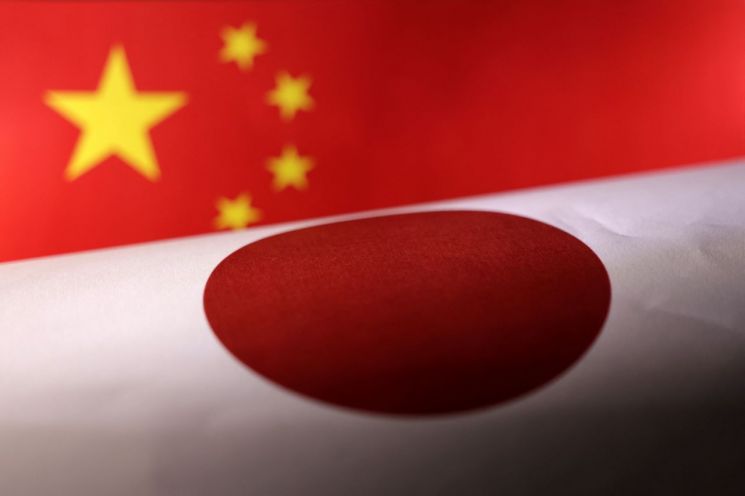
[Asia Economy Reporter Jeong Hyunjin] If Japan implements a 'Zero China' policy by cutting off most imports of parts and other products from China for two months, it is estimated that production in sectors such as home appliances and automobiles will be disrupted, resulting in a hit to production worth about 10% of the annual domestic gross product (GDP). Amid ongoing moves by global companies to decouple from China due to US-China tensions and global supply chain crises, there are concerns within Japan about its high dependence on China and the need for preparedness.
On the 18th, Nihon Keizai Shimbun reported that this estimate was made by Professor Yasuyuki Todo of Waseda University and others using a supercomputer. They estimated that if imports of Chinese products, including parts, amounting to 80% (about 1.4 trillion yen) were suspended for two months, production of home appliances, automobiles, clothing, and food would be impossible, causing damage to production worth approximately 53 trillion yen (about 512 trillion won). This corresponds to about 10% of Japan's annual GDP.
Japan's dependence on China is higher compared to other countries. In terms of the share of China in total imports, Japan's was 26% in 2020, higher than the US (19%) and Germany (11%). This is interpreted as Japan having established production bases in China, where labor costs and other expenses were relatively low during the era of active globalization, and imported inexpensive Chinese parts to enhance price competitiveness.
In this situation, if Japan stops importing Chinese products and replaces them with Japanese or other regional products, product prices will rise. A Japanese research firm assumed that 80 major items, including home appliances and automobiles, would be replaced with Japanese or other regional products instead of Chinese imports, estimating an annual cost increase of 13.7 trillion yen. Nihon Keizai reported that this amount corresponds to 70% of the total net profit of manufacturing companies listed on the Tokyo Stock Exchange Prime Market.
Looking at individual products, the average price of PCs is expected to rise by 50% to about 180,000 yen, and smartphones by 20% to about 90,000 yen. Although inflation has surged worldwide, including in Japan, due to supply chain disruptions and the impact of the Ukraine war this year, the price increase caused by blocking imports of Chinese products is considered to be less than these effects.
Nihon Keizai emphasized the need for preparedness, stating, "China is the world's largest market, and for companies to increase profitability, expanding business in China is essential. However, if military conflict occurs in the Taiwan Strait, companies will be forced to choose whether to continue operations in China." In a survey conducted last month by Nihon Keizai of 100 Japanese businesspeople, 96% of respondents expressed concern about the possibility of China invading Taiwan.
Some companies have already begun efforts to separate China from their supply chains. Japanese automaker Honda started a block strategy last month to bifurcate its global production system into China and non-China regions. American electronics company Apple, which produces iPhones, has also moved some production bases from China to India, producing the iPhone 14 in India. The share of iPhone production in India is expected to increase from 1% in 2020 to 7% in 2022.
© The Asia Business Daily(www.asiae.co.kr). All rights reserved.

















