Over 10 Million Sardines Dead in Unprecedented Phenomenon Amid Various Speculations
Namdong Fisheries Research Institute to Announce Sardine Mass Death Investigation Results
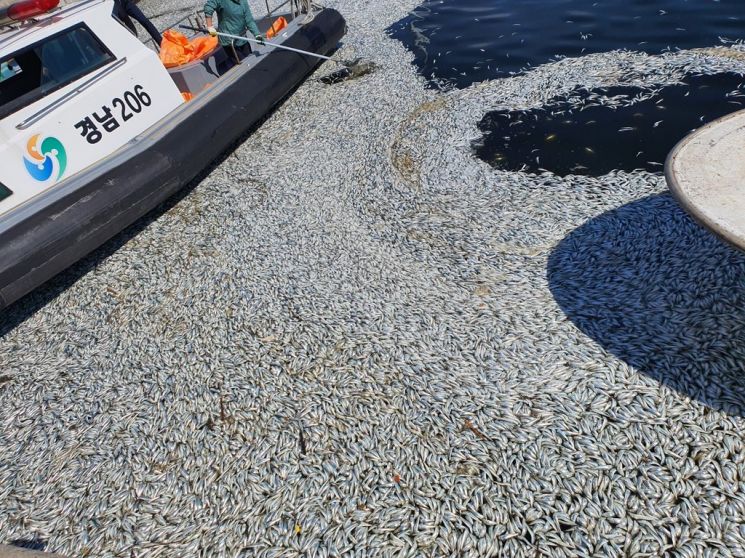 Sardines have died in large numbers around Masan Bay in Changwon City, Gyeongnam. The National Institute of Fisheries Science is expected to release the cause analysis results as early as next week. Photo by Changwon City
[Asia Economy Reporter Han Seung-gon] As sardines have died en masse around Masan Bay in Changwon City, Gyeongnam Province, fishermen's anxiety is growing. A dead school of mullet was found off the coast near Gadeokdo, Busan.
According to Changwon City on the 18th, the amount of dead sardines collected by the 16th reached a staggering 202 tons. It is estimated that more than 10 million fish have died.
According to the National Institute of Fisheries Science, on the morning of the previous day (17th), about 1,000 mullet were found dead floating 400 meters west of Dongdumal near Gadeokdo.
The National Institute of Fisheries Science and Changwon Coast Guard are currently conducting bacterial, parasitic, and viral pathological tissue examinations, as well as analyzing seawater quality for heavy metals. However, the cause of death has not yet been identified. The comprehensive analysis results from the Fisheries Science Institute are expected to be released after the 24th.
Earlier, sardine schools were found dead en masse in Masan Bay starting from the 1st. Subsequently, dead sardines continued to be found around Masan Bay, including Domanhang in Jindong-myeon, Dagu Port, and the waters in front of the 3·15 Marine Nuri Park. The number of dead sardines gradually decreased and showed a lull, but on the 13th, dead fish were found again, and by the 15th, the collected amount exceeded 50 tons, continuing the sardine mass death.
Additionally, according to Changwon Maritime Police Station and Busan Gangseo District Office, around 8:15 a.m. on the 17th, about 1,000 dead mullet were found floating 400 meters west of Dongdumal, Gadeokdo. The local district office, Seo-gu, plans to conduct an on-site investigation to determine the exact cause of the mullet mass death.
Changwon City is conducting collection operations for the dead sardines, but it is also reported that nearby residents are complaining about the foul odor generated from the decaying sardines. Given the situation, some rumors have emerged suggesting that this might be a precursor to natural disasters such as earthquakes or tsunamis.
Another issue is that fish found dead become marine debris. It is known that fish found dead cannot be used as feed. Since they are found dead without being caught or eaten, they do not contribute to maintaining the ecosystem.
Professor Jeong Seok-geun of the Department of Marine Biological Sciences at Jeju National University appeared on 'CBS Park Jae-hong's Hanpan Seungbu' on the 6th and said, "(The mass dead sardines) are just like food waste. If you don't eat food and throw it away, it becomes food waste, right? It wouldn't be a problem if they were eaten. Marine organisms are eaten by other organisms," adding, "The problem arises when they die without being eaten or are caught and discarded, or when they gather in such large numbers that they cannot serve as food for other organisms, causing decay and problems. If people or other animals eat them, there is no problem. Whether used as feed or eaten by other fish, there is no issue, but since they are not eaten and discarded, it causes all these problems."
Changwon Mayor Hong Nam-pyo stated that he will promptly devise measures to prevent recurrence of fish mass deaths and to preserve the marine environment. The Namdong East Sea Fisheries Research Institute is expected to announce the investigation results on the sardine mass death phenomenon as early as this week.
© The Asia Business Daily(www.asiae.co.kr). All rights reserved.

















