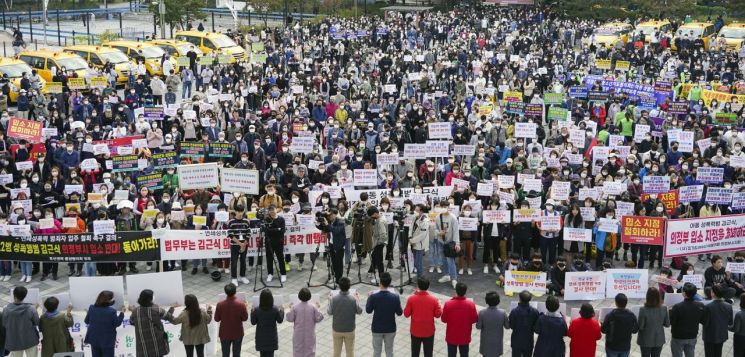
 On the afternoon of the 16th, citizens of Uijeongbu held a large-scale rally in the square in front of Uijeongbu City Hall, Gyeonggi-do, demanding the withdrawal of the admission of child sex offender Kim Geun-sik to the Uijeongbu rehabilitation facility. [Image source=Yonhap News]
[Asia Economy Reporter Kim Hyung-min] On the 15th and 16th, just before the release of child sex offender Kim Geun-sik (54), the citizens of Uijeongbu rose up like wildfire. Approximately 1,000 people, according to Uijeongbu city estimates, gathered in front of the Korea Rehabilitation Welfare Corporation Gyeonggi Northern Branch where Kim Geun-sik was to be admitted, protesting. Kim Dong-geun, the mayor of Uijeongbu, set up a field office in the mayor’s office there and staged an indefinite sit-in. He also enforced a road closure administrative order.
Earlier, Jo Doo-soon (69), who returned to Ansan City, Gyeonggi Province after his release in December 2020, has still not fully adapted to society. Whenever he goes grocery shopping at a mart, his movements are invariably shared in real-time by netizens on online communities. In May, a man in his 20s entered his home and assaulted Jo Doo-soon with a blunt weapon. He stated the reason for the crime was "anger over the sex crime committed by Jo Doo-soon."
Regardless of rehabilitation, this reflects the changed voice and signal from civil society rejecting the social reintegration of individuals who have committed shameless sex crimes. Experts emphasize that government ministries should closely monitor these developments and prepare alternatives. A lawyer in Seocho-dong evaluated, "As information about sex offenders becomes accessible to everyone, this case shows society’s heightened vigilance and unwillingness to overlook the harm caused by their reintegration."
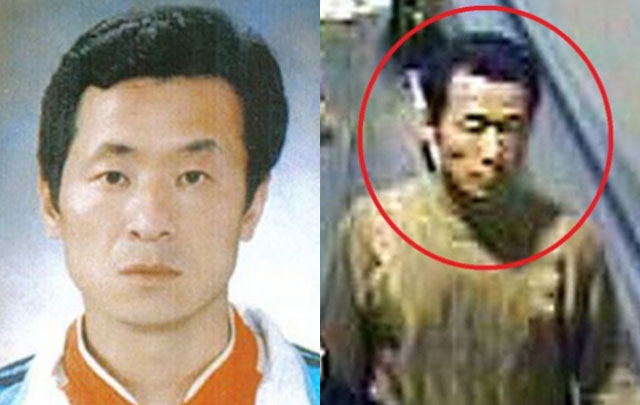 Child sex offender Kim Geun-sik, who was scheduled to be released after serving 17 days, was re-arrested.
 [Photo by Incheon Police Agency]
 Child sex offender Jo Doo-soon, who was released after serving his sentence, is entering his residence in Ansan, Gyeonggi Province, on the morning of December 12, 2020. [Image source=Yonhap News]
The biggest reason society rejects them is the risk of recidivism. Research results showing that most sex offenders are highly likely to commit crimes again have increased concerns. The process by which Kim Geun-sik chose his residence after release chills citizens even more. According to the Ministry of Justice, Kim Geun-sik himself applied to stay at the Korea Rehabilitation Welfare Corporation Gyeonggi Northern Branch after release. This location is near a school zone and within a 10-minute walk from the Uijeongbu Girls’ Youth Shelter. Kim Geun-sik, who was sentenced to 15 years in prison for sexually assaulting 11 female students from elementary to high school in the Incheon and Gyeonggi areas, was in an environment highly conducive to reoffending. It cannot be ruled out that Kim Geun-sik chose his residence with these factors in mind.
Meanwhile, 'chemical castration' has resurfaced as the best measure to prevent recidivism among sex offenders. Yoon Sang-hyun, a member of the People Power Party, announced on social media the day before, "We will establish legal grounds to allow chemical castration through medication for sexual impulse treatment even after the release of (child sex offenders)." This differs from the current chemical castration law enacted in June 2010, as it allows forced medication if there is a risk of reoffending after release. Yoon pointed out, "(The current law) requires a prosecutor’s request and a court’s decision, and since it can only be requested during the trial stage, it has the blind spot of not sufficiently considering the risk of sex offenders who are about to be released." However, opposition remains due to concerns over 'human rights violations' related to chemical castration, making controversy inevitable. The budget required for medication and other expenses is also expected to be considerable. In 2010, the Ministry of Justice spent 900 million won in the first year of implementing the chemical castration law. Nevertheless, as social concerns about child sex offenders like Kim Geun-sik have grown stronger than ever, there is a possibility that efforts to establish the law will gain momentum.
Attention is also focused on whether court judgments will change following the Kim Geun-sik case. The first confirmed chemical castration ruling was issued in February 2014. The Supreme Court sentenced Ko Jong-seok, who sexually assaulted an 8-year-old elementary school girl living next door in Naju, Jeollanam-do, to life imprisonment along with five years of medication for sexual impulse treatment. However, since then, most courts have shown caution in issuing chemical castration rulings. In May, the Daejeon High Court sentenced a man in his 30s to life imprisonment for sexually assaulting and abusing his cohabiting partner’s 20-month-old daughter to death, but dismissed the prosecution’s request for medication for sexual impulse treatment considering the sentence length.
© The Asia Business Daily(www.asiae.co.kr). All rights reserved.



















