800 Million Crabs in 2018 → 100 Million Last Year ... This Year’s Snow Crab Fishing Ban
Scientists Say Bering Sea Snow Crab Decline Due to Warming Rather Than Overfishing
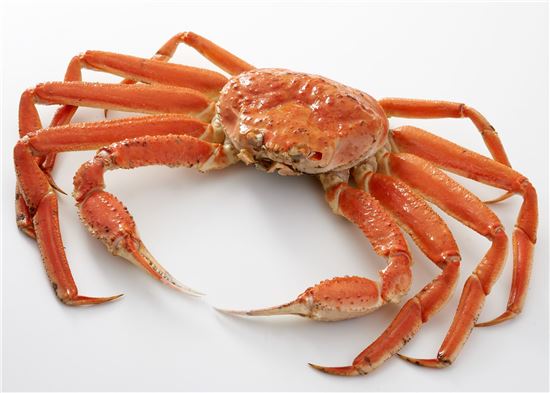 Snow crabs inhabit deep waters and are caught in South Korea as well as in Japan, Russia, and Alaska. Photo by Asia Economy DB
[Asia Economy Reporter Bang Je-il] Ahead of the peak snow crab season in December, the number of snow crabs in the waters near Alaska, USA, has decreased to one-eighth of the level seen 3 to 4 years ago, leading to a ban on snow crab fishing this year.
The Alaska Fisheries Commission and the North Pacific Fishery Management Council (NPFMC) announced last week that the snow crab population in the Bering Sea has fallen below the threshold required to start fishing operations. These organizations also explained that red king crab fishing in the Bristol Bay area along the southwestern coast of Alaska's Bering Sea is banned again this year, following last year's prohibition.
Benjamin Daily, a researcher at the Alaska Department of Fish and Wildlife, stated, "The snow crab population in the Bering Sea plummeted from 8 billion in 2018 to 1 billion last year," adding, "It is shocking and noteworthy that the most commonly caught crab in the Bering Sea has decreased so drastically."
Alaska fisheries officials attribute the fishing ban in these waters to overfishing. Mark Stewart, the Alaska Department of Fish and Wildlife's coordinator for bottomfish and crustacean fisheries, said, "More crabs are being caught than are naturally reproducing and increasing in number," and added, "The Bering Sea fishery resource survey showed that the number of mature male snow crabs this year decreased by 40% compared to last year."
According to a CNN report on the 16th (local time), scientists argue that limiting the cause of the snow crab decline in the Bering Sea solely to 'overfishing' does not explain the real reason, suspecting climate change as the main cause.
Michael Ritzow, director of the NOAA Kodiak Fisheries Research Center, said, "It is very clear that overfishing did not cause the collapse of the snow crab population," adding, "Human-induced climate change is a significant factor causing the disappearance of snow crabs." He explained that snow crabs are cold-water species mainly found in waters below 2℃, and that global warming has raised sea temperatures and caused the disappearance of sea ice near Alaska, creating an environment where snow crabs struggle to survive. He further noted that many studies conducted in 2018 concluded that the rising sea temperatures and decreasing sea ice in the Bering Sea are due to global warming.
Recent research shows that the Arctic's temperature is rising four times faster than other regions. Consequently, the rapid disappearance of sea ice in Arctic areas such as Alaska's Bering Sea is accelerating global warming in a vicious cycle.
Snow crabs are named for their long legs, which resemble bamboo joints. They inhabit deep waters in the sea and are caught in countries including Korea, Japan, Russia, and Alaska. In Korea, famous snow crab habitats include Uljin and Yeongdeok in Gyeongbuk Province.
© The Asia Business Daily(www.asiae.co.kr). All rights reserved.
!["The Woman Who Threw Herself into the Water Clutching a Stolen Dior Bag"...A Grotesque Success Story That Shakes the Korean Psyche [Slate]](https://cwcontent.asiae.co.kr/asiaresize/183/2026021902243444107_1771435474.jpg)















