The Biggest Issue in the Constitutional Court's Pending Jurisdiction Dispute Case
Conflict Between the Constitutional Court and the Supreme Court Over the Limited Unconstitutionality Decision Also a Problem
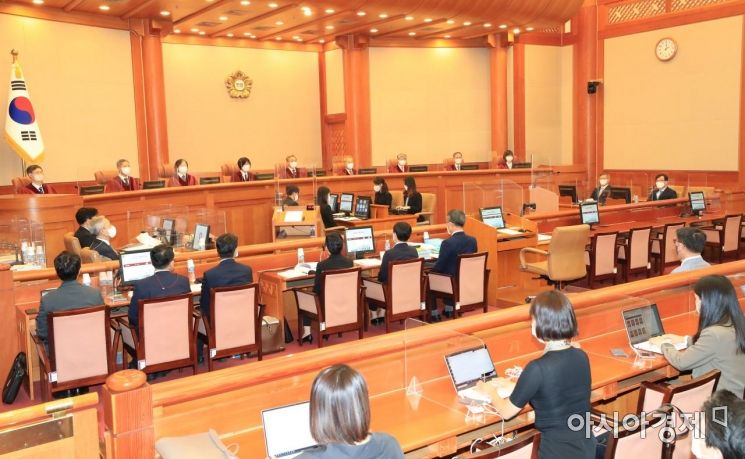 On the 27th of last month, a public hearing on the constitutional dispute over the amended Prosecutors' Office Act and Criminal Procedure Act, known as the 'Geomsu Wanbak' laws, was held at the Constitutional Court in Jongno-gu, Seoul. Photo by Kim Hyun-min kimhyun81@
[Asia Economy Reporter Choi Seok-jin, Legal Affairs Specialist] This year’s National Assembly inspection of the Constitutional Court is expected to focus on the so-called 'Geomsu Wanbak' (complete removal of prosecutorial investigation rights) laws, including the amended Prosecutors' Office Act and Criminal Procedure Act, for which both the ruling party and the Ministry of Justice have filed constitutional disputes. Various enforcement decrees of the Yoon Seok-yeol administration will also be major points of contention.
Lawmakers are also expected to criticize Justice Lee Young-jin of the Constitutional Court, who was reported to the Corruption Investigation Office for High-ranking Officials over allegations of 'golf entertainment.' Questions are anticipated regarding the resolution of conflicts between the two institutions following the Constitutional Court’s cancellation of Supreme Court rulings that contradicted its limited unconstitutionality decisions in June and July.
The National Assembly’s Legislation and Judiciary Committee will conduct the inspection of the Constitutional Court starting at 10 a.m. on the 17th.
During the inspection, a heated debate between ruling and opposition lawmakers is expected over the amended Prosecutors' Office Act, which drastically reduces the scope of crimes for which prosecutors can initiate investigations to two categories, and the Ministry of Justice’s revised enforcement decree on the 'scope of crimes for prosecutors’ investigation initiation' (Presidential Decree), known as 'Geomsu Wonbok' (restoration of prosecutorial investigation rights).
The amended Prosecutors' Office Act, passed by the Democratic Party just before President Moon Jae-in’s term ended, restricted prosecutors’ investigation rights, which had been reduced to six major crimes through police-prosecutor investigation rights adjustment, to only two categories: corruption crimes and economic crimes.
In response, lawmakers from the People Power Party filed a constitutional dispute, arguing that during the approval process, the Democratic Party neutralized the agenda adjustment committee through Representative Min Hyung-bae’s 'disguised party withdrawal,' undermined unlimited debate (filibuster) in the plenary session by splitting the session, and infringed on the rights of opposition lawmakers to deliberate and vote.
The Ministry of Justice also filed a constitutional dispute, claiming that the amended Prosecutors' Office Act infringed on the essential parts of prosecutors’ investigation and prosecution rights, violated constitutional principles of majority rule and due process during the National Assembly’s approval process, and circumvented the purpose of the multi-party system. The Constitutional Court is currently reviewing both cases simultaneously.
The Ministry of Justice holds the position that the amended Criminal Procedure Act, which includes provisions such as the prohibition of separate investigations by prosecutors, reduction of prosecutors’ supplementary investigation scope for cases transferred from the police, and removal of the complainant’s right to object to police non-prosecution decisions, also infringes on prosecutors’ investigation rights.
During the inspection, ruling party lawmakers are expected to once again point out the unconstitutionality of these 'Geomsu Wanbak' laws and urge the Constitutional Court for a swift decision.
On the other hand, opposition lawmakers are likely to emphasize the unconstitutionality of the 'Geomsu Wonbok' enforcement decree, which, contrary to the purpose of reducing prosecutors’ investigation rights, allows prosecutors to initiate investigations into abuse of authority, election-related crimes, organized crime, and drug trafficking, and will mount counterarguments.
Furthermore, opposition lawmakers are expected to strongly argue that the Yoon Seok-yeol administration’s establishment of the Personnel Information Management Unit within the Ministry of Justice and the creation of the Police Bureau within the Ministry of the Interior and Safety through enforcement decree revisions are unconstitutional measures exceeding the scope of legal delegation. Earlier this month, the National Police Commission filed a constitutional dispute with the Constitutional Court regarding the 'Police Command Regulations' that include the establishment of the Police Bureau.
Regarding Justice Lee Young-jin, who became the subject of an investigation by the Corruption Investigation Office for High-ranking Officials following a civic group’s report, lawmakers from both ruling and opposition parties are expected to criticize the justice’s inappropriate conduct.
Meanwhile, in June and July of last month, the Constitutional Court annulled Supreme Court rulings that applied laws it had declared partially unconstitutional. This marks the second and third such annulments in 25 years since the Constitutional Court first annulled a Supreme Court ruling for the same reason in 1997.
However, the Supreme Court maintains its stance that "the authority to interpret and apply laws is exclusively vested in the courts, with the Supreme Court as the highest court, and therefore it cannot recognize the effect of the Constitutional Court’s limited unconstitutionality decisions."
If both institutions stubbornly cling to their positions as they did 25 years ago, there will be no institution to resolve disputes between them, leaving the parties involved caught in the middle without relief, shuttling between the Constitutional Court and the courts. Thus, a solution is necessary.
© The Asia Business Daily(www.asiae.co.kr). All rights reserved.
![User Who Sold Erroneously Deposited Bitcoins to Repay Debt and Fund Entertainment... What Did the Supreme Court Decide in 2021? [Legal Issue Check]](https://cwcontent.asiae.co.kr/asiaresize/183/2026020910431234020_1770601391.png)
















