'Bar Harbor,' Famous Gateway to Acadia National Park
Vote Next Month on Limiting Daily Cruise Ship Visitors to 1,000
Residents of Venice, Italy Also Complain About Overtourism Discomfort
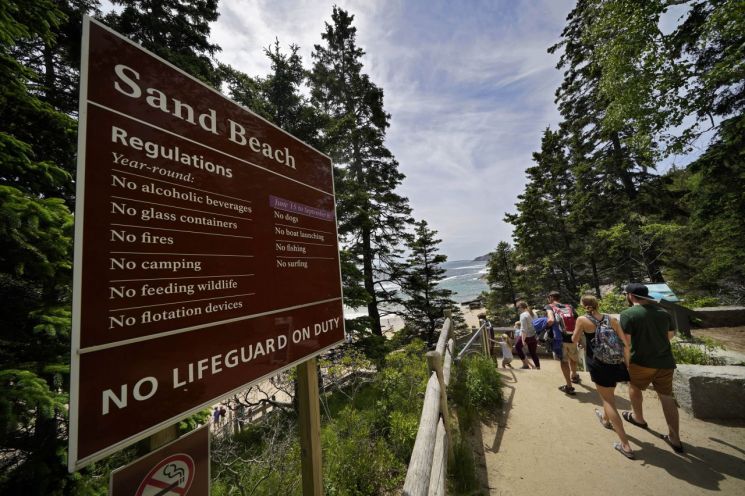 On June 11th (local time), tourists are moving at Sand Beach near Bar Harbor in Acadia National Park, Maine, USA. Photo by Yonhap News
[Asia Economy Reporter Hwang Sumi] A harbor town in the United States, famous as a resort destination, is soon set to decide whether to limit the number of cruise ship passengers. This comes as the influx of many tourists to the small island has increased inconvenience for residents.
According to the Wall Street Journal (WSJ) on the 15th (local time), Bar Harbor on Desert Island in Maine, northeastern United States, plans to hold a residents' vote on the 8th of next month to decide whether to limit the number of cruise ship passengers allowed to disembark at the harbor to 1,000 per day.
Bar Harbor, a small harbor town with a population of about 5,200, is famous as the gateway to Acadia National Park. Cruise ships with a total capacity of about 4,000 passengers carry tourists daily between the town and the park. This means that tourists amounting to about 77% of the town's population arrive at Bar Harbor at once.
Especially in September and October, many tourists visit this town to see the autumn foliage of Acadia National Park. Additionally, with pent-up travel demand due to COVID-19 exploding, WSJ reported that a total of 167 cruise ships are expected to dock at Bar Harbor this year.
However, island residents have expressed discomfort and negative views regarding such cruise tourism. One resident told WSJ, "Cruise passengers are blocking the small town," adding, "We think tourism is a good thing, but sometimes too much of a good thing becomes a bad thing." Another resident expressed concerns about the environmental impact of large cruise ships, saying, "Smaller ships are needed for sustainable tourism."
However, there is also considerable opposition from the tourism industry. Limiting tourists to about 1,000 per day is seen as an extreme measure. A resident who runs a grocery store in the town said, "When a large cruise ship recently arrived, I sold 157 lobster rolls in one day," adding, "We live and die according to the cruise ship schedule."
A similar situation has occurred in Venice, the Italian city built on water. According to the Associated Press (AP), Venice has seen strong protests from residents due to the side effects of so-called 'overtourism.' Overtourism refers to the phenomenon where the influx of tourists exceeds the acceptable capacity, negatively affecting the lives of local residents. Before COVID-19, about 100,000 people visited Venice daily, causing inconvenience to residents' daily lives and serious environmental pollution problems.
In response, Venice authorities announced that they will implement a visitor entrance fee ordinance enacted in 2018 starting January next year. According to the ordinance, from January 16th next year, day-trip tourists visiting the historic center of Venice and surrounding islands such as Lido, Murano, and Burano will have to pay an entrance fee of up to 10 euros (about 14,000 KRW), AP reported. Authorities plan to deploy staff throughout the city to check whether visitors have paid the fee, and those caught visiting without paying will face fines of up to 300 euros (about 420,000 KRW).
© The Asia Business Daily(www.asiae.co.kr). All rights reserved.

















