Domestic Securities Firms Anticipate Intensified US-China Conflict and Slowed Growth in Chinese Economy
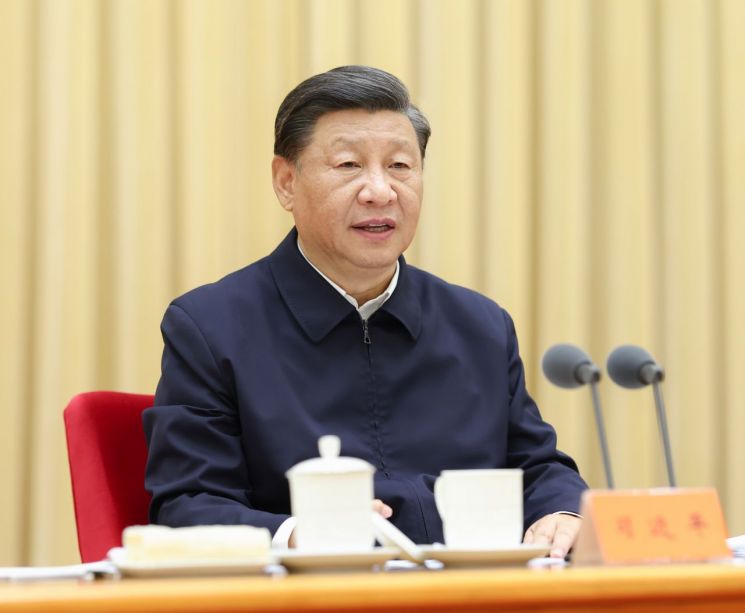
[Asia Economy Reporter Kim Pyeonghwa] It is forecasted that China's real economic growth rate will not reach 5% during Xi Jinping's third term (2022?2027) as China's president. Along with this, advice has been given to change the export strategy that depends on China, as US-China conflicts intensify.
On the 16th, the Federation of Korean Industries (FKI) announced these findings based on a survey conducted among research center heads of 19 domestic securities firms. The survey was conducted to inquire about prospects related to changes in China's economic and political policies following the opening of the 20th National Congress of the Communist Party of China on the same day.
The Party Congress is the largest political event held locally, where about 2,300 representatives of the Communist Party of China gather to elect the next leadership. It is held every five years. At this Congress, Xi Jinping's third consecutive term as General Secretary of the Party is expected to be formalized.
Xi Jinping's Third Term Economic Growth Rate Expected to be 'Cloudy'
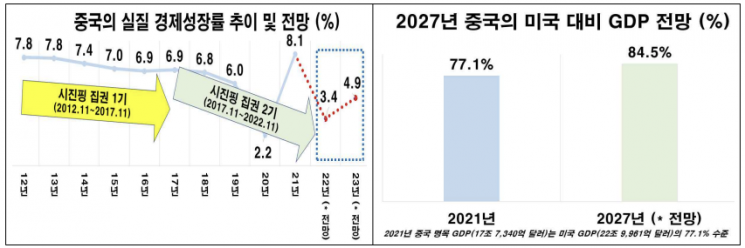
The research center heads forecast that China's real economic growth rate will be 3.4% this year and 4.9% next year immediately after this Party Congress. It is expected that this will be the first time in the past 30 years that China's economic growth rate falls below 6% for two consecutive years. In this case, the domestic economic growth rate, which depends on China for a quarter of total trade, may also find it difficult to rebound.
The research center heads also predicted that in 2027, the last year of Xi Jinping's third term, China's nominal Gross Domestic Product (GDP) will reach about 84.5% of the US nominal GDP. This forecast is based on the expectation that although China's economic growth will slow down, it will still be higher than that of the US.
Regarding the 'Common Prosperity Policy' announced by President Xi in August last year and the regulatory stance on big tech companies such as Alibaba and Tencent that followed, 47.4% of respondents believed this policy direction would continue for the time being. However, 42.1% also responded that the stance might ease, which is a significant proportion. The Common Prosperity policy aims to eliminate income disparities within China to ensure a prosperous living standard for all citizens.
Regarding China's strongly enforced 'Zero COVID Policy,' 94.7% of respondents expected regulations to ease in the future. This assessment was influenced by the government's efforts to revive the economy after the Party Congress and the fact that the number of confirmed COVID-19 cases in China has recently stabilized below 1,000.
Regarding whether Xi Jinping could be re-elected after 2027, opinions were divided. While 57.9% of respondents believed the possibility was high, 42.1% thought it was low. This is because Xi Jinping will be 74 years old in 2027 when the 21st Party Congress is held, which is considered an advanced age.
Korea-China Relations Expected to Maintain Current Level... "Need to Break Away from Dependence on China"
In this survey, 68.5% of respondents believed that US-China conflicts would intensify during Xi Jinping's third term. Opinions that cross-strait (China and Taiwan) tensions would also intensify accounted for 57.9%, a majority. However, the mainstream view, at 84.2%, was that the possibility of China's invasion of Taiwan, as raised by some, is low.
Following Russia's invasion of Ukraine at the end of February and the subsequent Western economic sanctions against Russia, the relationship between China and Russia, which has a honeymoon relationship centered on Russian crude oil trade, is expected to maintain the current level, with 52.6% of respondents agreeing. Regarding relations with the North Korean regime under Kim Jong-un, which has continued sudden actions such as missile launches since last month, 73.7% of respondents expected the relationship to remain at the current level.
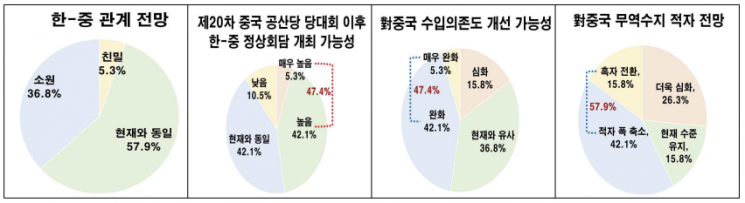
Regarding the weakening of Korea-China relations amid the Biden administration's efforts to rebuild its domestic supply chain focusing on strategic items such as semiconductors, electric vehicles, and batteries, and to check China, the outlook is that the situation will not worsen further. 57.9% of respondents expected Korea-China relations to maintain the current level during Xi Jinping's third term.
The research center heads mostly gave positive answers (47.4%) regarding the possibility of holding a Korea-China summit after this Party Congress. Regarding Korea's import dependence on China, 47.4% of respondents expected the dependence to decrease in the future. Also, concerning the continuous trade deficit with China over the recent four months (May to August), 57.9% expected it to improve going forward.
Based on these survey results, the FKI advised changing the export strategy that depends on China. Kim Bongman, head of the FKI International Headquarters, said, “We need to examine items not subject to US trade sanctions against China and establish support measures for exports to China. We should improve domestic companies' access to the Chinese market through Korea-China summits and regular ministerial meetings. Additionally, developing support policies for the domestic return of Korean companies operating in China is necessary.”
© The Asia Business Daily(www.asiae.co.kr). All rights reserved.



















