Protests Across Argentina Over Soaring Prices
"Triple-Digit Inflation Possible by Year-End... Wage Increases Only Half as Much"
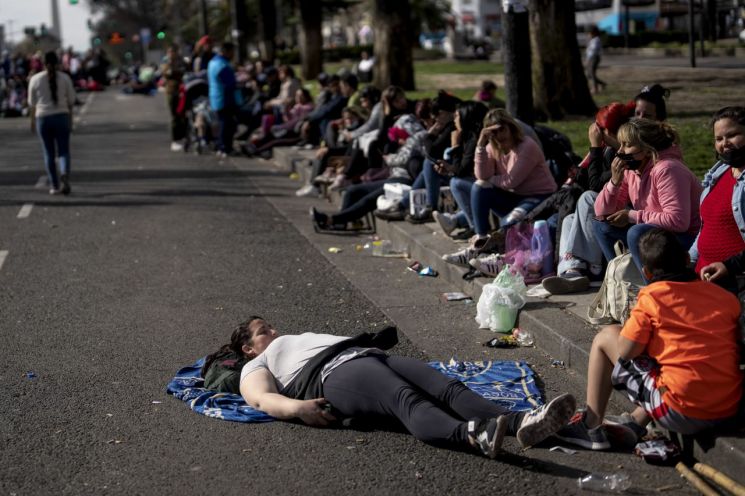 People resting during a protest on the 29th of last month (local time) in Buenos Aires, Argentina, calling for an increase in government subsidies and the establishment of countermeasures. Photo by Yonhap News
[Asia Economy Reporter Sumi Hwang] Large-scale protests against the murderous inflation are taking place daily in Argentina. On the 14th (local time), the National Institute of Statistics and Censuses (INDEC) of Argentina announced that the Consumer Price Index (CPI) in September rose by 83% compared to a year ago. This was about 7% higher than last month, which had already surpassed the 76% recorded in January 1992, 30 years ago. It was reported that the inflation rate for the first nine months of this year reached 66.1%.
In September, items such as clothing and footwear (10.6%), alcoholic beverages and tobacco (9.4%), various services (6.8%), and food and beverages (6.7%) mainly contributed to driving up prices. Economist Juan Paoliki said, "Although the inflation rate in September was below experts' expectations (6.7%), it reached the highest level since 1991 and is a bleak figure."
Previously, the Argentine government tried to stabilize soaring prices by restricting beef and grain exports and introducing price caps on essential goods, but failed to control inflation. Last year, to secure finances needed for COVID-19 response and economic stimulus, the government attempted to impose a wealth tax on the top income earners holding assets worth more than approximately 2.6 billion won, but failed to meet the collection target due to strong opposition from wealthy taxpayers.
As various government price control policies repeatedly failed, the hardships of citizens struggling with living costs deepened accordingly. In particular, while prices soared sharply, wage increases were only about half that level.
With everything from food to transportation becoming increasingly expensive, citizens who found it difficult to make a living took to the streets in anger. Civic groups are calling for increased government subsidies and countermeasures, while labor unions are demanding wage renegotiations, holding large-scale protests daily.
Notably, in August, a "Minimum Wage Funeral" was held in Buenos Aires, Argentina. Protesters marching with a mock coffin shouted "The salary is dead," protesting low wages and soaring prices.
The inflation-driven hardship is also affecting the Korean community. Over the past year, the sector with the highest inflation rate was the clothing industry, where the majority of Koreans are employed. Consumer prices have already risen by more than 100%, while sales have dropped by 17.4%.
Meanwhile, experts generally agree that Argentina's inflation rate, which has been setting new records every month, will not easily decline. According to the Market Expectations Survey (REM) conducted by the Central Bank of Argentina targeting professional analysts, the year-end inflation rate is projected at 94.5%. Moreover, many experts foresee the possibility of the year-end inflation rate exceeding triple digits.
According to a report by local media Ambito citing the International Monetary Fund (IMF), Argentina's year-end inflation rate this year is expected to rise by 95% compared to the previous year. Accordingly, Ambito reported that Argentina is expected to rank 4th in the global inflation rate rankings, following Zimbabwe (547.3%), Venezuela (220%), and Sudan (129.5%).
© The Asia Business Daily(www.asiae.co.kr). All rights reserved.