Worsening Business Conditions Amid High Inflation, Interest Rates, and Exchange Rates
Samsung, LG, SK, and Others Deliberate Business Strategies... Hold CEO Meetings and Workshops
Effectively Entering 'Emergency Management'... "Worse Next Year, Adopting Conservative Strategies"
[Asia Economy Reporters Sunmi Park and Chaeseok Moon] Major conglomerates such as Samsung, SK, Hyundai Motor, and LG have begun formulating their management plans for next year. Large corporations are struggling as business conditions worsen due to the 'three highs'?high inflation, high interest rates, and high exchange rates?making it impossible to predict even the near future.
According to the business community on the 14th, Samsung is in the process of preparing next year's management plans for each affiliate, including Samsung Electronics. LG also plans to conclude its business report meetings, which discuss this year's business performance and next year's plans, by next month. SK Group will hold a CEO seminar from the 19th to the 21st of this month, chaired by Chairman Chey Tae-won, gathering CEOs of its affiliates to review this year's operational performance and establish plans for next year.
Previously, the conglomerates frequently held president-level meetings and workshops to review directions in preparation for next year's management plans. The business community views this as companies effectively entering an emergency management mode.
Next year's management plans of major domestic companies are expected to be more conservative than this year. Since the preliminary third-quarter earnings of Samsung Electronics and LG Electronics announced on the 7th fell significantly short of market expectations, the prevailing forecast is that companies will have no choice but to adopt conservative management at least through the fourth quarter and the first half of next year.
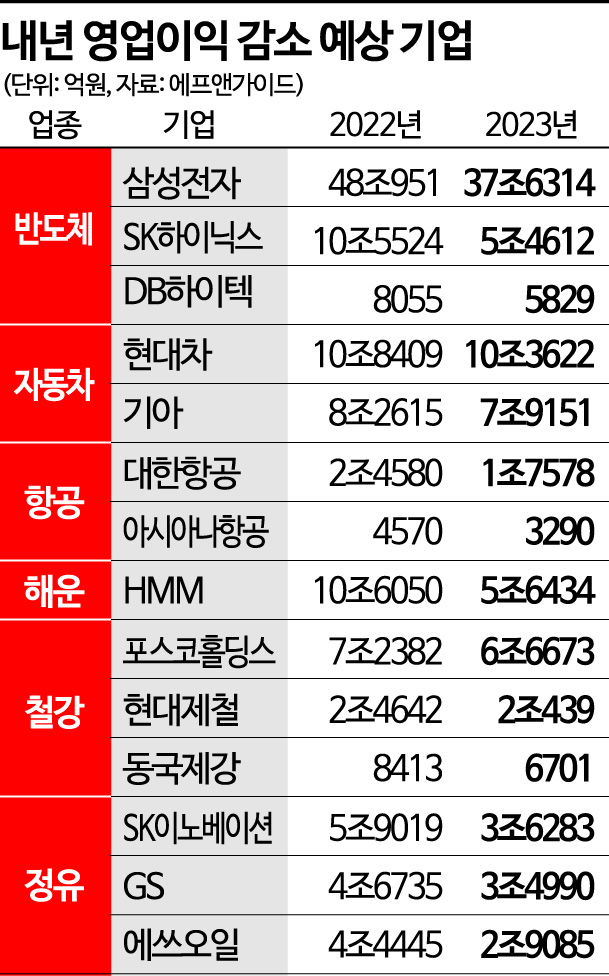
In fact, ahead of the full-scale third-quarter earnings announcement season at the end of this month, securities firms have already begun revising downward their earnings estimates for this year and next. According to financial information provider FnGuide, pessimistic views are emerging that next year's earnings in the electronics/semiconductor, aviation, shipping, and refining industries will be worse than this year, with operating profits potentially halving or even turning to losses. Nam Dae-jong, a researcher at eBest Investment & Securities, indicated that even SK Hynix, which has consecutively broken its record for highest earnings this year, may turn to a loss, forecasting "due to lowered demand expectations and a decline in average selling prices, next year's annual sales will decrease by 33%, and operating profit will turn negative."
Voices from the industrial field also emphasize that the environment forces companies to set conservative management plans for next year. A senior executive at a major corporation said, "The International Monetary Fund (IMF) has once again lowered its global economic growth forecast for next year to 2.7%, reflecting the overall poor economic atmosphere, and companies are reflecting this in their management plans." Another executive from a major affiliate explained, "There is a growing perception that next year will be worse than this year, so companies have no choice but to adopt conservative management strategies."
At least it is fortunate if the direction for next year's management plan formulation is clear. However, most companies still find it difficult to even establish plans due to rapidly changing global economic uncertainties. An airline official lamented, "Due to the current 'three highs' (high exchange rate, high interest rate, high inflation) and the complex geopolitical crisis, it is challenging to formulate next year's management plans. Especially, the high exchange rate poses a risk to corporate financial soundness, and it is unclear when this situation will end, making planning very difficult."
Companies view the overlapping risks and the realization of 'stagflation' (rising prices amid economic stagnation) and extreme economic contraction as the most serious risks. There is even pessimism that if next year's crisis situation leads from 'high exchange rate → widening trade deficit → stock price decline → investment sentiment contraction → liquidity squeeze → reduced investment and employment,' it could shake not only industrial restructuring but also the economic structure itself.
An automotive industry official involved in preparing next year's plans expressed, "This crisis is very serious in that even if predictions are made, the likelihood of realization is significantly lower than in previous years," adding, "Issues spanning politics and economics are linked, increasing the possibility of a chain reaction crisis, making this situation more severe than past foreign exchange or financial crises."
© The Asia Business Daily(www.asiae.co.kr). All rights reserved.

















