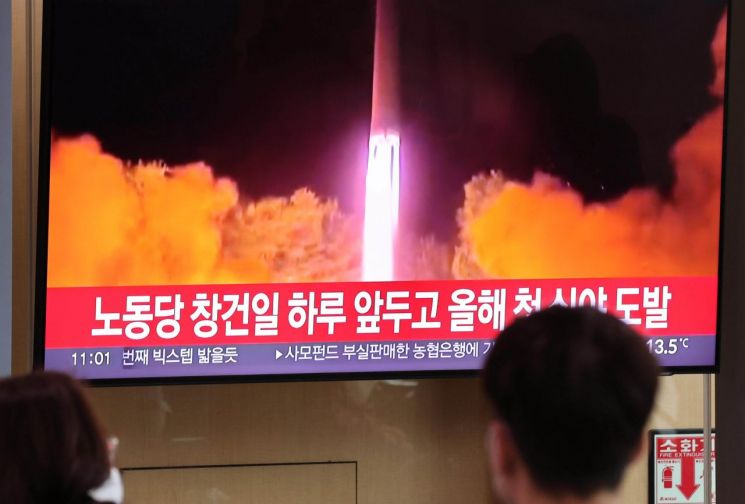
[Asia Economy Yang Nak-gyu, Military Specialist Reporter] North Korea launched ballistic missiles into the East Sea immediately after threatening flights with about 10 military aircraft south of the Tactical Control Line.
According to the Joint Chiefs of Staff on the 14th, North Korea conducted threatening flights with about 10 military aircraft south of the Tactical Control Line from around 10:30 PM the previous day until about 12:20 AM on the day.
North Korean military aircraft approached up to 5 km north of the no-fly zone set under the September 19 Military Agreement in the western inland area south of the Tactical Control Line (25 km north of the Military Demarcation Line), up to 7 km north of the no-fly zone in the eastern inland area (47 km north of the MDL), and up to 12 km north of the Northern Limit Line (NLL) in the West Sea area, before heading north. Our military responded with F-35A and other aircraft.
Afterwards, North Korea launched ballistic missiles into the East Sea. Currently, military authorities are analyzing specifications such as range, altitude, and speed. This appears to be a resumption of provocations following the launch of a long-range strategic cruise missile into the West Sea near Kaechon, South Pyongan Province, on the 12th.
North Korea has stated that the missile launches conducted since the 25th of last month were part of "tactical nuclear operational unit training." The tactical nuclear operational unit training included six launches of submarine-launched ballistic missiles (SLBMs) and short-range ballistic missiles (SRBMs) during this period.
North Korea began provocations by launching an SLBM from a reservoir near Taechon, North Pyongan Province, on the 25th of last month. This unusual reservoir launch caught the South Korea-US surveillance network off guard. Subsequently, short-range ballistic missiles (SRBMs) were launched into the East Sea from various locations: Sunan area in Pyongyang on the 28th, Sunchon area in South Pyongan Province on the 29th, Sunan area in Pyongyang on the 1st of this month, Samseok area in Pyongyang on the 6th, and Muncheon area in Gangwon Province on the 9th.
On the 4th, North Korea launched an intermediate-range ballistic missile (IRBM), presumed to be an improved Hwasong-12 type, at maximum range, recording a flight distance of 4,500 km. North Korea claimed that through the seven rounds of launch training by tactical nuclear operational units, they demonstrated the capability to strike and annihilate intended targets at intended times and places, revealing their intention to attack "anytime, anywhere."
Recent provocations were retaliatory demonstrations against the arrival of the US nuclear-powered aircraft carrier Ronald Reagan (CVN-76, 103,000 tons) in Busan on the 23rd of last month, the South Korea-US joint naval exercises from the 26th to the 29th, the South Korea-US-Japan anti-submarine warfare exercise on the 30th, the aircraft carrier's return on the 5th of this month, and the South Korea-US-Japan missile defense exercise on the 6th. North Korea has launched ballistic missiles 24 times and cruise missiles 3 times this year. Since the inauguration of the Yoon Suk-yeol administration, this is the 13th missile launch.
© The Asia Business Daily(www.asiae.co.kr). All rights reserved.

















