10-Year Return to 3% Base Interest Rate Era
2030 Generation "Worried About Falling House Prices and Loan Interest"
Bank of Korea "Further Real Estate Decline Possible if Rates Keep Rising"
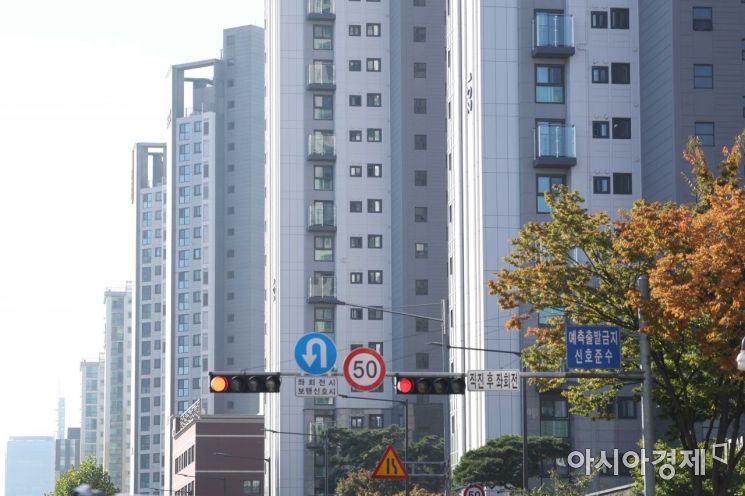 The Bank of Korea raised the base interest rate by 0.5 percentage points, and the real estate transaction market's ice age is expected to prolong. On the 13th, a red light was on at a traffic signal near an apartment in downtown Seoul.
[Asia Economy Reporter Jang Sehee]"I check Naver Real Estate every day, but selling my house seems impossible. Gangnam is just a dream in this lifetime." Minha Kim (35), who bought a 24-pyeong apartment in Mia-dong, Gangbuk-gu, Seoul two years ago by borrowing to the max (Yeongkkeul), said she is distressed by the rising interest rates.
The Bank of Korea took a big step the day before by raising the base interest rate by 0.5 percentage points. It is the first time in 10 years since October 2012 that the base rate has reached the 3% range. The cries of the 2030 Yeongkkeul generation who bought homes during the COVID-19 period are erupting everywhere as interest rates surge. They are already seeing the first digit of their transaction prices change and are worried about further declines. Eunmi Na (36), living in Seongbuk-gu, Seoul, said, "The house I bought for 750 million won rose to just over 900 million won but recently has been trading at 810 million won. If the first digit changes again, it means the price is lower than when I bought it, so I’m worried about losses."
Those in their 20s and 30s who bought homes in the Gyeonggi area also express concerns about moving to Seoul. Mo Jeong (35), who purchased a house in Jukjeon-dong, Suji-gu, Yongin-si, Gyeonggi-do, said, "I settled in Jukjeon for now, but I always wanted to move to Seoul for my children’s education. I’m worried because the decline in Gyeonggi seems even steeper than in Seoul."
Variable Interest Rates Rising Further Cause Anxiety... Sales Atmosphere Also Dampened
People who bought homes with variable interest rates are especially hit hard. Seokwon Jang (37) said, "With interest rates rising endlessly, I’m paying about 200,000 won more monthly in interest than originally planned. I’m worried about what will happen if rates rise further depending on the U.S. situation." Yoonju Lee (27), who bought an officetel in Mapo-gu, Seoul, said, "House prices are falling further, but the loan interest I have to repay is increasing. I’m considering whether I should sell because prices might drop even more."
As interest rates continue to rise, the sales atmosphere has also cooled. According to the Korea Real Estate Board on the 10th, from January to August, the number of apartment purchases by the 2030 generation in Seoul totaled 4,150. This accounts for 35.0% of the total 11,966 transactions during the same period. Mo Lee (48), who has operated real estate in Daechi-dong, Gangnam-gu, Seoul for 10 years, said, "Recently, the demand for jeonse (long-term lease) has doubled compared to last year. More than 20 people are on the waiting list for jeonse." He added, "Jeonse priced around 900 million won disappears as soon as it comes out."
Meanwhile, the Bank of Korea also forecasted further declines, increasing the burden on the Yeongkkeul generation. Lee Chang-yong, Governor of the Bank of Korea, said the day before, "Based on actual transaction prices from January to August this year, prices have fallen about 3-4%. Since interest rates are rising like this, there is a possibility of further declines."
© The Asia Business Daily(www.asiae.co.kr). All rights reserved.

















