Ahead of Korean launch, tried in advance... Noise canceling performance ↑
Apple focuses on upgrading semiconductor for earphones
With semiconductor improvement, evolving from audio devices to mobile devices
[Asia Economy Reporter Baek Jong-min] Apple released the AirPods Pro 2 last month. The moment you put them in your ears, your ears become transparent. The noise of the subway on the way to work, the loud sounds of heavy machinery?all are erased from your mind. What remains in your ears is either silence as blank as a white sheet or the sound of music and audiobooks. Could this be Simon & Garfunkel’s hit 'Sounds of Silence'? Switching to phone calls while listening to music, invoking the AI assistant Siri?all feel natural.
After using Apple’s wireless earphones, the AirPods Pro 2, for a week, what stood out was the advancement in semiconductor technology. Even after just a week, or rather a few hours, it was clear why users worldwide are enthusiastic about these small earphones. What is the secret behind transforming simple earphones into advanced smart devices? The answer is clear: semiconductors. Apple’s proprietary semiconductors, extending from smartphones, watches, and computers to earphones, build a domain difficult for competitors to follow through their unique closed operating system and software-hardware integration. The development of Apple semiconductors also has ripple effects on the existing semiconductor industry. Through earphones, we take a closer look at Apple semiconductors, or 'Apple Silicon.'
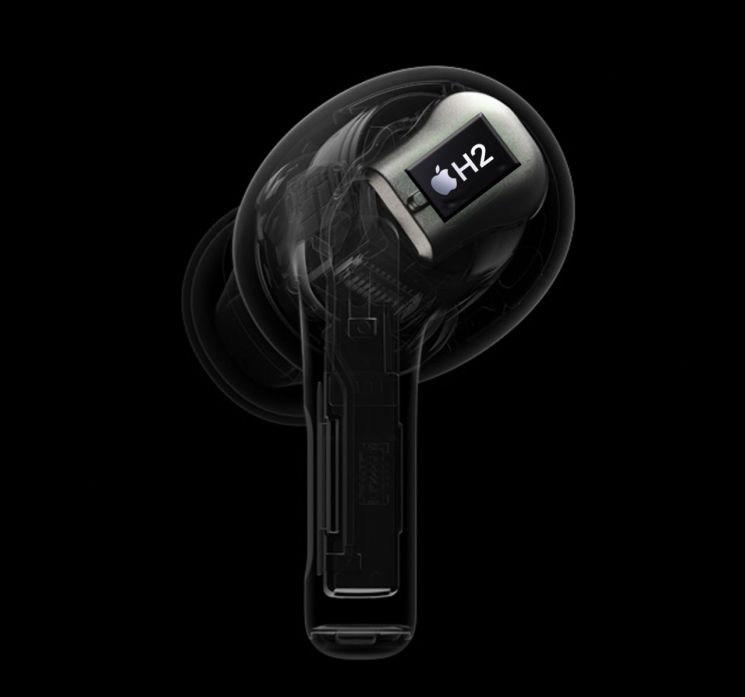
The AirPods Pro 2 houses a System on Chip (SoC) semiconductor called 'H2.' Apple emphasizes this point. While drivers are naturally the core of earphones and speakers, Apple’s perspective differs. Typically, earphones promote sound quality as their primary feature. Apple’s refusal to do so reflects confidence that earphones including semiconductors can outperform others based solely on sound quality.
It is difficult to know detailed performance or specifications of Apple-made semiconductors. The A16 chip used in the iPhone 14 Pro and the H2 chip in the AirPods Pro 2 are the latest products, and Apple’s secrecy makes detailed information hard to obtain. However, by looking at the H1 chip introduced three years ago, we can estimate how much the H2’s performance has improved. It is known that the H2 contains over 1 billion transistors, twice as many as the H1. The H1 chip is said to have performance comparable to the application processor (AP) of the iPhone 4. Although it is an old model from ten years ago, the chip that was the heart of the iPhone has now entered earphones. Given the three years that have passed, the H2 chip is expected to have made remarkable progress.
The H-series chips are based on designs from the UK company ARM and developed by Apple. They are designed exclusively for earphones and headphones. It is only assumed that the H chips handle Bluetooth wireless connections, DSP (Digital Signal Processing) for audio decoding, and management of various sensors. Apple explains that while the H1 chip performed 200 calculations per second, the H2 chip can perform 48,000 calculations per second. With increased processing power, more precise noise control became possible. Apple claims that the active noise cancelling (ANC) performance of the AirPods Pro 2 has doubled. Although this cannot be verified by ear, the new AirPods filter out more ambient noise compared to the previous AirPods Pro using the H1 chip.
Apple rejects the prejudice that earphones damage hearing. Instead, they advise wearing the AirPods Pro 2 to concerts. The explanation is that loud sounds that could damage hearing are filtered out, allowing users to enjoy the music at the venue as it is. Sounds transmitted through the air are processed via microphones and the H2 chip. The improvement in semiconductor performance also brought another advantage. Apple introduced a new noise cancelling feature through the H2: adaptive ambient sound allowance. The H2 chip removes particularly loud noises such as sirens and power tools. While reducing noise, it also offers the option to amplify conversation sounds.
Usage time and call time have also increased significantly. This is attributed to the more miniaturized H2 chip manufacturing process. The smaller the semiconductor’s process node, the smaller its size and power consumption. Advances in semiconductor process technology alone allow chips of the same performance to be produced in smaller sizes. This is why mobile devices prefer fine process semiconductors. It is known that Apple-designed semiconductors are manufactured by Taiwan’s TSMC.
The AirPods Pro are not the best in every aspect. For the highest sound quality, consumers should choose products other than Apple’s. Companies like Sony and Bose, which developed earphones and headphones with ANC features before Apple, are often rated by many users as having superior sound quality. Nevertheless, Apple focuses on future-oriented earphones by developing new semiconductors rather than obsessing solely over sound quality.
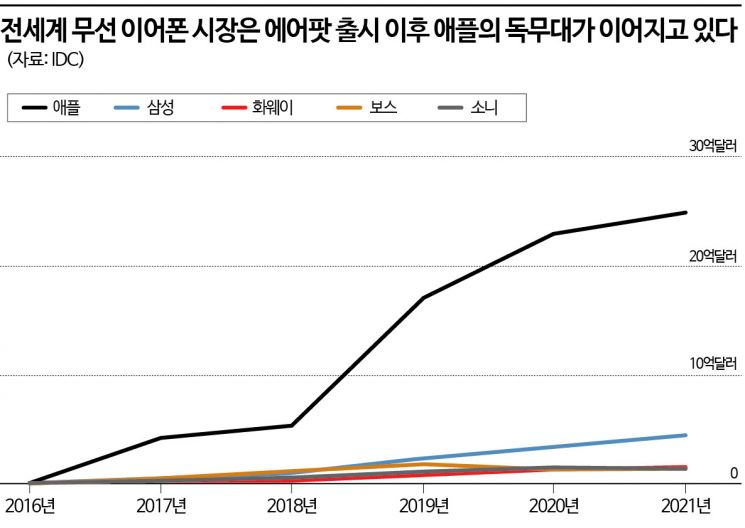
Could other companies also make earphones using excellent semiconductors? This is where the gap with Apple arises. Apple uses its self-produced semiconductors exclusively in its own products. Even when developing and applying new semiconductors, the massive sales volume reduces the burden. Competitors find it difficult to produce dedicated semiconductors for earphones. They barely even attempt it. Even if they try to buy other chips, it is hard to find semiconductors that perfectly fit their needs. They have to use general-purpose products. Even after acquiring semiconductors, efforts to integrate them with software are required. This gap differentiates Apple AirPods from other earphones.
There are competing products to the H chip. Qualcomm, MediaTek, Broadcom, and BES also make similar chips. These are chips used in earphones for Android smartphones competing with Apple. Samsung’s Galaxy Buds, which compete with AirPods Pro, used chips from Chinese companies Broadcom and BES.
Android phone review media Android Authority evaluated Qualcomm chips as boasting the latest performance. Qualcomm acquired the UK company CSR and has invested in audio chips for mobile devices. This means the Android camp also has alternative SoCs. Android Authority diagnosed that smartphone manufacturers in the Android camp lack the willingness to actively utilize semiconductors in earphones as much as Apple does.
Many consumers, especially Apple users, purchase expensive AirPods without hesitation. The AirPods Pro 2 costs 359,000 won. That is enough money to buy a low-priced smartphone. Yet consumers eagerly await the release of the AirPods Pro 2. This is the power of semiconductors.
© The Asia Business Daily(www.asiae.co.kr). All rights reserved.