The Most Toxic... Over 1 Million Deaths During the 1968 Global Pandemic
Medical Field Confusion Expected as Seasonal Flu and Respiratory Infections Coexist Following COVID-19
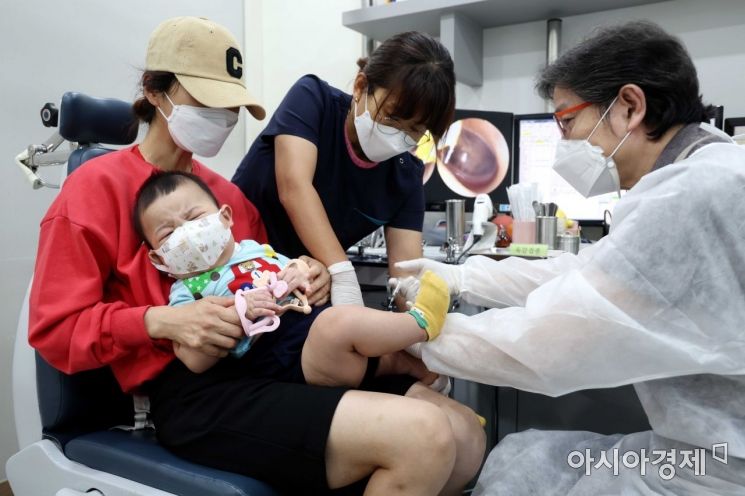 Amid the issuance of an "Influenza Epidemic Advisory," on the first day of free influenza vaccinations for children, pregnant women, and the elderly on the 21st, a child is receiving a vaccination at a pediatric clinic in Seoul. Photo by Moon Honam munonam@
[Asia Economy Reporter Byeon Seon-jin] While the COVID-19 pandemic continues to decline, an influenza (flu) advisory has been issued. In particular, the dominant strain expected to lead this winter's flu outbreak is the 'A-type H3N2,' known as the most potent among flu viruses, raising alarms among parents of infants and young children.
According to the Korea Disease Control and Prevention Agency's influenza sentinel surveillance statistics on the 13th, in the 37th week of this year (September 4?10), the number of influenza-like illness (ILI) patients was 5.1 per 1,000 outpatients, surpassing the 2021?2022 influenza epidemic threshold of 4.9. This is the first time in about two and a half years since the 9th week of 2020 (February 23?29), when the ILI rate reached 6.3, exceeding the influenza epidemic threshold. The most recent statistics (September 25?October 1) show this figure rising to 7.1.
The medical community identifies the A-type H3N2 virus as this year's dominant flu strain. A Ministry of Health and Welfare official stated, "H3N2 led the flu outbreak in Southern Hemisphere countries that have already passed through the winter season," adding, "Since most of the influenza detected domestically this year was H3N2, it is highly likely to become the dominant strain." The official also noted, "Especially, A-type H3N2 can have a significant impact on high-risk groups such as the elderly and infants," but added, "A-type H3N2 is a subtype that typically circulates during flu seasons and does not differ significantly in characteristics from other influenza viruses."
Flu viruses are broadly classified into four types: A-type H1N1 and H3N2, and B-type Yamagata and Victoria. A-type H3N2 originated in Hong Kong in 1968 and infected over 100 million people worldwide by 1969, causing more than one million deaths. At that time, patients experienced respiratory symptoms along with chills, fever, and muscle pain lasting up to two weeks.
Professor Lee Kyung-soo of Yeungnam University’s Department of Preventive Medicine explained, "The dominant genetic type of respiratory infectious diseases, including the flu, changes every year," emphasizing, "It is important to predict the dominant strain based on confirmed case trends and quickly develop and administer the optimal vaccine." He added, "Since dominant strains of respiratory infectious diseases like COVID-19 and influenza change frequently, there is no single response method. The best preventive measures are to expedite flu vaccination, practice personal hygiene such as handwashing and mask-wearing, and avoid sudden indoor and outdoor temperature changes to prevent immune system decline."
Concerns have also been raised about a 'twindemic,' where flu outbreaks coincide with a resurgence of COVID-19, causing a rapid increase in patients, or 'flurona,' where individuals are simultaneously infected with both viruses, potentially leading to more severe cases. According to a 2020 study by Public Health England (PHE), the mortality rate of patients co-infected with COVID-19 and other respiratory infections was 2.3 times higher than those infected with COVID-19 alone and six times higher than uninfected individuals.
Additionally, other infectious diseases such as metapneumovirus, respiratory syncytial virus, and rhinovirus are showing signs of spreading. According to the KDCA, 940 patients were hospitalized due to these respiratory infections in the 40th week, about three times more than the 320 patients hospitalized during the same period last year.
There are concerns that because symptoms such as fever and cough are similar among these viruses, accurate diagnosis and timely prescription or treatment may be delayed, causing a 'medical gap.' Professor Eom Jung-sik of Gachon University Gil Medical Center’s Department of Infectious Diseases pointed out, "When multiple respiratory infections circulate simultaneously, diagnosis for each patient takes longer in medical settings, making effective response difficult."
© The Asia Business Daily(www.asiae.co.kr). All rights reserved.

















