Korea's First Refining-Petrochemical Joint Venture 'Hyundai Chemical'
Annual Production of 850,000 Tons Ethylene and 500,000 Tons Propylene Begins
Using Korea's First Refining Process Byproduct 'Desulfurized Heavy Oil' as Raw Material
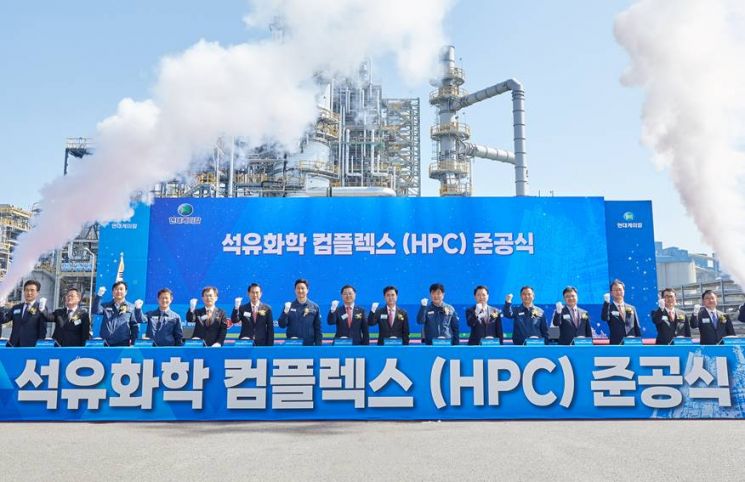 Hyundai Chemical, a petrochemical affiliate of Hyundai Oilbank, held a completion ceremony for the HPC plant on the 12th at the Daesan Plant in Seosan, Chungnam. The event was attended by Kwon Oh-gap, Chairman of HD Hyundai (tenth from the left), Kang Dal-ho, Vice Chairman of Hyundai Oilbank (twelfth from the left), Jung Ki-sun, President of HD Hyundai (seventh from the left), and Kim Kyo-hyun, Vice Chairman of Lotte Group (fifth from the left). Also present to celebrate the completion ceremony were Kim Tae-heum, Governor of Chungnam Province (ninth from the left), Park Il-jun, Vice Minister of the Ministry of Trade, Industry and Energy (eighth from the left), Sung Il-jong, Member of the National Assembly for Seosan·Taean (eleventh from the left), and Lee Wan-seop, Mayor of Seosan (sixth from the left). Photo by Hyundai Oilbank
[Asia Economy Reporter Choi Seoyoon] Hyundai Oilbank has completed the HPC (Heavy feed Petrochemical Complex), a heavy oil-based petrochemical facility, and is set to actively enter the eco-friendly chemical materials business.
Hyundai Chemical, a petrochemical affiliate of Hyundai Oilbank, held a completion ceremony for the HPC plant on the 12th at the Daesan plant in Seosan, Chungnam Province, attended by Kwon Oh-gap, Chairman of HD Hyundai, Kang Dal-ho, Vice Chairman of Hyundai Oilbank, Jung Ki-sun, President of HD Hyundai, and Kim Kyo-hyun, Vice Chairman of Lotte Group. The ceremony was also attended by Kim Tae-heum, Governor of Chungnam Province, Park Il-joon, Vice Minister of the Ministry of Trade, Industry and Energy, Sung Il-jong, National Assembly member for Seosan-Taean, and Lee Wan-seop, Mayor of Seosan, who congratulated the completion.
The HPC project is a mega petrochemical new business in which Hyundai Chemical, a joint venture between Hyundai Oilbank and Lotte Chemical, has invested over 3 trillion won. The plant, built on a 660,000㎡ site within the Daesan plant, can produce 850,000 tons of ethylene and 500,000 tons of propylene annually.
At the completion ceremony, Kwon Oh-gap, Chairman of HD Hyundai, said, “Hyundai Chemical, launched in 2014 as the first joint venture between a refinery and a petrochemical company in Korea, has been recognized as an exemplary case in the industry by generating mutual synergy based on the raw materials and sales networks of both companies. With the completion of the HPC plant, Hyundai Chemical will leap forward as a comprehensive petrochemical company actively pursuing future businesses such as eco-friendly chemical materials.”
Kim Kyo-hyun, Vice Chairman of Lotte Chemical, said, “The HPC project is a large-scale petrochemical investment that maximizes synergy based on the strong trust between Hyundai Oilbank and Lotte Chemical. I am confident that it will become a model case that enhances business competitiveness through strategic alliances between different industries and contributes significantly to the national economy.”
Through the HPC project, Hyundai Oilbank has further diversified its petrochemical business portfolio. The petrochemical industry is broadly divided into olefin and aromatic sectors. Until now, it produced only aromatic products such as paraxylene through its affiliates Hyundai Chemical and Hyundai Cosmo, but with the operation of HPC, it has entered the olefin sector as well. In particular, by subdividing the production lines, it can produce various products such as high-density polyethylene (HDPE), low-density polyethylene (LDPE), polypropylene (PP), ethylene vinyl acetate (EVA), and butadiene.
The biggest advantage of HPC is cost competitiveness through vertical integration of refining and petrochemicals. HPC can selectively use desulfurized heavy oil, by-product gases, LPG, and other refining process by-products, which are cheaper than naphtha, the main raw material in existing petrochemical processes, depending on market conditions. HPC is the only petrochemical process in Korea that can use desulfurized heavy oil as a raw material.
Hyundai Oilbank is determined to lay the foundation for future eco-friendly chemical materials business through the HPC project. The production capacity of EVA, a material for solar panels whose demand is rapidly increasing, is 300,000 tons, the largest scale in Korea for a single production line. Hyundai Oilbank plans to further expand its petrochemical downstream business focusing on eco-friendly chemical materials such as basic materials, energy materials, secondary battery materials, and bio materials.
With the completion of the HPC plant, Hyundai Oilbank expects an increase in petrochemical product exports of about 1.15 million tons annually, worth approximately 3.8 trillion won. During the plant construction period, it employed 3.2 million construction workers annually, and with the plant operation, it expects to create about 1,500 direct and indirect jobs in the future.
© The Asia Business Daily(www.asiae.co.kr). All rights reserved.
!["I'd Rather Live as a Glamorous Fake Than as a Poor Real Me"...A Grotesque Success Story Shaking the Korean Psyche [Slate]](https://cwcontent.asiae.co.kr/asiaresize/183/2026021902243444107_1771435474.jpg)
















