National Public Research Union Announces Survey Results on the 12th
High Criticism of Ministry of Economy and Finance's Public Institution Restructuring Guidelines
[Asia Economy Reporter Kim Bong-su] Recently, there has been serious opposition from the science and technology community, including government-funded research institutes, against the public institution restructuring being promoted by the Yoon Seok-yeol administration.
The National Public Research Union announced on the afternoon of the 12th that it conducted an anonymous online survey targeting 433 researchers from about 20 research institutions, including government-funded research institutes and specialized universities such as KAIST, regarding the new government's public institution guidelines. Earlier, in July, the Ministry of Economy and Finance instructed public research institutions under the National Science and Technology Council (NST) to implement guidelines centered on organizational downsizing, personnel reduction, cuts in operating expenses, and welfare reductions, and to report on the implementation status by next month.
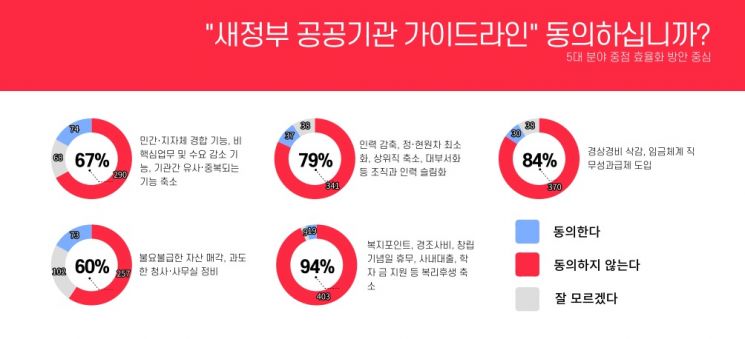
Respondents expressed strong dissatisfaction. Among the demands, 94% opposed reductions in welfare benefits such as welfare points, congratulatory and condolence expenses, and tuition support, showing the strongest resistance. Additionally, 84% opposed cuts in operating expenses and the introduction of a job performance-based wage system, while 79% opposed personnel reductions, minimizing the difference between authorized and actual staff, downsizing upper management, and departmental consolidation. Regarding instructions to reduce overlapping functions with private and local governments, non-core tasks, and functions with decreased demand, 67% opposed, and 60% opposed the sale of unnecessary assets and excessive office renovations.
There was also significant dissatisfaction with the effectiveness of the research and development purpose institution system implemented since 2019. This system was introduced to improve the research environment by guaranteeing independence and autonomy for public research institutions such as government-funded research institutes, unlike general public enterprises that focus on performance. However, when asked whether the research environment had improved compared to before, 68.5% of researchers responded that it had not improved at all, and 16.9% said it had mostly not improved, resulting in 85.4% negative evaluations. When asked how the current Public Institution Operation Act should be changed, most (78.4%) believed that separate laws and systems should be established for public research institutions. Regarding the improvement direction of national R&D budget support policies, 43.1% said the project-based performance budget system (PBS) should be abolished and replaced with a full budget support system for research institutions, while 43.8% favored improving the PBS system and fully supporting only personnel expenses per institution.
Regarding the retirement age, which was reduced from 65 to 61 after the 2008 International Monetary Fund (IMF) crisis, 53.1% said it should be immediately restored, and 42.0% said it should be gradually expanded. Opinions were divided on the wage peak system, with 52.6% supporting complete abolition and 44.9% supporting its retention with expanded compensation measures.
Dissatisfaction with the treatment of the science and technology sector was also high. 81.5% agreed that the treatment of public research institutions is poor and that significant improvements are needed to boost morale and secure excellent personnel, while 15.7% demanded partial improvements. Only 2.1% supported maintaining the current status. Regarding the treatment of indefinite-term contract workers in the science and technology sector, 36.6% supported significant improvements and 43.2% supported reasonable improvements, showing overall approval.
Regarding the National Science and Technology Council (NST), which oversees government-funded research institutes, many expressed the need to strengthen its autonomy and independence.
© The Asia Business Daily(www.asiae.co.kr). All rights reserved.

















