Various 'Kids Zones' Appear, Including 'Care Kids Zone' and 'Yes Kids Zone'
Controversy Arises Over Age and Generation Segmentation
Experts Say "Awareness and Space Changes Must Be Led Through Educational and Institutional Reforms"
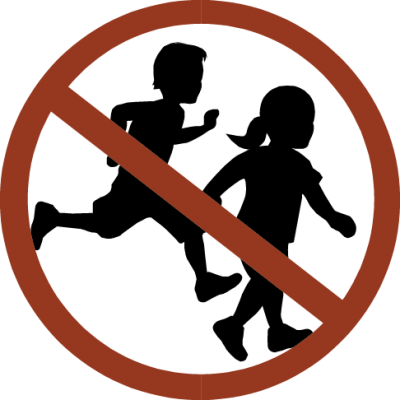 As various 'Kids Zones' are emerging, there are calls for alternatives.
 Source=cliparts.zone
[Asia Economy Reporter Kim Jung-wan] #. Kang (30), who recently visited Korea after living in Canada, experienced difficulties while looking for a restaurant to go with his parents. He planned to visit a restaurant with his 5-month-old baby, but was repeatedly turned away because every place he looked at was a 'No Kids Zone.' He said, "There was no running around, and when I asked if I could reserve a room if noise was the issue, I only received apologies in return," adding, "I had heard that No Kids Zones are quite common in Korea, but I didn't realize it was this widespread."
As the number of establishments that do not accept young customers, known as No Kids Zones, increases, opinions are emerging that alternatives are needed. Various types of kids zones have appeared, such as 'Care Kids Zone,' which requires active care for children, and 'Yes Kids Zone,' which actively welcomes young customers, but there are also criticisms that these are not fundamental solutions.
The number of businesses introducing No Kids Zones in Korea is on the rise, and public opinion appears to be favorable. According to a survey conducted last year by Korea Research on 1,000 adult men and women nationwide, 71% responded that they could accept No Kids Zones, while only 17% said they could not. Kim (38), who has been running a cafe in Mapo-gu, Seoul for five years, said, "There have been problems when children fall and get hurt and the responsibility is questioned, but more often, conflicts between customers have caused difficulties," adding, "Originally, it was not a No Kids Zone, but due to many problems, we changed it."
In light of this trend, there are calls for alternatives to No Kids Zone establishments. In 2017, the National Human Rights Commission of Korea judged that No Kids Zones constitute clear discrimination against children unless the child's physical or mental health is harmed or special abilities or caution are required to use the facility, and recommended their withdrawal. Seo (34), a mother of two, said, "I understand the intention that children can be disruptive to other customers, but completely excluding them is not the answer," pointing out, "In most controversial cases, the problem was not the children but the parents." She added, "Instead of banning children, parents who do not take responsibility for their children should be held accountable."
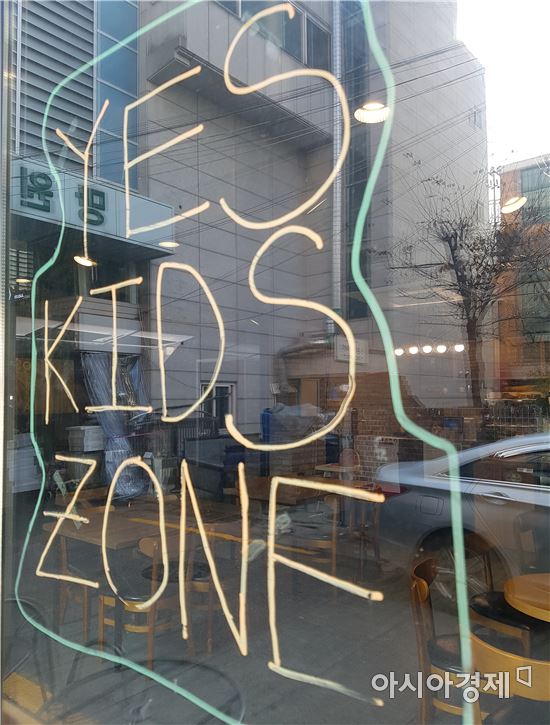 A store labeled as 'Yes Kids Zone'.
In fact, various kids zones have emerged as alternatives to No Kids Zones. Some establishments have introduced Care Kids Zones, which allow children to enter but require active supervision by guardians, while others have opened Yes Kids Zones that actively welcome infants and young children.
Although various alternatives have appeared, there are criticisms that distinguishing kids zones is not a fundamental solution. Various 'No Zones' excluding specific age groups or generations have emerged from No Kids Zones, sparking controversy over discrimination. Recently, a camping site announced a 'No Middle-Aged Zone' claiming that people over their 40s cause inconvenience to other users due to excessive drinking and loud noise, causing controversy. A cafe in Busan applied a 'No Youth Zone' because middle and high school students were smoking around the cafe. A pub near a university in Busan posted a 'No Professors Zone' notice, claiming some professors were abusing power, but removed it after receiving complaints.
Experts say that instead of pursuing short-term solutions, long-term goals should focus on changes in awareness and the composition of spaces through education and institutional reforms. Kim Ji-hak, director of the Korea Diversity Research Institute, emphasized, "The fundamental solution is to create a society for everyone." He added, "It is important to have architectural spaces and cultures where children, people with disabilities, the elderly, and everyone can be safely and equally included anywhere," stating, "Whether in restaurants, schools, public transportation, or restrooms, they should be able to be present."
Kim explained, "To create an inclusive society and space, education and institutional measures must be addressed simultaneously," adding, "Because awareness change is necessary, education is needed, and to change society as a whole through spatial components, laws and systems must be discussed." He also said, "Since both must proceed simultaneously, it may be somewhat difficult to see major changes in the short term, but with long-term goals, fundamental changes in conflicts caused by No Kids Zones are possible."
© The Asia Business Daily(www.asiae.co.kr). All rights reserved.
















