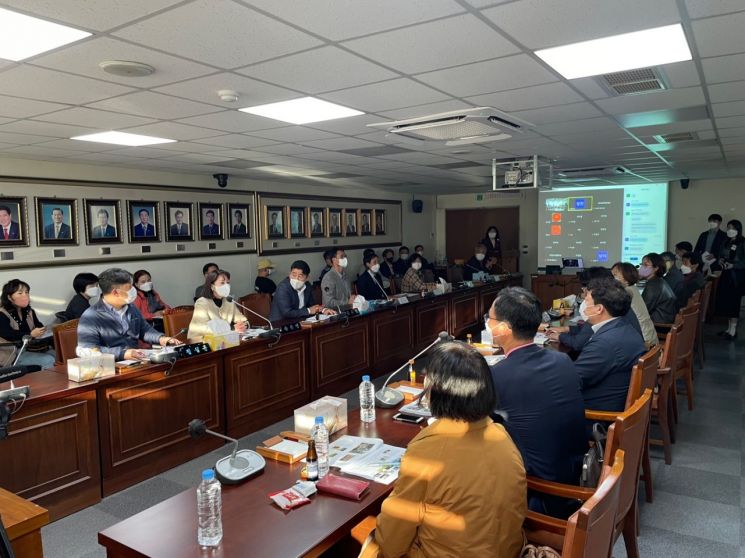
 The "Yangsan Tail-striped Salamander International Symposium" is currently underway. / Photo by Hwang Du-yeol bsb03296@
[Asia Economy Yeongnam Reporting Headquarters, Reporter Hwang Du-yeol] A newly discovered species of salamander, the only one in the world named after Yangsan where it was found, is facing extinction due to inadequate protection.
The scientific name of the salamander is ‘Yangsan Tail-striped Salamander.’ To protect this salamander, Yangsan City Council member Choi Bok-chun held the ‘Yangsan Tail-striped Salamander International Symposium’ on the 11th at the special committee room on the 3rd floor of the city council building.
Councilor Choi hosted and moderated the event, which was organized by the Gimhae Yangsan Environmental Movement Federation and the Sasong Goridorongyong Habitat Preservation Citizens’ Countermeasure Committee.
The international symposium included a live video conference participation by Professor Amael Volche from Nanjing Forestry University in China, along with many stakeholders and citizens such as Professor Hong Seok-hwan from Pusan National University, activist Sa Gong Hye-seon from the Gimhae Yangsan Environmental Movement Federation, Kang Ho-yeol, head of the Citizens’ Countermeasure Committee, Lim Hee-ja, director of the Gyeongnam Citizens’ Environmental Research Institute, and activist Kim Hap-su from the Gyeongnam Amphibian Network.
During the symposium, specific measures to protect the salamanders were discussed, including the current situation of the Sasong salamanders and how to respond to protect them.
According to local environmental groups, 31 temporary spawning sites have been created in Sasong in cooperation with the Korea Land and Housing Corporation (LH), but these temporary spawning sites are unsuitable due to drying water, a 1-meter drop shaft, wire mesh tying stones on the bottom, and steep slopes.
Activist Sa Gong Hye-seon, who gave a keynote presentation, said, “There are no temporary spawning sites properly created for the salamanders’ environment,” adding, “LH and Yangsan City are passing responsibility to each other and are not establishing proper habitats within the green areas.”
Sa Gong Hye-seon added, “What we want to create in the Sasong area is not harmful to people, nor are we trying to obstruct construction,” and “It is neither difficult nor impossible, so it would be good to find a way to coexist.”
Two species of salamanders live in the Sasong area: the Goridorongyong and the Yangsan Tail-striped Salamander. The Goridorongyong is a second-class endangered species and is classified as Endangered (EN) on the International Union for Conservation of Nature (IUCN) Red List.
The Yangsan Tail-striped Salamander was first discovered in 2014 by a research team from Seoul National University College of Veterinary Medicine and was identified as a distinct species separate from the Korean Tail-striped Salamander.
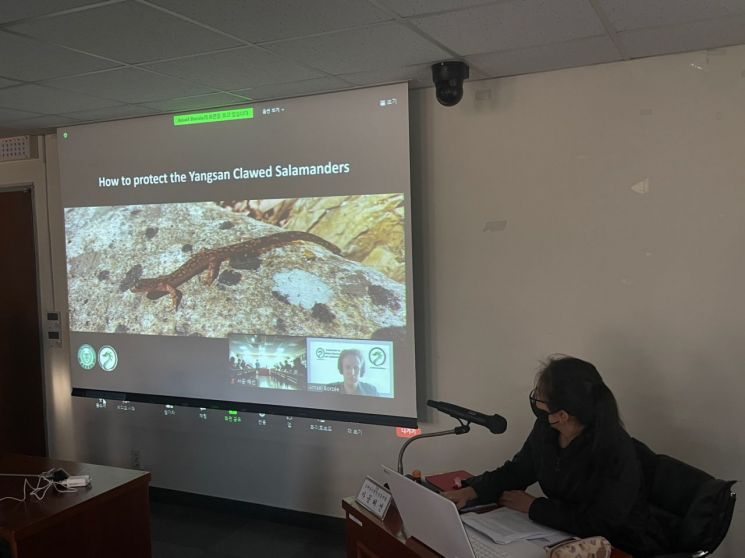 Professor Amael Volche from Nanjing Forestry University in China is giving a lecture on salamanders in the Sasong area via online video conference. / Photo by Hwang Du-yeol bsb03296@
Professor Amael Volche from Nanjing Forestry University in China said, “The Yangsan Tail-striped Salamander has not been reviewed yet because it has not been registered for a long time, but it is expected to be classified as Critically Endangered (CR) on the IUCN Red List.”
Professor Amael Volche added, “If an alternative habitat for the Yangsan Tail-striped Salamander is not established soon, the risk of extinction could begin as early as this fall,” and “If the city does not take direct action to establish appropriate protection measures, this species will disappear before people even know about it.”
City Council member Choi Bok-chun, who hosted the symposium, said, “The discovery of a new species of salamander in Yangsan is a good sign that the local ecosystem is still alive,” and “I hope this symposium will serve as an opportunity for both the public and private sectors to unite and reflect on the local ecological environment, rather than being an environmental struggle symbolized by the ‘Cheonseongsan Salamander.’”
The Yangsan Tail-striped Salamander breathes through its skin without lungs and requires clean, fast-flowing water and undisturbed habitats. Its larvae take 2 to 3 years to metamorphose, and it takes several years to grow into adults.
The Sasong area was removed from the development restriction zone in 2007, and the Sasong New Town is being developed on a 2.76 million square meter site in Dongmyeon Naesong, Oesong, and Sasong-ri areas.
© The Asia Business Daily(www.asiae.co.kr). All rights reserved.


















