Japan Allows Visa-Free Travel for Koreans After 2 Years 7 Months
Hanatour's September Japan Travel Bookings Up 625% Compared to August
Jeju Air's October Incheon-Narita Booking Rate Hits Mid-90% Range
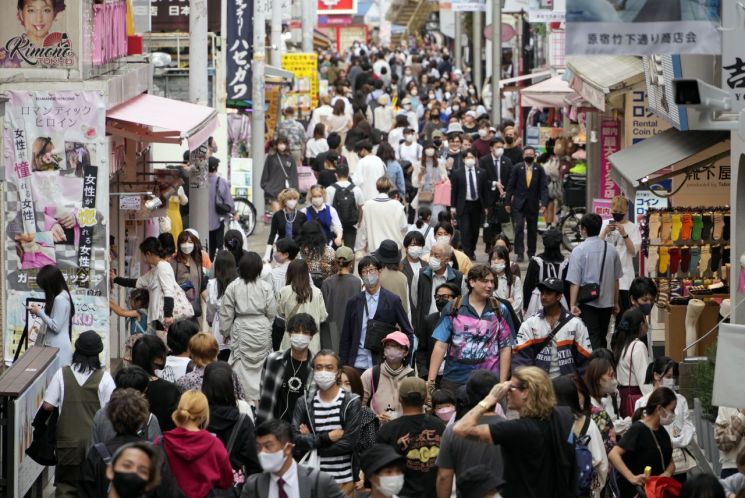 On the 11th, the first day Japan resumed visa-free (visa exemption) tourism, Harajuku, the fashion street in Shibuya Ward, Tokyo, was crowded with people. The Japanese government has reinstated visa-free entry for 68 countries and regions, including South Korea, and has also lifted the daily entry limit, which had been maintained at around 50,000 people. [Image source=Yonhap News]
[Asia Economy Reporter Han Seung-gon] The Japanese government has resumed visa-free (visa exemption) entry to Japan for 68 countries and regions, including South Korea, starting from the 11th. As a result, Koreans can now stay in Japan for up to 90 days without a visa for purposes such as tourism, visiting relatives, study tours, and inspections.
This marks the resumption of visa-free entry for Koreans after about 2 years and 7 months. Consequently, there has been a positive response that the path to travel to Japan has fully opened. However, some critics argue that the 'NoNoJapan' movement, which advocates boycotting Japanese products, may be fading.
Hanatour announced that reservations for trips to Japan last month increased by 625% compared to August, while Modetour saw a 1200% increase. For Modetour, the proportion of Japan travel bookings among total reservations is about 22%, with Tokyo and Osaka air hotel packages being particularly popular. Chamjoeun Travel reported that the number of travelers departing for Japan in October tripled compared to September, reaching 3,664 people.
According to the airline industry, reservations for Japan routes are nearly full. As of the 12th, Jeju Air's reservation rate for the Incheon-Narita route in October is in the mid-90% range. The Incheon-Osaka, Incheon-Fukuoka, and Busan-Narita routes also approach reservation rates in the low 90% range, while Busan-Osaka and Busan-Fukuoka routes are recording reservation rates in the high 80% and low 80% ranges, respectively.
The distribution industry is also conducting various promotions. Gmarket reported that sales of Japan travel products from the 23rd to the 30th of last month increased by 1816% compared to the same period the previous month, offering discount coupons for package and air hotel products. Lotte Duty Free provides discount coupons, and Shilla Duty Free offers exchange rate compensation benefits.
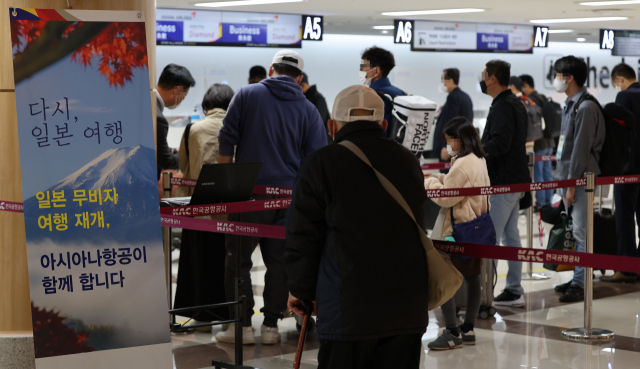 On the morning of the 11th, when visa-free (visa exemption) travel for Koreans to Japan, which had been suspended due to the spread of COVID-19, resumed, passengers were waiting at the Asiana Airlines international counter at Gimpo International Airport to check in for the Gimpo-Haneda flight.
 [Image source=Yonhap News]
Given this situation, various opinions about NoNoJapan have emerged. Kim, a company employee in his 30s who still participates in the boycott of Japanese products, said, "I understand the desire to travel, but I don't know if it has to be Japan," adding, "Honestly, I feel a bit disappointed."
On the other hand, there are differing views. Some believe that the NoNoJapan movement cannot be forced, and that the decision to travel to Japan is a personal freedom. Park, a worker in his 40s, emphasized, "After being unable to travel due to COVID-19, now that we can finally go, mentioning NoNoJapan seems inappropriate."
Amid conflicts surrounding travel to Japan, a survey showed that favorable perceptions of Japan have increased. According to the 'Korea-Japan Mutual Perception Survey' report released in September by the East Asia Institute (EAI), a Korean private think tank, and Genron NPO, a Japanese non-profit think tank, positive perceptions of Japan among Koreans rose from 20.5% last year to 30.6% this year.
This is the highest figure since 2019 (31.7%), which was the record high since the survey began in 2013. The 2020 survey, conducted after the boycott movement started, recorded the lowest at 12.3%. Meanwhile, recent Japanese Asahi Beer advertisements have resumed on domestic Twitter and other social networking services (SNS) and YouTube, and Uniqlo, which suffered significant damage in Korea after the boycott began, has returned to profitability in domestic operations.
Reflecting this change in perception, negative views toward Japan decreased from 48.8% last year to 40.3% this year. This is also the lowest figure except for the first survey year in 2013 (37.3%). Favorability between the two countries was higher among younger age groups. Regarding improving Korea-Japan relations, the percentage of Koreans who answered "There is a need to make efforts to improve Korea-Japan relations" increased annually from 61.2% in 2020 to 71.1% in 2021, and 81.1% this year.
In response to these survey results, the research team explained, "Conflicts between the two countries have continued for 10 years, including the 2012 Korea-Japan GSOMIA controversy, former President Lee Myung-bak's visit to Dokdo, the termination of the Korea-Japan currency swap, and the suspension of talks on the Japanese military comfort women issue," adding, "However, public opinion in both countries showed a clear positive trend this year."
Meanwhile, due to the surge in demand for travel to Japan, flights between Gimpo and Haneda (Tokyo) are expected to double. The Ministry of Land, Infrastructure and Transport announced on the 11th that the number of flights on this route will increase from 28 times per week to 56 times per week starting from the 30th. The Gimpo-Haneda route was suspended in March 2020 due to the spread of COVID-19 and resumed in June this year. Four Korea-Japan airlines can each operate two round trips daily between the two airports. The actual timing of the increased flights will be decided by each airline based on demand. Korean Air, Asiana Airlines, Japan Airlines, and All Nippon Airways operate this route.
© The Asia Business Daily(www.asiae.co.kr). All rights reserved.


















