CEO Score Investigation of Operating and Investment Cash Flows for 341 Companies
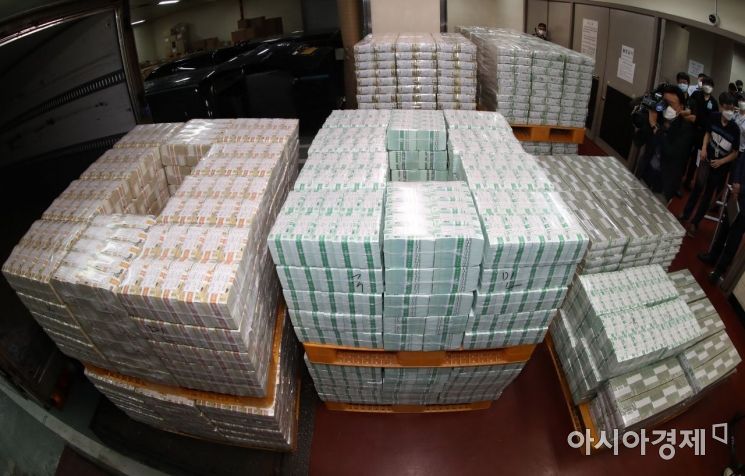
[Asia Economy Reporter Moon Chaeseok] It has been found that the cash flow from operating activities of major domestic companies in the first half of the year contracted by about 20 trillion won. The significant decrease in cash inflows from major public enterprises such as Korea Electric Power Corporation (KEPCO) had a large impact. On the investment side, companies like Samsung and LG increased their spending, resulting in an overall increase in expenditure of about 33 trillion won.
On the 12th, CEO Score, a corporate data research institute, investigated the cash flows of 341 companies out of the top 500 that submitted semi-annual reports and had comparable data over three years. The total cash inflow from operating activities of these companies in the first half was recorded at 86.6498 trillion won, down 20.6068 trillion won from 107.2566 trillion won in the first half of last year.
The sharp decline in cash inflows from public enterprises had a significant effect. While public enterprises had a net inflow of 12.5173 trillion won in the first half of last year, they experienced a net outflow of 4.9446 trillion won in the first half of this year. The decrease amounted to 17.4619 trillion won. In particular, KEPCO, which recorded a net inflow of 5.3732 trillion won in the first half of last year, reversed to a net outflow of 9.7488 trillion won in the first half of this year, marking the worst operating cash flow among the surveyed companies.
Industries such as petrochemicals, banking, construction & building materials, and shipbuilding, machinery & equipment also saw deteriorations in operating cash flow.
Out of 21 industries, 10 showed improvements in operating cash flow. The securities industry (17 companies) saw the largest increase in net inflows, rising from 1.0938 trillion won in the first half of last year to 13.6772 trillion won in the first half of this year. Transportation (4.7056 trillion won → 12.0124 trillion won), automobiles & parts (7.1808 trillion won → 11.3282 trillion won), and energy (1.0102 trillion won → 1.9434 trillion won) also increased.
Among companies, 190 out of the 341 surveyed (55.7%) experienced a decline in operating cash flow, while 151 companies (44.3%) improved.
Meritz Securities posted the best performance, turning from a net outflow of 983.5 billion won in the first half of last year to a net inflow of 6.1242 trillion won in the first half of this year. Korea Securities Finance, Hyundai Motor (Hyundaicha), and Mirae Asset Securities followed with significant increases in cash inflows.
The largest decreases were seen in KEPCO, Korea Standard Chartered Bank, and Hi Investment & Securities, among others. LG Chem shifted from a net inflow of 2.6543 trillion won to a net outflow of 431 billion won.
Despite worsening operating conditions, the surveyed companies increased their investments. Investment expenditures totaled 152.411 trillion won, up 33.3096 trillion won from 119.1014 trillion won in the same period last year. This marks the third consecutive year of increase in the first half since 2020 (97.1341 trillion won). During the same period, net cash inflows from financing activities of major companies reached 77.8973 trillion won, an increase of 51.6407 trillion won from 26.2566 trillion won the previous year. This indicates that companies borrowed more cash. This shows that despite a sharp decline in operating profits, large domestic companies increased borrowings to boost investments in the first half.
Investments were led by large corporations such as Samsung and LG. Samsung Electronics invested 19.9293 trillion won in the first half of this year, 14.1823 trillion won more than the 5.747 trillion won spent in the first half of last year. LG Chem also increased its investment by over 9 trillion won, from 1.3982 trillion won last year to 10.6021 trillion won this year.
In contrast, Naver's investment expenditure dropped significantly from 13.0304 trillion won in the first half of last year to 567.4 billion won this year. Although the merger of its subsidiary Line with Japan's SoftBank is reflected, the decrease in investment was substantial. Kia (down 3.8866 trillion won), Korea Standard Chartered Bank (down 3.3816 trillion won), Hyundai Motor (down 2.3852 trillion won), and SK Chemicals (down 1.5583 trillion won) also reduced their investment expenditures.
Eight companies, including Korea Securities Finance and Kyobo Securities, improved both operating and investing cash flows.
© The Asia Business Daily(www.asiae.co.kr). All rights reserved.
![Clutching a Stolen Dior Bag, Saying "I Hate Being Poor but Real"... The Grotesque Con of a "Human Knockoff" [Slate]](https://cwcontent.asiae.co.kr/asiaresize/183/2026021902243444107_1771435474.jpg)
















