KOSDAQ Market Share at 9.2%
Undervalued Stocks Require Caution Compared to the Past
[Asia Economy Reporter Myunghwan Lee] It has been revealed that 37% of KOSPI-listed companies are undervalued. Securities firms advised that the price-to-book ratio (PBR) can be used as a basis to explore the bottom price of stocks.
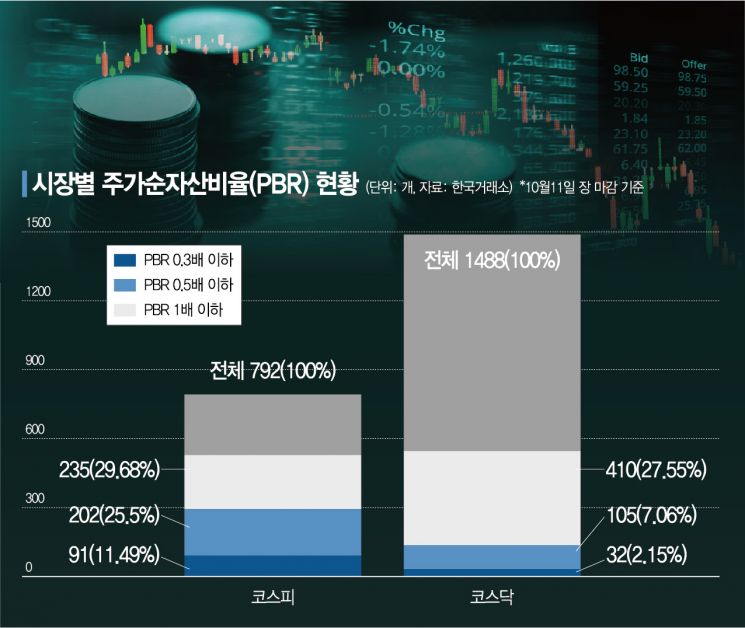
According to the Korea Exchange on the 12th, as of the market close on the 11th, 293 stocks listed on the KOSPI market had a PBR of 0.5 or less. Considering that there are 792 KOSPI-listed companies excluding preferred stocks and REITs, this corresponds to 36.99%.
PBR is a figure that shows how many times the stock price is divided by the net asset value per share. If the PBR is 1 or less, it is interpreted as the stock price being undervalued compared to the company's net asset value. If the PBR is 0.5 or less, the degree of undervaluation is considered significant, which means about 37% of KOSPI-listed companies are in an undervalued state.
The proportion of stocks with a PBR of 0.3 or less, indicating a high degree of undervaluation, was also high. Among KOSPI-listed companies, 91 companies, accounting for 11.49%, had a PBR of 0.3 or less. Stocks with a PBR of 1 or less numbered 528, accounting for 66.67% of listed companies.
The proportion of undervalued stocks in the KOSDAQ market was lower compared to KOSPI. In the KOSDAQ market, 137 stocks had a PBR of 0.5 or less, accounting for 9.21%. Stocks with a PBR of 1 or less accounted for 36.76%, only about half compared to KOSPI. Looking at the indices, the difference in the degree of undervaluation between the two markets was prominent. As of the 11th, the PBR of KOSPI was 0.86, below 1, whereas the PBR of the KOSDAQ index was 1.61.
When dividing PBR by sector indices, the degree of undervaluation was notable in the securities and financial sectors. In KOSPI, sector indices such as securities (0.38), KOSPI200 financial (0.42), finance (0.45), and insurance (0.64) were below the KOSPI index PBR. In the KOSDAQ market, finance (0.85) also showed a relatively low PBR.
Looking at PBR by individual stocks, undervaluation of financial-related stocks stood out. Insurance companies such as Hanwha Life (0.13), Mirae Asset Life (0.18), and securities firms like DB Financial Investment (0.20), Eugene Investment & Securities (0.22), Kyobo Securities (0.26) showed low PBRs. Regional financial holding companies such as BNK Financial Group (0.21) and DGB Financial Group (0.22) were also found to be undervalued compared to the index.
Securities firms analyzed that the PBR can be used as a basis to explore the lower price range of individual stocks. Son Juseop, a researcher at Cape Investment & Securities, said, "Considering the experience in 2008 when the won-dollar exchange rate surpassed 1,400 won and the KOSPI PBR fell to around 0.81, it is still recommended to maintain a conservative perspective," adding, "From a conservative viewpoint, it may be possible to check the historical lowest PBR of individual stocks and use it as a reference point for the lower price range."
However, there is also a diagnosis that caution is needed for undervalued stocks that have fallen below past levels. Researcher Son said, "Among KOSPI200 companies, about 10%, or 20 stocks, show the lowest PBR levels since 2006," and analyzed, "These stocks are either newly listed, making it difficult to estimate the bottom, or have already fallen below past bottoms, so it is more appropriate to understand them as caution stocks rather than undervalued stocks."
© The Asia Business Daily(www.asiae.co.kr). All rights reserved.
![Clutching a Stolen Dior Bag, Saying "I Hate Being Poor but Real"... The Grotesque Con of a "Human Knockoff" [Slate]](https://cwcontent.asiae.co.kr/asiaresize/183/2026021902243444107_1771435474.jpg)










