IMF 'World Economic Outlook (WEO)' Release
Growth Forecast for Next Year Revised Down Again... Inflation Expected to Rise 5.5% This Year and 3.8% Next Year
[Asia Economy Sejong=Reporter Kwon Haeyoung] The International Monetary Fund (IMF) has downgraded South Korea's economic growth forecast for next year to 2.0%. The inflation rate this year is expected to exceed the government's forecast, reaching 5.5%, and is projected to be 3.8% next year.
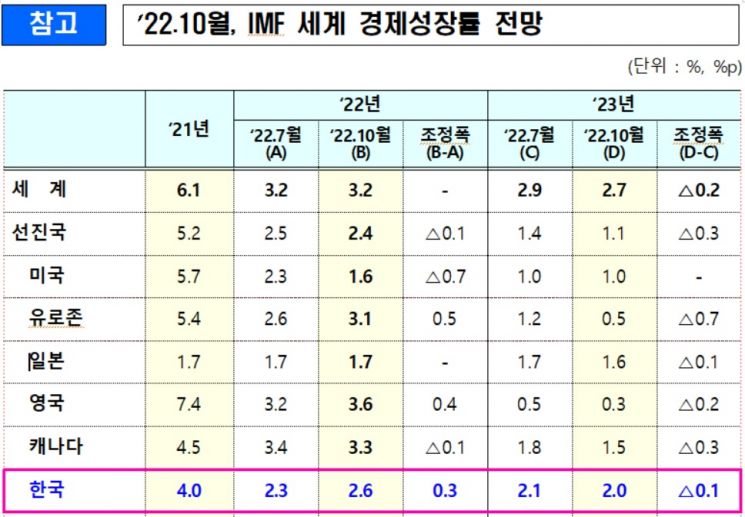
According to the Ministry of Economy and Finance on the 11th, the IMF presented South Korea's economic growth forecast for next year as 2.0% in the 'World Economic Outlook (WEO)' released that day. This is a 0.1 percentage point decrease just three months after lowering the previous forecast of 2.1% by 0.8 percentage points in July.
This forecast is lower than the government's projection (2.5%), as well as those of the Asian Development Bank (ADB, 2.3%), the Organisation for Economic Co-operation and Development (OECD, 2.2%), and the Bank of Korea (2.1%).
During the same period, the global growth forecast was lowered by 0.2 percentage points to 2.7%. Advanced economies were projected to grow by 1.1%, and China by 4.4%, down 0.3 and 0.2 percentage points respectively. The United States maintained its previous forecast of 1.0%.
The IMF diagnosed the situation as "high downside risks to the economy amid persistent high inflation and high exchange rates, along with a strong dollar, emerging market debt, and various risk factors including the resurgence of COVID-19 variants."
On the other hand, South Korea's economic growth forecast for this year was presented at 2.6%. This is a 0.3 percentage point upward revision from the previous forecast of 2.3% released in July. The government analyzed that this is due to the South Korean economy maintaining growth centered on private consumption in the first half of the year, with the second quarter growth rate performing better than expected.
Growth forecasts for major advanced countries were lowered by 0.1 percentage points during the same period, and forecasts for major countries such as the United States (-0.7 percentage points) and China (-0.1 percentage points) were also revised downward.
The consumer price inflation forecast was significantly raised. The IMF raised South Korea's inflation forecast for this year from 4.0% to 5.5%, an increase of 1.5 percentage points. Among major institutions, the IMF is the first to present an inflation forecast in the mid-5% range for this year. This exceeds the forecasts of the government (4.7%), ADB (4.5%), OECD (5.2%), and the Bank of Korea (5.2%). If the IMF's forecast materializes, South Korea will record the highest inflation rate in 24 years since the 1998 foreign exchange crisis (7.5%).
The IMF also expects South Korea to continue experiencing a high inflation rate of 3.8% next year.
The IMF recommended prioritizing inflation management through monetary and fiscal policies. The IMF advised, "Even at the cost of increased unemployment, strong and consistent tight monetary policy should be pursued to respond to inflation, taking into account each country's specific circumstances. In terms of fiscal policy, selective support for vulnerable groups should continue, but price caps and subsidies should be avoided, and efforts should be made to reduce fiscal deficits and secure medium-term fiscal soundness to alleviate inflation."
© The Asia Business Daily(www.asiae.co.kr). All rights reserved.
!["The Woman Who Threw Herself into the Water Clutching a Stolen Dior Bag"...A Grotesque Success Story That Shakes the Korean Psyche [Slate]](https://cwcontent.asiae.co.kr/asiaresize/183/2026021902243444107_1771435474.jpg)
















