Promotion to Register at Least 30 Hallyu Terms by Next Year
"Hangul Could Become a Global Writing System"
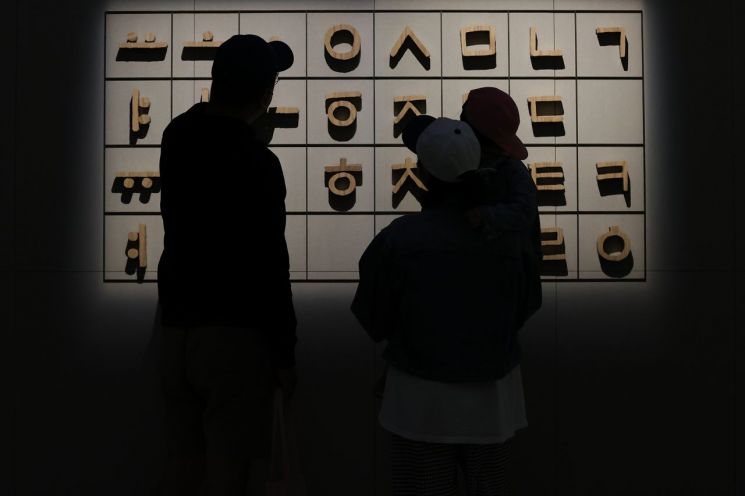 More than 30 Korean words are expected to be included in the Oxford English Dictionary (OED) next year. The photo shows a family viewing a Hangul display installed at the National Hangeul Museum in Yongsan-gu, Seoul, on the afternoon of the 4th. Photo by Yonhap News
[Asia Economy Reporter Hwang Sumi] More than 30 Korean words like maknae and dongsaeng are expected to be included in the Oxford English Dictionary (OED) next year.
On the 9th, Yonhap News reported this through an interview with Professor Jo Ji-eun of Oxford University, a Korean language consultant for the OED. Professor Jo is known to teach linguistics and translation studies at the Oxford University Oriental Institute and Hartford College.
According to the report, Professor Jo is working on recommending Hallyu words for inclusion next year. He told Yonhap News, "The Oxford English Dictionary has decided to update Hallyu words regularly every year, and we are also discussing the separate publication of a K-Culture dictionary."
Accordingly, Professor Jo predicted that at least 30 words will be included in the OED next year alone. He explained, "Based on usage, many more could be included, but it takes time to analyze the meanings commonly used among English speakers." He added, "We are working on words frequently appearing in Korean dramas like maknae and dongsaeng, as well as emoticons like son heart."
Published by Oxford University Press in the UK, the OED is recognized as the most authoritative English dictionary in the world. The dictionary includes not only alphabetic words but also pictograms, and in 2015, the 'face with tears of joy' emoticon was selected as the word of the year.
Last year, 26 Korean words were newly added to the OED. These included Korean foods like kimbap and bulgogi, as well as popular culture-related words such as hallyu and mukbang. Korean honorifics like noona, unni, and oppa were also included.
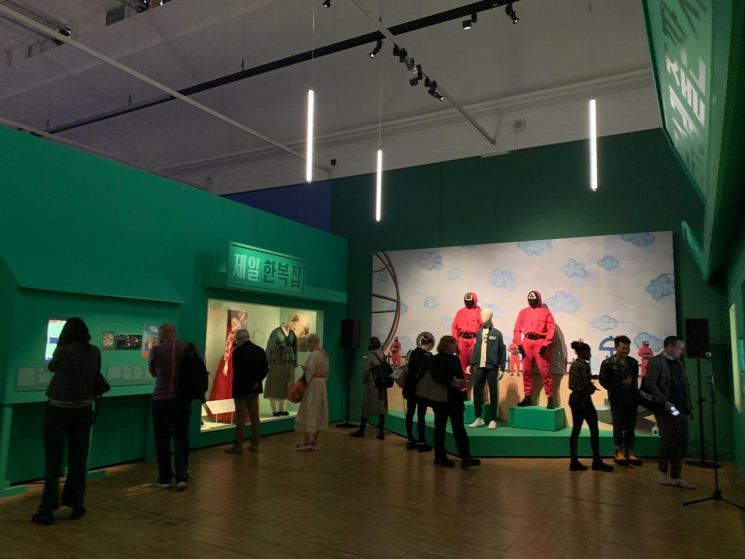 More than 30 Korean words are expected to be included in the Oxford English Dictionary (OED) next year. The photo shows the Korean Wave exhibition at the Victoria and Albert (V&A) Museum in London, UK, on the 21st (local time). Photo by Yonhap News.
The inclusion of these Korean words in the dictionary is related to the global Hallyu wave. As Korean content in music, movies, and various fields gains worldwide popularity, the number of Hallyu words used by English speakers has increased exponentially. Professor Jo said, "Words related to Korean popular culture are widely circulated on social networking services (SNS)," adding, "It is even difficult to object to why only Korean is regularly updated among other languages."
Professor Jo predicted that as people around the world use Hallyu words more frequently, there is a possibility that Hangul could become a global writing system in the future. Hangul can represent more sounds than the Roman alphabet and is easier to learn.
In particular, if Korean honorifics become widespread, English itself could change, Professor Jo said. He explained, "In English-speaking countries, people usually call each other by names, so translating oppa as 'brother' was not smooth, but since words like oppa and unni were included in the dictionary last year, now people can just say 'oppa'." He added to Yonhap News, "The intention of King Sejong, who created Hangul, can extend beyond Korea to the world."
© The Asia Business Daily(www.asiae.co.kr). All rights reserved.
![User Who Sold Erroneously Deposited Bitcoins to Repay Debt and Fund Entertainment... What Did the Supreme Court Decide in 2021? [Legal Issue Check]](https://cwcontent.asiae.co.kr/asiaresize/183/2026020910431234020_1770601391.png)

















