Over 250 Bottlenose Dolphins Found Dead in Mass Stranding on New Zealand Beach
Mass Stranding Also Occurred in Australia Last Month... "Exact Cause Unknown"
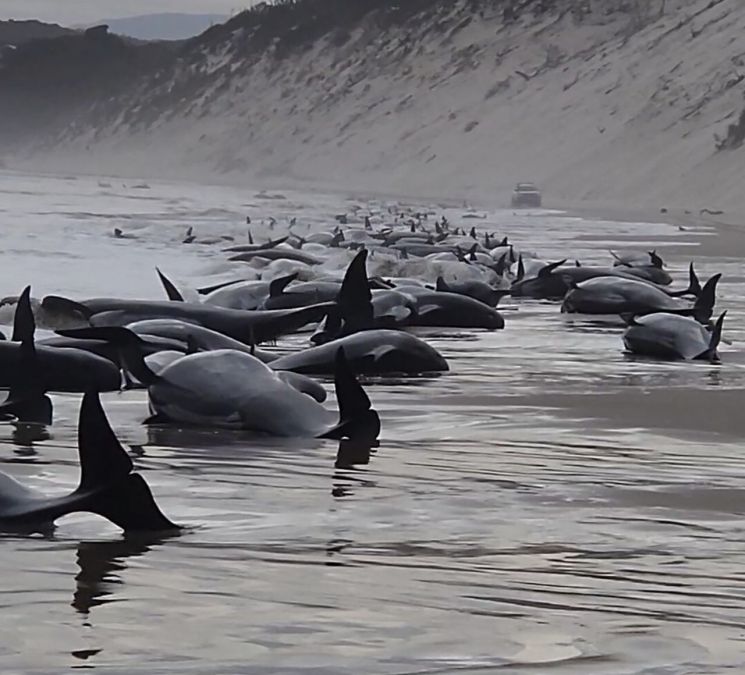 Recently, there have been consecutive incidents of dolphins stranding and dying in groups across the Southern Hemisphere. The photo shows around 230 bottlenose dolphins washed ashore on a beach near Strahan in Macquarie Harbour, western Tasmania, southeastern Australia, on the 21st of last month.
 [Image source=AP News]
[Asia Economy Reporter Hwang Sumi] Mass strandings of dolphins resulting in death have been occurring repeatedly across the Southern Hemisphere. Following the mass death of about 200 dolphins on a beach in Australia last month, approximately 250 dolphins were found dead in a mass stranding on a beach in New Zealand this time.
According to New Zealand Television (TVNZ) 1 News on the 9th (local time), about 250 bottlenose dolphins were washed ashore on the northwest beach of the Chatham Islands on the 7th. The Chatham Islands, consisting of 10 islands, are located about 800 km southeast of New Zealand's mainland in the South Pacific Ocean.
The New Zealand Department of Conservation explained, "Due to the risk of attacks from sharks living nearby, we could not actively salvage the dolphins," and added that trained personnel euthanized the living dolphins to prevent their suffering. They also stated that the dolphin carcasses will be left to decompose naturally.
Such mass dolphin deaths had previously occurred on a nearby beach in Australia. According to Australia's ABC broadcast on the 21st of last month, about 230 bottlenose dolphins were washed ashore on a beach near Strahan, close to Macquarie Harbour on the west coast of Tasmania in southeastern Australia.
Of the approximately 230 dolphins stranded in the mass event, only 44 were rescued and returned to the sea. The Tasmanian authorities explained, "When first discovered, about 170 dolphins were already dead," and said that with the help of nearby aquaculture workers and the use of heavy equipment, rescue operations were conducted, saving 44 dolphins.
Notably, this incident attracted attention as it occurred exactly two years after a similar tragedy in Australia where hundreds of dolphins died in a mass stranding at a similar location. On September 21, 2020, about 470 long-finned pilot whales were stranded on a sandbank near Macquarie Harbour, Tasmania. At that time, authorities conducted rescue operations for a week, saving about 100 whales, but over 300 whales died in the mass stranding.
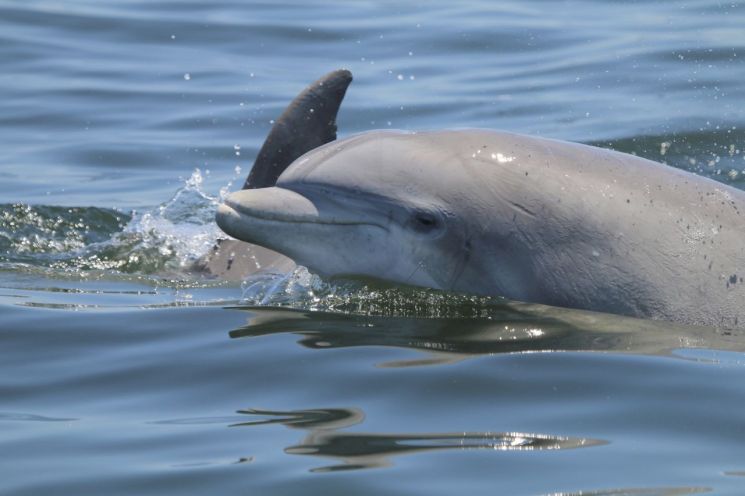 Recently, there have been consecutive incidents of dolphins stranding and dying in groups across the Southern Hemisphere. The photo shows dolphins swimming in the Potomac River, Virginia, USA, in May 2019.
 [Image source=AP Yonhap News]
Meanwhile, the exact cause of such mass dolphin strandings remains unknown. Various factors such as abnormal climate or unusual terrain that cause confusion or illusions in the whales' senses have been suggested as causes of strandings, but all remain hypotheses. Regarding this, Professor Karen Stocklin, a whale expert at Massey University in New Zealand, explained, "There are various causes for whale strandings, including changes in water temperature such as La Ni?a and El Ni?o," and added, "Recently, dolphins have been approaching closer to the shore in search of food more frequently."
© The Asia Business Daily(www.asiae.co.kr). All rights reserved.


















