[Asia Economy New York=Special Correspondent Joselgina] The Biden administration, which has openly indicated a supply chain restructuring excluding China, has effectively banned the sale of advanced U.S. semiconductor equipment to Chinese semiconductor manufacturers. It has also decided to restrict exports of semiconductors used in artificial intelligence (AI) and supercomputers to China.
On the 7th (local time), the U.S. Department of Commerce officially announced these export control measures and stated that it will "limit China's ability to acquire advanced computing chips and to develop and maintain supercomputers and advanced semiconductors."
Accordingly, U.S. companies must obtain separate approval to sell advanced semiconductor manufacturing equipment to Chinese companies producing chips above certain levels. Specifically, this applies to cases where U.S. companies produce ▲ DRAM at 18nm (nanometers, one billionth of a meter) or below ▲ NAND flash with 128 layers or more ▲ logic chips at 14nm or below within China. These are known to be the highest levels currently achievable by Chinese companies. This is a clear message to effectively limit China's semiconductor rise.
Korean companies with factories in China are also inevitably affected. According to the announced control measures, if the production facilities are owned by Chinese companies, the so-called 'presumption of denial' principle applies, resulting in virtually full export control, while for foreign companies (multinationals), decisions will be made through individual reviews.
Currently, Samsung Electronics operates NAND flash production plants and semiconductor back-end process plants in China, while SK Hynix operates DRAM plants, back-end process plants, and NAND plants respectively. Accordingly, existing production equipment is permitted, but future equipment will require individual approval from the U.S. government.
Additionally, the U.S. government has imposed export restrictions on transactions involving advanced computing semiconductor chips and supercomputers. High-performance AI training chips and certain semiconductors for supercomputers have been included in the control list. This follows the directive issued last August to domestic semiconductor companies Nvidia and AMD not to export AI semiconductors to China without permission.
Furthermore, the Department of Commerce has added 31 Chinese companies, including YMTC (Yangtze Memory Technologies Co.), a Chinese semiconductor memory chip manufacturer, to the export control list.
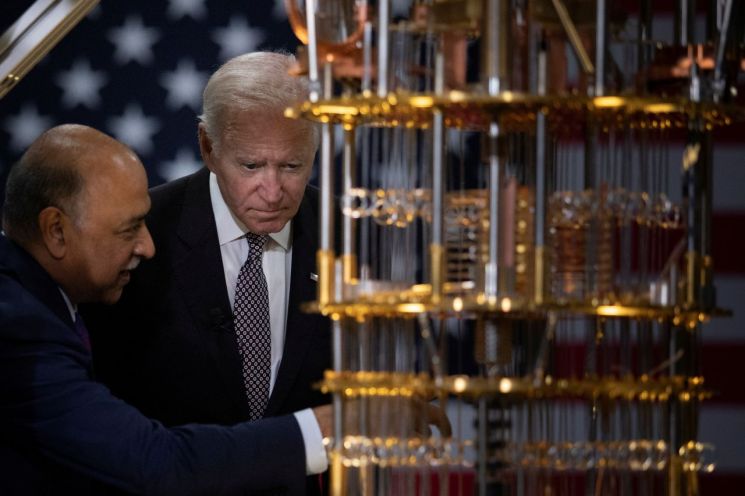
Thea Roseman Kendler, Deputy Assistant Secretary for Export Administration at the U.S. Department of Commerce, said, "Our measures send a clear message that U.S. technological leadership is about innovation and values while protecting U.S. national security and foreign policy interests." The day before, U.S. President Joe Biden visited an IBM production facility located in New York State and emphasized, "Supply chains will start and end in the U.S.," adding that "this is important for the revival of manufacturing and U.S. national security."
© The Asia Business Daily(www.asiae.co.kr). All rights reserved.
!["The Woman Who Threw Herself into the Water Clutching a Stolen Dior Bag"...A Grotesque Success Story That Shakes the Korean Psyche [Slate]](https://cwcontent.asiae.co.kr/asiaresize/183/2026021902243444107_1771435474.jpg)
















