Foreigners Net Buy Samsung Electronics for 5 Consecutive Days
SK Hynix Up 1.45%
Heightened Caution Ahead of US Employment Report
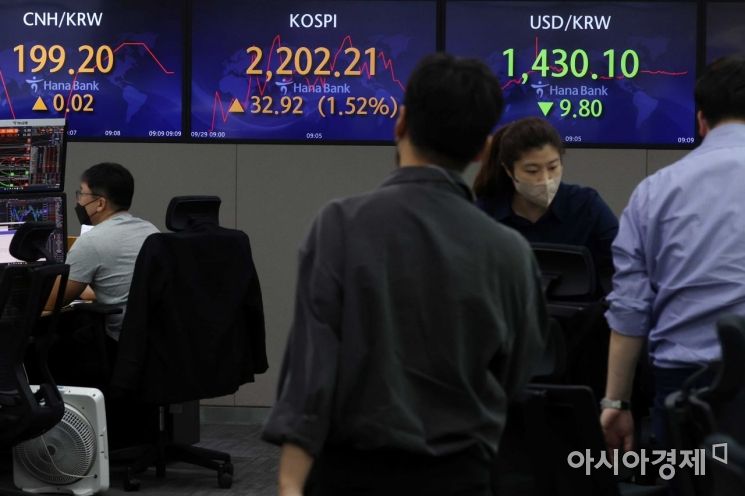 On the 29th, dealers were working in the dealing room of Hana Bank in Euljiro, Seoul. On this day, the KOSPI index opened at 2197.75, up 28.46 points (1.31%) from the previous trading day. The won-dollar exchange rate opened at 1424.5, down 15.4 won. Photo by Moon Honam munonam@
[Asia Economy Reporter Ji Yeon-jin] The KOSPI index closed slightly lower on the 7th. Following the sluggish performance of Samsung Electronics, the leading stock in KOSPI, and negative factors such as South Korea's current account deficit last month, the index fell in early trading. However, foreign investors, encouraged by expectations of reduced semiconductor production, expanded their buying in the latter part of the session, reducing the decline.
The KOSPI index closed at 2,232.84, down 5.02 points (0.22%) from the previous day. Institutions were net sellers with about 153.2 billion KRW, while foreign investors, who had sold over 100 billion KRW in early trading, recorded net purchases of 99.9 billion KRW. Individual investors reduced their buying during the day, ending with net purchases worth about 45.6 billion KRW.
The KOSPI started the day with a drop of more than 1% influenced by the decline in the US stock market. Samsung Electronics, which announced its earnings before the market opened, reported a more than 30% decrease in operating profit for the third quarter. Additionally, with the trade deficit continuing for six consecutive months and South Korea's current account turning to a deficit of 3.05 billion USD last month, foreign and institutional investors intensified their joint selling.
However, the KOSPI narrowed its losses as Samsung Electronics and SK Hynix turned to gains. The weak performance of Samsung Electronics reflected expectations that semiconductor producers might reduce supply amid concerns over weakening demand in the semiconductor front-end industry.
US semiconductor company Micron announced plans to reduce supply starting in the fourth quarter, and Japan's Kioxia also stated it would cut wafer input by 30% from next month.
US Employment Report Disappoints Expectations, Boosting Fed Pivot Hopes
Moreover, ahead of the US employment report release that night, a cautious market sentiment spread, resulting in a 'wait-and-see' trading atmosphere. Kim Seok-hwan, a researcher at Mirae Asset Securities, said, "The biggest factor driving the rebound earlier this week was the expectation of a Fed 'pivot.' Although recent Fed officials have expressed caution about pivot expectations, market hopes are expected to continue."
If the September employment report, scheduled for release at 9:30 PM, falls short of market expectations, there could be hopes for a slowdown in the Fed's tightening pace. Conversely, if it exceeds expectations, the dollar index and Treasury yields could rise, increasing market volatility.
Kim Yumi, a researcher at Kiwoom Securities, explained, "Market participants need to check the employment report results, as this report could stimulate tightening, which may weigh on the dollar. This is because ongoing wage growth in the US could heighten concerns about the Fed's tightening intensity."
Samsung Electronics, after announcing weak earnings, fell more than 1% in early trading but managed to rebound during the session. However, it closed slightly lower (-0.18%) due to late selling pressure. SK Hynix closed up 1.45%, buoyed by late foreign buying, while LG Energy Solution (0.94%), LG Chem (1.03%), and Samsung SDI (1.03%) also rose.
On the other hand, Hyundai Motor (-1.40%), Kia (-0.70%), and Celltrion (-2.35%) closed lower. Notably, Naver (NAVER, -4.19%) plunged sharply following the acquisition of the US secondhand platform Poshmark, briefly rebounded the previous day, but then fell steeply again due to a sell report from Citibank.
Kakao Group Stocks Plunge Together as Earnings Forecasts Are Revised Downward Today
Kakao also closed sharply down 7.12% at 50,900 KRW. Kakao group stocks, including Kakao Bank (-9.38%), Kakao Pay (-14.41%), and Kakao Games (-5.15%), also fell significantly as major domestic and international securities firms forecast poor earnings, dragging down their stock prices.
The KOSDAQ index fell below the 700 mark again in just one day. The index closed at 698.47, down 7.54 points (1.07%) from the previous day. Foreign and institutional investors led the decline with net sales of 135.6 billion KRW and 77.9 billion KRW, respectively, while individual investors were the sole net buyers with 210.9 billion KRW.
Among the top market cap stocks on KOSDAQ, EcoPro BM (0.31%) and L&F (0.51%) showed slight gains, while Celltrion Healthcare (-2.21%), HLB (-1.35%), EcoPro (-1.39%), Pearl Abyss (-1.42%), and Celltrion Pharm (-1.55%) closed lower.
© The Asia Business Daily(www.asiae.co.kr). All rights reserved.
![User Who Sold Erroneously Deposited Bitcoins to Repay Debt and Fund Entertainment... What Did the Supreme Court Decide in 2021? [Legal Issue Check]](https://cwcontent.asiae.co.kr/asiaresize/183/2026020910431234020_1770601391.png)















