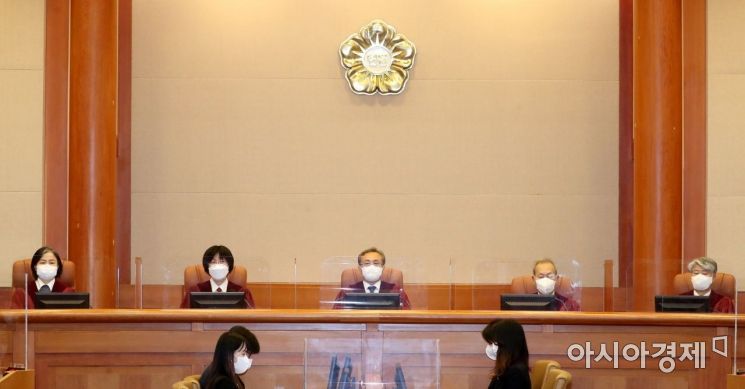
 Yoo Nam-seok, Chief Justice of the Constitutional Court, attended a public hearing on the constitutional complaint case regarding the "Complete Removal of Prosecution's Investigation Rights" law at the Constitutional Court in Jongno-gu, Seoul, on the afternoon of the 27th of last month. Photo by Kim Hyun-min kimhyun81@
[Asia Economy Reporter Choi Seok-jin, Legal Affairs Specialist] The Constitutional Court has ruled that a prosecutor's decision to suspend prosecution, based on the assumption that a crime was committed by a suspect who does not possess the status required for a status offense?an offense that can only be committed by a person with a certain status?is illegal and must be canceled.
On the 7th, the Constitutional Court announced that it unanimously accepted the constitutional complaint filed by Mr. A, the chairman of the management committee of a building in Junggye-dong, Nowon-gu, Seoul, who claimed that the prosecutor's decision to suspend prosecution by a prosecutor from the Seoul Northern District Prosecutors' Office violated his right to equality and pursuit of happiness, and ordered the cancellation of the prosecutor's suspension of prosecution decision.
The Constitutional Court stated, "There was a serious legal error or investigative negligence that influenced the decision to suspend prosecution in this case, constituting an arbitrary exercise of prosecutorial power, which infringed upon the petitioner’s rights to equality and pursuit of happiness."
In July and August 2017, Mr. A confirmed through the building’s closed-circuit television (CCTV) that a person appearing to be tenant B took other tenants’ management fee notices, and subsequently filed a complaint with the police against B on suspicion of concealment of property.
However, during the process of drafting and submitting the complaint, the management committee of the building verified B’s resident registration number through personal information data collected and stored from individual unit owners, and included it in the complaint. B then filed a complaint against Mr. A for violating the Personal Information Protection Act.
The charge applied to Mr. A was a violation of Article 18, Paragraph 1 of the Personal Information Protection Act, which punishes a personal information handler who uses collected personal information for purposes other than intended or provides it to a third party.
Article 71, Item 2 of the Personal Information Protection Act stipulates that violating Article 18, Paragraph 1 is punishable by imprisonment of up to five years or a fine of up to 50 million won.
The prosecutor judged that Mr. A’s actions constituted a violation of the Personal Information Protection Act but, considering the lightness of the charge, issued a suspension of prosecution.
Suspension of prosecution is a type of non-prosecution disposition, but unlike a dismissal due to lack of evidence, it is issued when there is sufficient suspicion and prosecutorial conditions are met, yet the prosecutor decides not to bring the case to trial considering factors such as the suspect’s criminal record, extent of damage, agreement with the victim, and degree of remorse.
Mr. A filed a constitutional complaint, arguing that the prosecutor’s suspension of prosecution, based on the premise that his actions violated the Personal Information Protection Act, was unjust.
The Constitutional Court premised that "the violation of Article 18, Paragraph 1 of the Personal Information Protection Act defines the subject as a personal information handler, so the petitioner must be a personal information handler for the crime to be established."
Just as bribery is a status offense that can only be committed by a person with the status of a public official or arbitrator, the violation of Article 18, Paragraph 1 of the Personal Information Protection Act applied to Mr. A means that only a 'personal information handler' can commit this crime.
The Constitutional Court judged, "In this case, the victims and other unit owners of the building provided personal information not to the individual petitioner but to the management committee, which, for the purpose of building management, operated a personal information file?a collection of personal information of the building’s unit owners?in the form of unit owner management cards, processing (collecting, retaining, etc.) the personal information of the victims and others. Therefore, the management committee as an entity qualifies as the personal information handler, and the petitioner is only the representative of the committee as an institution, not a personal information handler."
In other words, the entity that collects and manages the information written on the unit owner management cards used by Mr. A to verify B’s resident registration number is not Mr. A personally, the chairman of the building management committee, but the management committee as an organization, so Mr. A cannot be the subject of the crime.
Meanwhile, the Constitutional Court also examined whether Mr. A, although not having the status of a personal information handler and thus unable to be the sole subject of the crime, could be punished under the joint liability provision of the Personal Information Protection Act as the representative of the management committee.
Article 74, Paragraph 2 (Joint Liability Provision) of the Personal Information Protection Act stipulates that when a representative of a corporation or an agent, employee, or other worker of a corporation or individual commits a violation of Article 71 in relation to the corporation’s or individual’s business, not only the perpetrator but also the corporation or individual shall be subject to fines under the relevant provisions.
The Constitutional Court stated, "A search of the corporate registry revealed no registration under the management committee involved in this case," and defined the management committee as a non-corporate association rather than a corporation.
It further cited a Supreme Court ruling, stating, "The Personal Information Protection Act applies the joint liability provision only to corporations or individuals as personal information handlers, and there is no explicit provision regarding whether the joint liability provision applies to public institutions without corporate status. According to the principle of legality, it is reasonable to conclude that public institutions without corporate status cannot be punished under the joint liability provision, and in such cases, the actors cannot be punished under the joint liability provision either."
In other words, the Supreme Court’s position excludes the application of the joint liability provision under the Personal Information Protection Act, which applies to corporations, to non-corporate associations.
The Constitutional Court concluded, "Ultimately, the petitioner is not a personal information handler and the joint liability provision does not apply, so the violation of Article 18, Paragraph 1 of the Personal Information Protection Act does not constitute a crime against the petitioner. Nevertheless, the respondent (prosecutor) recognized the petitioner’s guilt of violating the Personal Information Protection Act and issued the suspension of prosecution in this case, so there is a serious legal error or investigative negligence affecting the decision to suspend prosecution."
© The Asia Business Daily(www.asiae.co.kr). All rights reserved.
![User Who Sold Erroneously Deposited Bitcoins to Repay Debt and Fund Entertainment... What Did the Supreme Court Decide in 2021? [Legal Issue Check]](https://cwcontent.asiae.co.kr/asiaresize/183/2026020910431234020_1770601391.png)















