Presenting the Life and Scholarly World of Baekyoung Jeong Byeonguk, Who Embraced Poetry to Convey Light
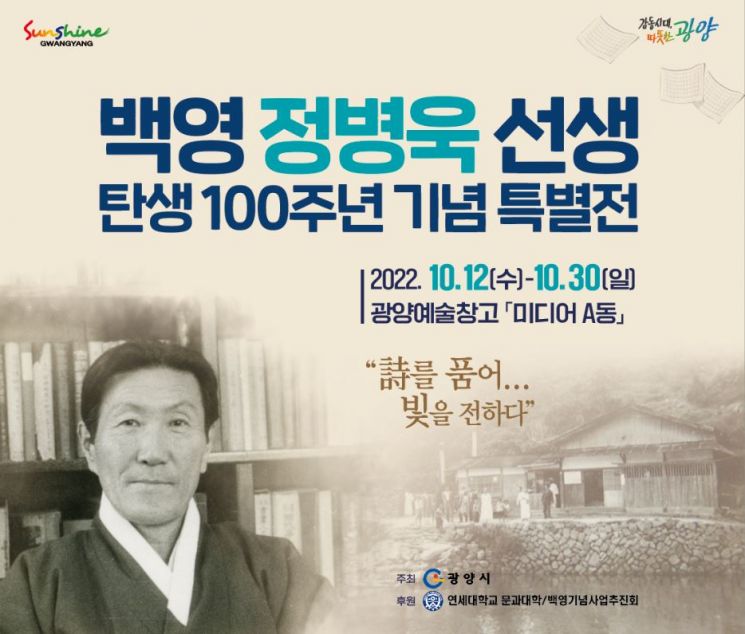
[Asia Economy Honam Reporting Headquarters, Reporter Heo Seon-sik] Gwangyang City in Jeollanam-do announced that it will hold a "Special Exhibition Commemorating the 100th Anniversary of the Birth of Baekyoung Jeong Byeong-wook" from the 12th to the 30th at Media Building A of the Gwangyang Arts Warehouse.
This exhibition, hosted by Gwangyang City, was prepared to widely promote the life and academic world of Baekyoung Jeong Byeong-wook, who illuminated the essence and tradition of Korean classical poetry and preserved and publicized the posthumous works of poet Yun Dong-ju, thereby spreading the light of poetry. It is sponsored by Yonsei University College of Liberal Arts and the Baekyoung Memorial Project Promotion Association.
As a young man, Jeong Byeong-wook entered Yonhee Professional School in April 1940, where he met Yun Dong-ju and lived together for two years in the dormitory and boarding house as a friend and junior of the poet during their Yonhee Professional School days.
Jeong Byeong-wook’s pen name Baekyoung (白影) was taken from Yun Dong-ju’s poem "White Shadow" to never forget the poet throughout his life.
The exhibition features various materials created during his research process, including the "Yonhee Professional School Academic Record," "Yonhee Professional School Report Card," "Graduation Certificate," "Academy Appointment Letter," "Documents and the teacher’s Korean literature research manuscripts," "Lecture Notes," "Britannica Encyclopedia Korean Literature Writing Materials," and his book "Outline of Korean Pansori Table of Contents."
Photographic materials include 32 pieces such as "Photos with siblings at the Jinwol house in Gwangyang," "Photo taken with his father when entering elementary school," "Graduation commemorative photo of Yun Dong-ju and Jeong Byeong-wook," and "Photos showing the process of establishing the Yun Dong-ju poetry monument."
Baekyoung Jeong Byeong-wook was born in 1922 in Seolcheon-myeon, Namhae-gun, Gyeongsangnam-do, and spent his growing years in Jinwol, Gwangyang, passing through Hadong.
He graduated from the College of Liberal Arts at Yonhee Professional School and the Department of Korean Language and Literature at Seoul National University, earned a Ph.D. in Literature from Seoul National University, and worked at the Departments of Korean Language and Literature at Pusan National University, Yonsei University, and Seoul National University.
Specializing mainly in classical poetry, he laid the academic foundation for Korean literature research in the fields of classical novels, Pansori, Chinese literature, and traditional cultural arts. In particular, he played a major role in establishing Pansori as a refined art of the Korean people by founding the "Pansori Society" (1974), holding appreciation meetings, and dedicating efforts to the preservation and promotion of Pansori and traditional arts overall.
He also led the shift in Korean language education from a grammar- and knowledge-centered approach to one focused on writing and literature. For his contributions to Korean language and literature, he received the Korean Publishing Culture Award for Authorship, the Oesol Award, and the March 1st Culture Award, and was posthumously awarded the Silver Crown Cultural Medal in 1991.
During his time as a visiting professor at Harvard University in the United States and Coll?ge de France in France, he presented papers and lectures on Korean classical poetry and literature at international academic conferences and contributed to the "Encyclopedia Britannica" by writing the "Korean Literature" entry, greatly promoting Korean literature overseas.
His scholarship is characterized by combining aesthetic analytical criticism with empirical methods based on thorough verification, precisely exploring literary qualities and historicity. He devoted his life to elucidating the characteristics of traditional Korean melodies (rhythms) and the essence of beauty (aesthetics).
His major works include "Studies on Korean Literature," "Theory of Korean Classical Poetry," "Re-recognition of Korean Classics," "Korean Pansori," and "Dictionary of Sijo Literature."
Kim Mi-ran, Director of Culture and Arts, said, "We hope the special exhibition commemorating the 100th anniversary of Baekyoung Jeong Byeong-wook’s birth will serve as an opportunity to widely promote his life and academic research achievements," and added, "We ask for the interest and attendance of many citizens."
Meanwhile, the "Yun Dong-ju Posthumous Works Preservation Jeong Byeong-wook House" located at Mangdeok Port in Jinwol, Gwangyang, is a rare structure combining a store and residence, built in 1925. It serves as a space for preserving and reviving the handwritten manuscript poetry collection "Sky, Wind, Star, and Poem," which contains 19 representative works of Yun Dong-ju. Recognized for its cultural and architectural historical value, it is preserved and managed as a national registered cultural heritage.
Asia Economy Honam Reporting Headquarters, Reporter Heo Seon-sik hss79@asiae.co.kr
© The Asia Business Daily(www.asiae.co.kr). All rights reserved.
![User Who Sold Erroneously Deposited Bitcoins to Repay Debt and Fund Entertainment... What Did the Supreme Court Decide in 2021? [Legal Issue Check]](https://cwcontent.asiae.co.kr/asiaresize/183/2026020910431234020_1770601391.png)















