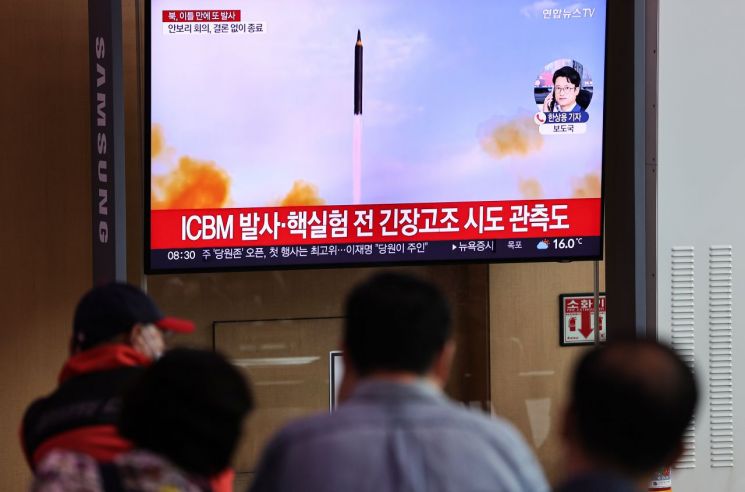
[Asia Economy Reporter Jeong Hyunjin] Amid concerns that North Korea may conduct its 7th nuclear test following missile provocations, CNN reported on the 6th (local time), citing sources, that the United States is struggling to determine the timing of the test or North Korea's intentions due to a lack of intelligence.
According to the report, White House officials have refused to publicly discuss classified information or provide specific analysis or assessments regarding North Korea's nuclear tests. CNN noted that two current and former senior U.S. government officials familiar with North Korea intelligence acknowledged that a key obstacle in understanding North Korean leader Kim Jong-un's motives for nuclear provocations is the lack of information.
Chris Johnston, a senior fellow at the Center for Strategic and International Studies (CSIS) who served as the Director for East Asia at the National Security Council (NSC) under the Biden administration, said, "We have a pretty good 'picture' of North Korea's conventional and missile military capabilities. What is much more difficult is the element of intent, and the bigger problem there is (intelligence) collection."
Johnston emphasized, "Most of what North Korea does is led by the leader himself (Kim Jong-un), so you really have to get inside his head, which is a difficult classified matter." He added, "Intelligence agencies know quite a bit about his inner circle and how decisions are made, but ultimately, the decision-maker is that person. The inner group is very small, and when they do not leave the country, it becomes a quite difficult target to access."
This is interpreted as an explanation that intelligence gathering by the U.S. and its allies has become more difficult due to North Korea's long-term isolation from the outside world and the intensified social lockdown caused by the COVID-19 pandemic. Johnston also assessed, "North Korea suffered greatly during the COVID-19 period and implemented lockdown measures with the outside world, including China, leading to poor food conditions," and that Kim Jong-un uses external enemies to suppress internal dissatisfaction within North Korea.
John Kirby, White House NSC Coordinator for Strategic Communications, also said, "It is difficult to know what is on his (Kim Jong-un's) mind and how he will make decisions." He added, "Extracting information from Pyongyang is quite limited, so it is hard to know what triggered the events. However, what we do know is that he continues to try to improve his programs and capabilities."
North Korea has raised tensions on the Korean Peninsula by firing one intermediate-range ballistic missile (IRBM) over Japanese airspace on the 4th and launching two short-range ballistic missiles (SRBMs) into the East Sea on the 6th. There are expectations that North Korea will soon carry out strategic provocations such as the 7th nuclear test.
CNN highlighted the unclear role of China regarding North Korea issues. Several senior U.S. government officials evaluated that over the past few months, as the U.S. and China have increasingly clashed, practical communication between the two countries has been delayed, making it difficult for the U.S. to gauge Kim Jong-un's intentions, CNN added.
Earlier in June, Jake Sullivan, White House NSC Advisor, mentioned that North Korea was among the issues discussed during his meeting with Yang Jiechi, a member of the Chinese Communist Party Politburo. At that time, Sullivan emphasized to China that North Korea is an area where the two countries can cooperate.
© The Asia Business Daily(www.asiae.co.kr). All rights reserved.
![User Who Sold Erroneously Deposited Bitcoins to Repay Debt and Fund Entertainment... What Did the Supreme Court Decide in 2021? [Legal Issue Check]](https://cwcontent.asiae.co.kr/asiaresize/183/2026020910431234020_1770601391.png)















