The 576th Hangeul Day Commemoration Symposium
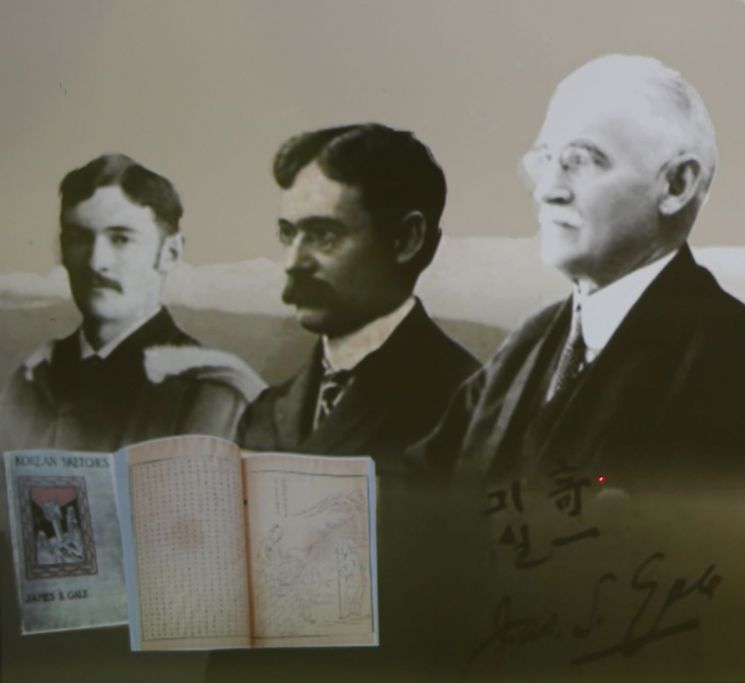 Symposium material screen commemorating the 576th Hangul Day, themed on missionary James S. Gale. / Photo by Ryeong Lee ryeong@
[Asia Economy Yeongnam Reporting Headquarters Reporter Se-ryeong Lee] A symposium highlighting the life of James S. Gale, who first translated the novel The Pilgrim's Progress into Korean, was held on the evening of the 6th.
At the 576th Hangeul Day commemorative symposium held at Changwon Far East Broadcasting in Gyeongnam, Park Si-young, president of the Busan-Gyeongnam Christian History Research Association, gave a keynote presentation titled "Missionary Gale Who Loved Hangeul More Than Koreans."
According to President Park, James Scarth Gale was a Canadian missionary who first set foot in Busan, Republic of Korea, on December 12, 1888.
As a Protestant missionary and a Korean linguist, James Gale came to Korea at the age of 25 and devoted himself to adapting to the local culture.
He studied not only the language and lifestyle but also diligently studied Chinese characters, believing it was essential to properly understand Korean culture.
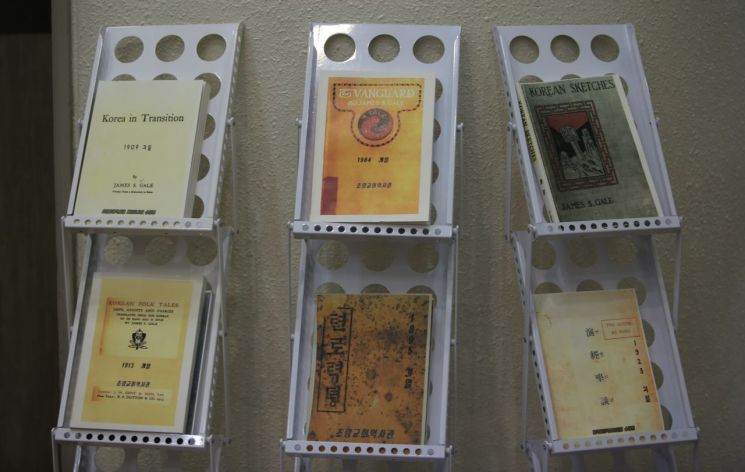
Having traveled across the country for 40 years researching Korean culture and classical literature, he compiled the Korean Bible, an English-Korean dictionary, Korean grammar books for foreigners, and Chinese character textbooks.
He translated and published the Bible along with The Pilgrim's Progress and Robinson Crusoe into Korean, and also published collections of Korean oral literature and books documenting Joseon customs in the United States.
He translated works such as Dongguk Tonggam, Chunhyangjeon, Heungbujeon, Simcheongjeon, Geumsujeon, Hong Gil-dongjeon, Ongnyumong, and Unyeongjeon into English to introduce them abroad.
He introduced traditional Joseon instruments like the geomungo and janggu into worship services and personally wrote hymn lyrics in Hangeul.
Missionary Gale, who loved Hangeul so much that he used the Korean-style name "Giil (奇一)" as his signature, instilled enlightenment about modernization and the spirit of independence in young Koreans living through the Japanese colonial period.
While pastoring at Yeondong Church, he founded Jeongshin Girls' School and Kyungshin School, nurturing figures such as former President Syngman Rhee, Hague envoy Lee Jun, Lee Gap-seong?one of the 33 signers of the Declaration of Independence?and patriotic women’s association members Kim Maria, Lee Hae-gyeong, Kim Young-soon, and Jang Seon-hee.
In 1912, Gale said, "By a prophetic grace unknown to us, Koreans already possessed a truly convenient script 466 years ago," adding, "Thanks to this simple script created by King Sejong, we have been able to spread the words of the Bible in this forbidden country."
 From the left, Yoon Pyeongwon, Advisor of Busan Gyeongnam Christian History Research Association, Park Siyoung, President, Park Dongcheol, Executive Director of Gyeongnam Christian Culture Center. / Photo by Se Ryeong Lee ryeong@
Park, who spoke at the event, said, "Missionary Gale was a figure who evaluated Korea as a land of literature and gentlemen at a time when neighboring countries looked down on it as uncivilized," adding, "I am glad to be able to introduce him, who led the popularization of Hangeul."
Park Dong-chul, executive director of the Gyeongnam Christian Culture Center and a discussant, said, "It is regrettable that despite living a life using Hangeul all his life, I did not know much about Missionary Gale," adding, "It was a time to think about what we can do to share his grateful and astonishing life."
Another discussant, Yoon Pyung-won, advisor to the Busan-Gyeongnam Christian History Research Association, said, "Missionary Gale’s contributions to our culture are immense," and "His extraordinary affection for Hangeul and Korean culture was evident."
© The Asia Business Daily(www.asiae.co.kr). All rights reserved.



















