Evaluation of 'Practical Expertise' Within Departments... Control Tower Overseeing and Coordinating Policies Between the Presidential Office, Ministries, and Other Party-Government Entities
Expanding Policy Discussions... Frequent Coordination While Moving Between the National Assembly
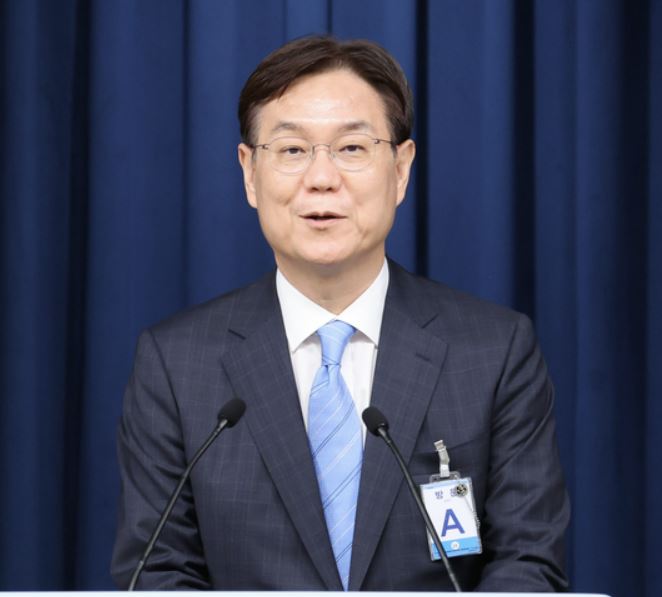
[Asia Economy Reporter Baek Kyunghwan] "The third floor of the Presidential Office was a calm zone amid the personnel reshuffle. Unlike other places, it was lively. The atmosphere was completely different."
At the end of August, when the personnel reshuffle wave was sweeping through, a senior government official who visited the Presidential Office building described the atmosphere at that time like this. To strengthen the policy coordination function, the Presidential Office appointed Lee Gwan-seop, then Vice Chairman of the Korea International Trade Association, as the Senior Secretary for Policy Planning (currently Senior Secretary for National Planning) and established the Policy Planning Office on the third floor of the building. It was evaluated that the atmosphere on the third floor was distinctly different from other senior secretaries' offices, where the personnel reshuffle was extensive.
As Lee marks his 50th day at the Presidential Office on the 9th, the biggest change is the significant strengthening of policy functions. A Presidential Office official said, "Since the establishment of the Senior Secretary for National Planning, decision-making has accelerated, and the ruling party is also less burdened with policy coordination." Recent government reorganization plans, including the amendment to the Long-term Public Rental Housing Act to support joint management fees of permanent rental housing with national funds, the amendment to the Act on the Promotion of Mutual Cooperation between Large and Small Enterprises mandating linkage of supply prices to raw material price fluctuations, and the amendment to the Child Allowance Act introducing parental benefits, were all finalized through this Senior Secretary.
This also reflects the fact that Lee effectively serves as the senior-most secretary within the Presidential Office. Although there is no formal hierarchy among the Presidential Office senior secretaries, the first position in the organizational chart has been recognized as the senior role. This also reflects President Yoon's intention to strengthen policy functions such as national tasks. Lee is reported to be coordinating as the senior secretary in major meetings within the Presidential Office.
The evaluation within the Presidential Office is increasingly that of a "practical expert." Even within the ruling party, Lee is praised as a traditional administrative bureaucrat who possesses not only planning, coordination, and adjustment capabilities across government policies but also political acumen.
Recently, Lee has been attending high-level party-government meetings regularly, playing the role of a "control tower" overseeing and coordinating policies between the Presidential Office, ministries, and the party-government. The analysis opinions of the Senior Secretary for National Planning were reflected in the government's recent 'government reorganization plan,' which includes the abolition of the Ministry of Gender Equality and Family, indicating that Lee is effectively overseeing the Yoon administration's national tasks, according to evaluations from the Presidential Office and the ruling party.
The People Power Party's Policy Committee analyzes that the establishment of the Senior Secretary for National Planning within the Presidential Office has greatly expanded the scope of policy discussions. A Policy Committee official said, "Considering Lee's past career, we expected him to focus more on economic national tasks, but he is also exchanging opinions on non-economic areas such as education and society," adding, "He directly explains vast amounts of data and frequently visits the National Assembly to increase communication channels."
The Presidential Office's Senior Secretary for National Planning is focusing on processing the 'Top 10 Bills' in the regular National Assembly session. The plan is to deliver tangible national task outcomes that citizens can feel by the end of the year. Regarding the '7 Major Legislative Tasks' recently announced by the Democratic Party of Korea, the approach is to find points of coordination through persuasion rather than confrontational responses. A Senior Secretary for National Planning official said, "We have set the processing of key bills, which are essentially the foundation for a new leap forward reflecting the new government's national agenda, as a core goal," and added, "We will also listen carefully to internal and external voices and proceed with responses and coordination regarding the 7 legislative tasks proposed by the opposition party."
© The Asia Business Daily(www.asiae.co.kr). All rights reserved.
![Clutching a Stolen Dior Bag, Saying "I Hate Being Poor but Real"... The Grotesque Con of a "Human Knockoff" [Slate]](https://cwcontent.asiae.co.kr/asiaresize/183/2026021902243444107_1771435474.jpg)
















